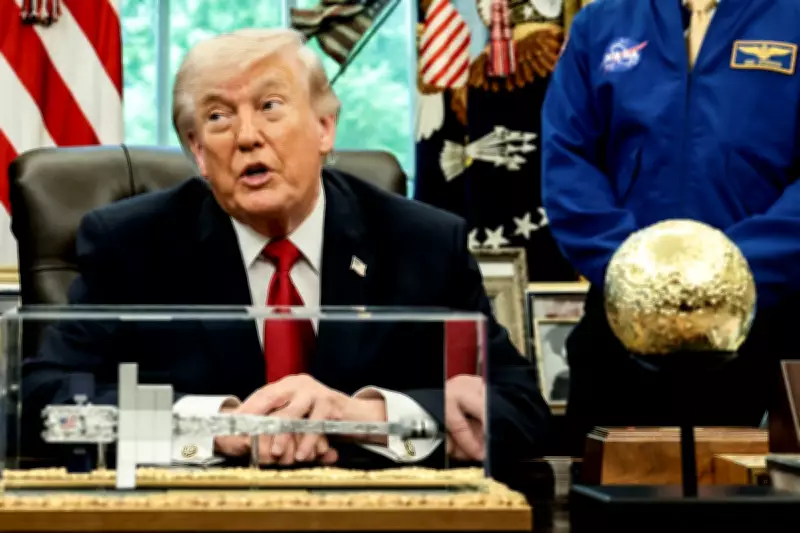
President Donald Trump on Wednesday could not say whether the 60-day-old war he launched against Iran in February would end before the four-year-old Russian war against Ukraine. He confused the two countries during an Oval Office meeting meant to honor the Artemis II lunar mission crew, turning the event into a wide-ranging question-and-answer session with reporters.
Oval Office Discussion with Artemis II Crew
After four minutes of remarks honoring the NASA crew that traveled to the Moon for the first time since the Nixon administration, Trump immediately took questions. He told reporters that a recent conversation with Russian President Vladimir Putin had focused on both the Ukraine and Iran wars.
"I talked about Ukraine, and I talked a little bit about Iran. I talked about a few different subjects, mostly about Ukraine, and we had a very good conversation. I think we are going to come up with a solution relatively quickly," Trump said.

Trump stated that Putin would "like to be involved" with resolving Iran's possession of enriched uranium, something the United States opposes. He remarked that he had told Putin he would prefer him to be "involved with ending the war with Ukraine."
"He does not want to see them have a nuclear weapon either. But I had a long talk with President Putin. I suggested a little bit of a cease fire. And I think he might do that. He might announce something having to do with that," Trump said.
Confusion Over Wars
When pressed on which of the two wars would end first, Trump said he did not know but called the question "interesting."
"Which war would end first? I do not know. Maybe they are on a similar timetable," he said, just before confusing Ukraine with Iran as he repeated his oft-used claim that Tehran is "defeated."
Comments on James Comey Case
The president also weighed in on the active criminal case against former FBI director James Comey, who turned himself in earlier in the day after a North Carolina grand jury indicted him for allegedly threatening Trump's life. The charge stems from Comey posting a photo of seashells that spelled out "86 47" on Instagram last year.
The numerical phrase is commonly used in the restaurant industry to indicate that a dish is no longer available or that an intoxicated customer should not be served more alcohol. Comey has said he meant to indicate that the president should be removed from office. However, the Justice Department alleges that Comey intended it as an imminent threat against the president's life. Legal experts have said the charges are unlikely to survive a motion to dismiss because the allegations do not meet the Supreme Court's threshold for bringing charges for a threat against the president.
Asked if he believed Comey was truly endangering him, Trump suggested that the term "86" had origins in Italian organized crime as a shorthand for murder.
"You know, you ever see the movies ... the mobster says to one of his wonderful associates, '86 him' — that means, kill him. I think of it as a mob term. I do not know. People think of it as something having to do with disappearing, but the mob uses that term to say, when they want to kill somebody, they say '86 the son of a gun,'" he said.
Reaction to King Charles III's Remarks
Trump also responded to a reporter's question about King Charles III's address to Congress, in which the King gave a strong defense of the NATO alliance that Trump has repeatedly denigrated. Asked if Charles's speech changed his thinking on the alliance, Trump said he was "very disappointed" because NATO members — including the UK — did not join the US-Israeli air campaign against Iran when it began in February.
However, Trump also praised the King as "fantastic" and said he enjoyed his visit with the British monarch.
"We spent a lot of time together. We had a lot of talk ... and he loves his country, and he is a great king, and he is a great friend of mine," Trump said. He added that Charles is a "phenomenal representative for his country" of whom the British people "should be proud" and said he "loved" the King's remarks to Congress — and his subsequent toast at Tuesday night's White House state dinner.

"I loved his speech yesterday. I watched it. I loved the speech last night. I do not know about my speech. I thought my speech was okay, too, but I thought he is an unbelievable King, and, by the way, an unbelievable queen," he said.
Artemis II Mission
The president's Oval Office appearance was ostensibly to honor the Artemis II crew that circumnavigated the Moon earlier this month. At the outset of the roughly 20-minute appearance, he congratulated them for executing the lunar flyby, the first trip humans have made there in 53 years, while traveling the farthest distance anyone has traveled from Earth.
"I do not know how they do it. I would not want to do it — they have unbelievable courage," he said as NASA Administrator Jared Isaacman, NASA astronauts Christina Koch, Victor Glover, Reid Wiseman, and the Canadian Space Agency's Jeremy Hansen looked on from behind the Resolute desk. The astronauts remained expressionless as Trump answered various political questions.
Trump also joked that he had the chops to become a NASA astronaut himself because one has "to do a lot of things physically good," which would have given him "no trouble making it."
Koch and Glover became the first woman and first Black man to reach the Moon during their flight earlier this month. They launched from NASA's Kennedy Space Center in Florida on April 1 aboard NASA's Orion spacecraft and the Space Launch System rocket before splashing down in the Pacific off the coast of Southern California on April 10. During their 10-day journey, they performed science experiments and observed parts of the Moon that have never been seen before. The crew even got to name some areas, including a crater they named "Carroll," as a tribute to Wiseman's late wife, Carroll Wiseman, who died from cancer in 2020.
The astronauts are now helping NASA to understand the data they collected on the trip and test next-generation technology, including improved spacesuits. NASA is working toward launching the next phase of its Artemis lunar program next year. During that mission, known as Artemis III, astronauts will test docking capabilities with the spacecraft needed to land on the Moon. After that, the space agency is aiming to land astronauts on the lunar surface, exploring the Moon's South Pole region, with NASA drones assisting. The target date is early 2028, and Trump said he believes NASA has a "good shot." NASA hopes to eventually set up a permanent base of operations on the Moon, including nuclear reactors, before shifting focus to Mars.