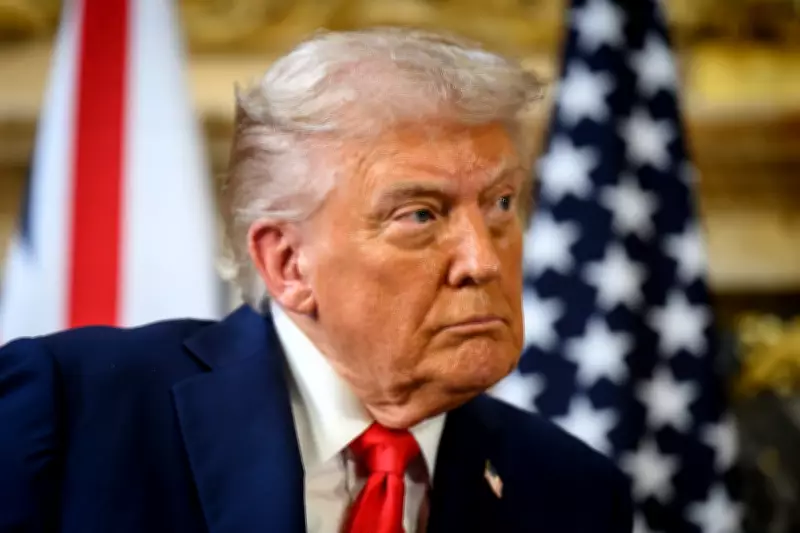
Donald Trump is facing widespread condemnation from political opponents and constitutional experts following his latest controversial remarks about transforming America's electoral system. The former president has sparked a fresh debate about the future of US democracy by urging Republicans to "take over" voting administration in what he described as "crooked" states.
Trump's Controversial Proposal
During an appearance on a podcast hosted by former FBI deputy director Dan Bongino, Trump revived his unsubstantiated claims about widespread fraud in the 2020 election. He went further by suggesting Republicans should assert control over election administration in approximately fifteen unspecified locations across the country. "We should take over the voting in at least... 15 places," Trump declared, without providing specific details about which areas he had in mind.
The president also argued that federal control of elections - managed by the Republican party - was essential to counter what he claimed was the electoral impact of undocumented immigrants. "If Republicans don't get them out, you will never win another election as a Republican," he told Bongino, repeating a claim that election experts have consistently rejected as baseless.

What Nationalising Elections Would Mean
The United States currently operates a highly decentralised election system with more than 10,000 separate election jurisdictions, each maintaining its own complex rules, officials and procedures. Trump's suggestion that Republicans should "take over" voting represents a radical departure from this established model, though his remarks remained characteristically ambiguous about practical implementation.
A White House spokesperson later attempted to reframe Trump's comments as support for national voting standards rather than an actual takeover. Press secretary Karoline Leavitt claimed Trump's assertions aligned with the Safeguard American Voter Eligibility Act, legislation that would require photo identification for voting and restrict mail-in ballots. Critics argue these measures would disproportionately restrict eligible citizens from exercising their voting rights.
While Trump hasn't presented a detailed plan for nationalised elections, any move to end state-level election administration would represent a fundamental transformation of American democracy. Such a change would require removing powers that the Constitution currently grants exclusively to individual states.
Constitutional Barriers and Legal Challenges
"There is one small problem - the Constitution prevents federalizing elections," Colorado Secretary of State Jena Griswold, a Democrat, told CNN. "It's very alarming that Trump continues to use his platform to undermine American elections. These attacks are largely failing, but we need to take these comments seriously."
Under the U.S. Constitution's Elections Clause, states establish the "times, places and manner" of congressional elections, though Congress retains authority to override state rules. Presidential elections are similarly state-run, with individual states determining how electors are chosen. The president possesses no existing authority to "take over" state election systems, meaning any attempt would require congressional action followed by inevitable court scrutiny.
Even with substantial government support, federalising elections would necessitate sweeping legislation and would likely face determined challenges from states determined to maintain their constitutional powers. The practical and legal hurdles appear formidable, if not insurmountable.
Political Reactions and Democratic Concerns
The proposal has triggered outrage from Democrats, who argue that Trump's comments represent a dangerous attempt to undermine state-run elections and concentrate power in Washington. "This is not about the 2020 election," Democratic Senator Mark Warner of Virginia stated at a press conference. "This is frankly about what comes next."

Democratic Senate Minority Leader Chuck Schumer delivered perhaps the most scathing criticism, asking: "Does Donald Trump need a copy of the Constitution? What he is saying is outlandishly illegal." Several Democratic lawmakers noted that the remarks echoed Trump's previous efforts to overturn the 2020 election and warned that nationalising elections could be used to systematically restrict voting access for millions of Americans.
Some Republicans have also expressed reservations about Trump's proposed strategy. Both House Speaker Mike Johnson and Senate Majority Leader John Thune declined to endorse Trump's call to "take over" election administration, though both supported his push for stricter voter-ID and citizenship requirements. Thune specifically stated he was "not in favor of federalizing elections," arguing that a decentralised system enhances security because "it's harder to hack 50 election systems than one."
The controversy highlights deepening divisions about election administration in America and raises fundamental questions about the balance of power between federal and state governments. As constitutional experts examine the legal implications, political observers warn that Trump's comments could further erode public confidence in America's electoral institutions at a time when democratic norms face unprecedented challenges.