Trump's Tariff Policy Overturned by Supreme Court, Prompting Global Mockery
Former President Donald Trump has been subjected to widespread ridicule from international leaders and political rivals following a dramatic Supreme Court ruling that declared his tariff policy unconstitutional. The court's decision, which found that Trump had overstepped his authority by imposing sweeping reciprocal tariffs without Congressional approval, triggered a furious response from the former president.
Trump's Fiery Response and Executive Action
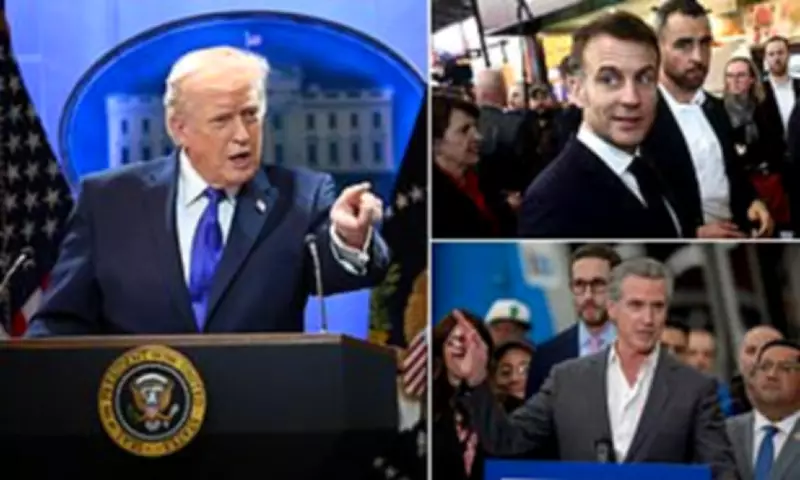
In the immediate aftermath of the ruling, Trump launched into a bitter tirade against the justices, branding them as "unpatriotic" and "un-American." He then swiftly signed an executive order implementing a ten percent global tariff, citing Section 122 of the 1974 Trade Act as his legal basis. Within twenty-four hours, he escalated the levy to fifteen percent—the maximum permissible under the statute—during another heated public address.
"I was very modest in my ask of other countries and businesses, because I wanted to be very well-behaved," Trump claimed, adding sarcastically, "I want to be a good boy." He particularly targeted Chief Justice John Roberts, accusing him of disloyalty, and expressed disappointment with Justices Amy Coney Barrett and Neil Gorsuch, both of whom he had appointed.

International and Domestic Criticism
French President Emmanuel Macron seized the opportunity to celebrate the judicial rebuke while attending the annual agricultural salon in Paris. "It is not bad to have a Supreme Court, and therefore, the rule of law," Macron told journalists. "It is good to have power and counterweights to power in democracies." His comments highlighted the international scrutiny of Trump's governance style.
Meanwhile, California Governor Gavin Newsom, a longtime political adversary, wasted no time in mocking Trump's defeat. His press office posted an AI-generated image on social media depicting Trump as a crying pig with a "rejected" Supreme Court ruling. "Poor piggy," the caption read. At a press conference, Newsom declared, "Donald Trump is increasingly unhinged. Even his hand-picked Supreme Court said what he was doing was lawless. The tariffs were illegal from day one."
Financial Demands and Legal Implications
Newsom demanded immediate refunds for Americans affected by the tariffs, stating that Trump had an obligation to return the money. Illinois Governor JB Pritzker escalated the pressure by sending Trump's office an invoice for $8.6 billion in tariff refunds, threatening further legal action if compliance was not forthcoming.
The Supreme Court's ruling emphasized that Trump had exceeded his authority by imposing "Liberation Day" tariffs without Congressional approval. Trump responded by claiming the court had been "swayed by foreign interests" and warned, "They are dancing in the streets—but they won't be dancing for long."
Historical Context and Alternative Legal Avenues
Section 122 of the 1974 Trade Act, originally enacted under President Richard Nixon, is designed for short-term emergencies to address balance-of-payments issues, not for long-term economic policy. The provision allows tariffs to be imposed for up to 150 days, though legal challenges are anticipated.
Trump's administration has indicated it will explore other legal mechanisms to continue its tariff agenda. These include Section 301, which permits tariffs against discriminatory foreign trade practices and was used against Chinese imports during Trump's first term; Section 232 of the US Trade Expansion Act of 1962, which addresses national security threats and was applied to steel and aluminum; and Section 338 of the Tariff Act of 1930, targeting countries that discriminate against US commerce.
The unprecedented use of Section 122 marks a historic moment for the Trump administration, reflecting its aggressive approach to trade policy despite judicial setbacks. As the legal and political battles unfold, the episode underscores deep divisions over executive power and international trade relations.