President Donald Trump has provocatively suggested that Venezuela could become the 51st state of the United States, following the nation's victory over Italy in the World Baseball Classic semi-final. The former president made the startling declaration on his Truth Social platform, reigniting concerns over his expansionist rhetoric during his second term in office.
Baseball Triumph Sparks Statehood Speculation
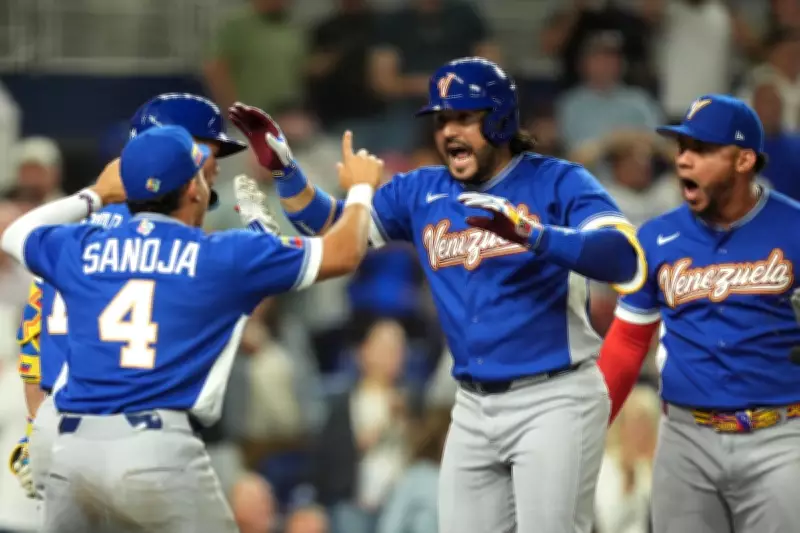
Trump's latest annexation proposal came shortly after Venezuela's 4-2 win against Italy in the World Baseball Classic semi-final on Monday night. "Wow!" Trump exclaimed in his social media post. "Venezuela defeated Italy tonight, 4-2, in the WBC (Baseball!) Semifinal. They are looking really great."
The former president continued with his characteristically bold speculation: "Good things are happening to Venezuela lately! I wonder what this magic is all about? STATEHOOD, #51, ANYONE? President DONALD J. TRUMP." This remark represents the most recent in a series of territorial claims that have defined Trump's foreign policy approach.
Pattern of Expansionist Threats
Throughout his second presidential term, Trump has repeatedly threatened to annex various countries and regions, establishing a concerning pattern of expansionist rhetoric. His targets have included Canada and Greenland, with the latter causing particular diplomatic tension with Denmark.
Trump previously asserted that the United States needed Greenland for "national security" reasons, while regarding Canada, he promised to transform the nation into a "cherished" 51st state. Although the frequency of his Canadian threats has diminished recently, Trump referred to Prime Minister Mark Carney as the "future Governor of Canada" on Truth Social just last week.
Venezuela's Complex Relationship with the US
Venezuela's victory has propelled them to a tense rematch with the United States in the World Baseball Classic final. The two nations previously faced each other in 2023, with the United States securing a comfortable victory. This sporting rivalry mirrors the complex political relationship that has developed between the countries during Trump's presidency.
Venezuelan affairs have become a cornerstone of US foreign policy under Trump's leadership. In January, the United States launched a high-stakes operation that resulted in the capture of Nicolás Maduro, Venezuela's former president. This followed weeks of airstrikes targeting boats allegedly transporting drugs from Venezuelan waters.
Following Maduro's capture, Trump announced that American oil companies would flood investment into Venezuela to modernise the country's energy sector. This move represented a significant shift in economic policy toward the South American nation.
Middle East Conflict Diverts Attention
In recent weeks, Trump has redirected his focus toward the escalating crisis in the Middle East. On February 28, the United States and Israel launched coordinated attacks on Iran, resulting in the death of Supreme Leader Ayatollah Ali Khamenei.
Trump claimed these attacks aimed to achieve regime change in Iran, while also asserting that the country was weeks away from developing nuclear weapons. The conflict has triggered a dramatic increase in global oil prices, with GasBuddy reporting that gasoline prices reached $3.68 per gallon on Sunday, up significantly from $2.88 in mid-February.
Despite promising to reduce energy costs during his 2024 presidential campaign, Trump bragged on Truth Social that rising gas prices would mean the United States would "make a lot of money." This contradiction highlights the complex economic realities facing his administration.
International Reactions and Implications
Trump's repeated annexation threats have generated significant international concern and diplomatic tension. European leaders expressed outrage earlier this year when Trump threatened Greenland, while Canadian officials have consistently rejected his territorial claims.
The suggestion that Venezuela could become a US state represents perhaps the most audacious of Trump's expansionist proposals, given the nation's history of anti-American sentiment under previous administrations. Political analysts suggest that while such declarations may energise Trump's base, they complicate diplomatic relations and undermine international stability.
As Venezuela prepares to face the United States in the World Baseball Classic final, the geopolitical implications of Trump's statement continue to reverberate through international circles. The former president's willingness to connect sporting achievement with territorial ambition remains a distinctive and controversial aspect of his political legacy.