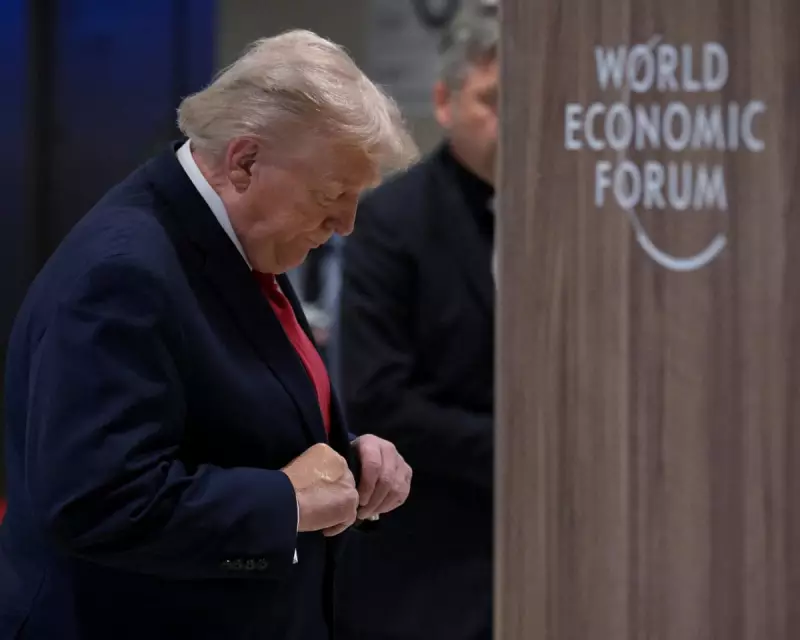
The 56th annual World Economic Forum in Davos, Switzerland, witnessed a stark confrontation of ideologies on 21 January 2026, as former US President Donald Trump delivered a characteristically provocative speech. His presence at the elite gathering served as a potent symbol of the profound challenges facing the so-called 'rules-based order' that the event has long championed.
A Clash of Visions at the Alpine Summit
Donald Trump embodies a direct antithesis to the core principles typically celebrated in Davos. His hour-long address reiterated a protectionist trade stance, scepticism towards multilateral institutions, dismissal of climate crisis concerns, and a rejection of the 'woke' capitalism focused on social and ethical goals. Reports indicate that forum organisers had to temporarily sideline their usual emphasis on gender equality and ethical investment to secure his participation, highlighting the tension between his worldview and the WEF's traditional agenda.
The Structural Cracks in the Post-War System
The liberal international order, largely constructed by the United States and its European allies after the Second World War, is facing existential threats from both within and outside. This system, often described as a framework for US hegemony with Europe as a junior partner, guaranteed European security through NATO and positioned America as the global consumer of last resort. However, as French President Emmanuel Macron noted, the world is shifting towards a 'world without rules'.
The institutional pillars of this order are now widely seen as obsolete. The International Monetary Fund and the World Bank, designed over eight decades ago during America's peak power, still operate under governance structures that grant the US an effective veto and allow Europe to appoint key leaders. Emerging economic giants like China, India, and Brazil increasingly question why these institutions do not reflect contemporary global economic realities.
Trade Imbalances and Declining Hegemony
Global trade frameworks tell a similar story. Past liberalisation deals are often viewed as agreements negotiated primarily between the US and Europe, with terms then imposed on developing nations. As these nations have grown in economic stature, their willingness to accept unfavourable terms has diminished. It has been more than three decades since a comprehensive global trade agreement was reached.
Meanwhile, America's position as the unchallenged economic hegemon has been eroded by China's rapid ascent. Europe finds itself in a particularly precarious position, exhibiting slower growth, lagging innovation compared to the US, and remaining dependent on American security guarantees. The article starkly notes that if Trump acted on his past musings about acquiring Greenland, Europe collectively lacks the power to prevent it.
Internal Erosion and Economic Discontent
The rules-based order is also crumbling from within. The promise of liberal democracy was closely tied to broad-based economic prosperity, but that social contract is fraying. In nations like the United States, the share of national income going to labour has plummeted to historic lows, creating a landscape where the wealthy prosper while middle and lower-income households struggle. This domestic discontent fuels the political forces that figures like Trump represent.
Charting a Path Forward for Global Governance
The critical question is what comes next. A return to a 'law of the jungle' in international relations is undesirable, yet crafting a new, functional system presents immense difficulties. Experts argue that a sustainable order requires several foundational changes:
- Fostering faster and more inclusive economic growth that benefits a wider population.
- Significant new investment in public infrastructure across developed and developing nations.
- Financial assistance from wealthy Western nations to help poorer countries mitigate and adapt to the climate crisis.
- A greater European commitment to funding its own defence capabilities.
- Comprehensive reform of international institutions, including the United Nations, World Trade Organization, IMF, and World Bank.
The article recalls that the IMF's original design, influenced by British economist John Maynard Keynes, proposed shared responsibility between creditor and debtor nations. However, the US, as the dominant creditor, rejected obligations to import more, placing the entire adjustment burden on debtor nations through austerity. A truly equitable system would address this fundamental flaw.
No Return to the Status Quo
There is a dangerous temptation to believe the system's problems will vanish once particular leaders like Donald Trump leave office. This optimism is misguided. The crisis is structural, not merely personal. As noted by figures such as Canada's Prime Minister Mark Carney in Davos, the old order 'is not coming back'. The challenge is not simply replacing individuals but confronting the deep-rooted economic, political, and institutional failures that have caused the rules-based system to collapse. The 2026 forum may be remembered not for its solutions, but as a vivid display of a global paradigm in terminal decline.