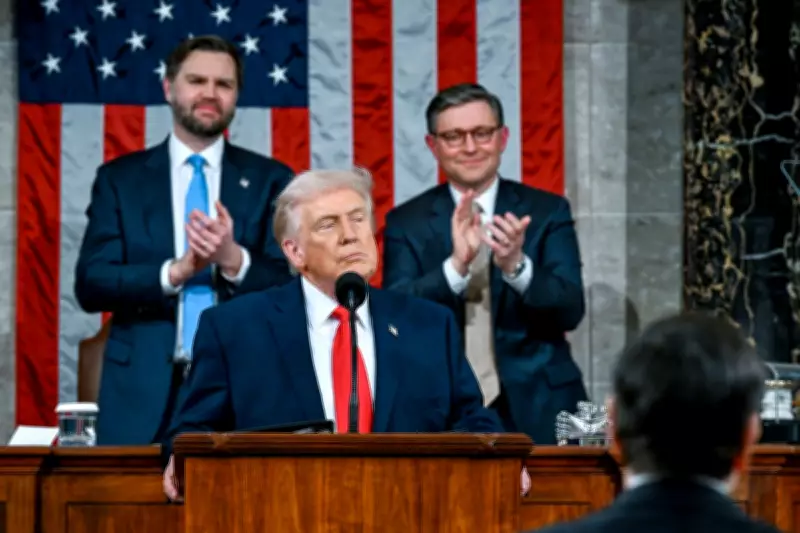
On Tuesday night, President Donald Trump delivered a State of the Union address that resembled a daytime game show, complete with surprise guests like the U.S. Men's National Hockey team, aiming to energize Republican midterm hopes. However, voter polling indicates widespread disbelief in his optimistic claims, with Democrats potentially softening the blow through a strategic boycott of the event.
Voter Skepticism Over Trump's Economic and Immigration Policies
Despite Trump's declaration that America is entering a "golden age," multiple polls reveal deep public dissatisfaction. A YouGov survey shows 60% of Americans approve of the Supreme Court striking down his tariff policy, while a CNN poll finds 61% of voters believe his policies will move the country in the wrong direction. Additionally, 68% report Trump has not addressed the nation's most pressing problems adequately.
Economic Concerns and Dismissive Responses
An ABC News/Washington Post/Ipsos poll highlights disapproval rates: 65% on inflation handling, 64% on tariffs, and 57% on the economy. U.S. Trade Representative Jamieson Greer dismissed these numbers, attributing them to opt-in polls by critics, and pointed to GDP growth and wage increases as evidence of success. This mirrors past Democratic attempts to paint the economy positively, which backfired, leading to Trump's return to the White House and Republican Senate gains.

Immigration Backlash and Racial Rhetoric
Trump's immigration policies also face scrutiny, with 58% disapproval on immigration and 50% on border security. His shift to draconian measures, including racist remarks labeling Somali-Americans as "pirates," has alienated voters who once supported him for border control. Incidents like ICE killings have further eroded trust, turning immigration into a liability rather than a strength.
Democratic Boycott and Its Consequences
Many Democrats, including Rep. Rashida Tlaib and Ilhan Omar, publicly criticized Trump during the address, but a broader party boycott allowed his claims to go unchallenged. This absence may have reinforced voter perceptions of Democrats as weak or lacking solutions, contrasting with past successes like the 2018 Blue Wave.
Contrasting Approaches Within the Party
Some Democrats, such as Rep. Lauren Underwood, initially stayed but left over health care lies, while others like Abigail Spanberger and Sen. Alex Padilla offered effective rebuttals. Spanberger's gubernatorial win in Virginia and Padilla's immigration protests provided sharp contrasts, yet the overall boycott risked insulating Trump from public discontent.
Political Insulation and Future Risks
Speaker Mike Johnson's reluctance to oppose Trump, coupled with the boycott, may have created a cocoon that prevents the president from recognizing voter dissatisfaction. This dynamic could hinder Republican midterm prospects, as Trump remains unaware of growing threats to his political agenda.
In summary, Trump's State of the Union failed to convince voters on key issues, but Democratic strategies, including a boycott, may have inadvertently bolstered his narrative, setting a precarious stage for the 2026 midterm elections.