Trump's Unorthodox Address at National Prayer Breakfast Reveals Political-Religious Dynamics
Former President Donald Trump delivered a characteristically unconventional speech at the National Prayer Breakfast in Washington DC on February 5, 2026, highlighting the complex relationship between the Republican party and rightwing evangelical Christians. The event, held at the Washington Hilton hotel, traditionally features spiritual reflection but under Trump's presence transformed into what observers described as a campaign rally atmosphere.
The Political Trinity: Trump, Bukele, and Republican Morality
Trump's address referenced what some commentators termed a political trinity. The former president himself represented the father figure, despite his controversial record including deploying federal forces in Minneapolis, threatening Greenland's sovereignty, and numerous documented falsehoods. Remarkably, he remains the favored candidate of the religious right movement.
The son figure was represented by Nayib Bukele, President of El Salvador, whom Trump praised as "one of my favourite people" and "a great ally." This endorsement came despite Bukele's government facing international criticism for human rights violations and mass detentions affecting thousands of children.
The holy ghost, according to political analysts, symbolized the Republican party's moral compass, which critics argue has diminished significantly during the Trump era. The relationship between Trump and religious conservatives represents what some describe as a devil's pact—a strategic alliance where theological purity is sacrificed for political influence.
Campaign Rhetoric Masquerading as Prayerful Reflection
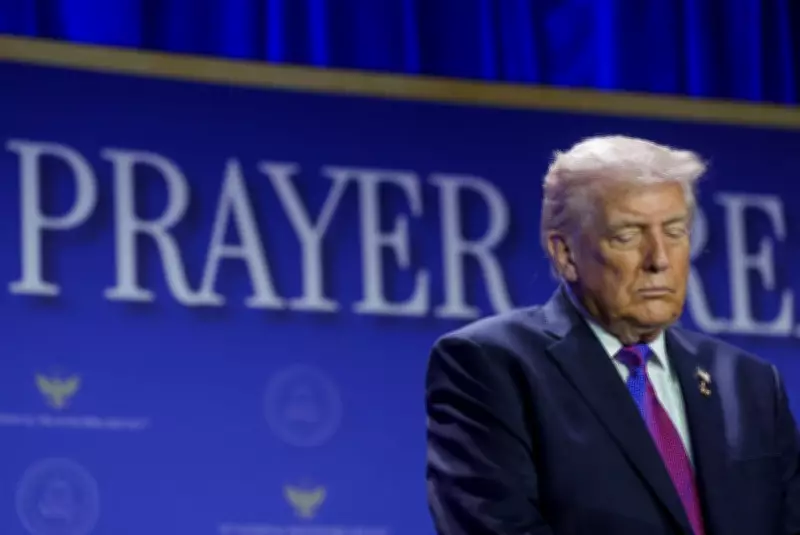
Wearing a dark suit with purple tie, Trump delivered remarks in what observers noted was a somewhat slurry tone, covering familiar political territory rather than spiritual themes. His speech included attacks on "transgender insanity," criticism of wind energy projects, bizarre commentary about Greenland being "the biggest piece of ice in the world," and boasts about military personnel resembling "Tom Cruise only bigger."
The former president insulted Kentucky Representative Thomas Massie as a "moron" and recycled nicknames for political opponents, debating whether to call President Joe Biden "Sleepy Joe" or "Crooked Joe." He described Barack Obama as "divisive" while asserting that "I don't know how a person of faith can vote for a Democrat."
Trump repeated his baseless claim about the 2020 election being "rigged" and boasted about his 2024 victory, stating: "I had to win it. I needed it for my own ego. I would have had a bad ego for the rest of my life. Now I really have a big ego. Beating these lunatics was incredible."
International Diplomacy and Memory Lapses
The event featured awkward diplomatic moments when Trump welcomed special guests. He praised Bukele's prison management before attempting to introduce "the president of the Congo" but failing to recall Félix Tshisekedi's name. Trump recovered by asking the Congolese leader to stand, describing him as "a very, very brave and wonderful man" while remaining apparently unaware of his identity.
Trump shared personal anecdotes including his sleeping habits during presidential travel, revealing: "I don't sleep on planes. I don't like sleeping on planes. You know, I like looking out the window watching for missiles and enemies, actually."
The Theological Justification for Political Support
The most revealing moment came when Trump recalled Southern Baptist pastor Robert Jeffress's assessment from a decade earlier: "He may not be as good with the Bible as some of them. He may not have read the Bible as much as some of them. In fact, he may not have ever read the Bible, but he will be a much stronger messenger for us and he will get things done that no other man has the ability to get done."
Trump acknowledged this characterization, adding: "You know, I didn't want to admit anything, but that was very interesting and I think we've gotten more done than anybody could have ever gotten done." This exchange crystallizes the pragmatic alliance between Trump and evangelical leaders who view him as a modern Cyrus figure—an imperfect instrument achieving divine purposes against secular liberalism.
Trump's Personal Theology and Political Mission
Trump articulated his personal approach to religion during the event, stating: "You have to believe in something. You have to believe that what we're doing, there's a reason for it. There has to be a reason for it. We're all working and we're doing, we're behaving. I mean, I behave because I'm afraid not to, OK, because I don't want to get in trouble."
This contrasts sharply with previous Republican leaders like Ronald Reagan, who invoked poetic spiritual imagery. Trump instead presents a transactional view of faith and behavior. Despite his unconventional religious posture, Trump expressed confidence in his spiritual standing, suggesting: "I really think I probably should make it. I mean, I'm not a perfect candidate but I did a hell of a lot of good for perfect people."
The National Prayer Breakfast, which has hosted figures ranging from Mother Teresa to Bono and Tony Blair over the years, served as another platform demonstrating how Trump has reshaped the relationship between American politics and religion. While critics question the sincerity of his faith expressions, his political alliance with evangelical conservatives remains robust, built on shared cultural battles rather than theological alignment.