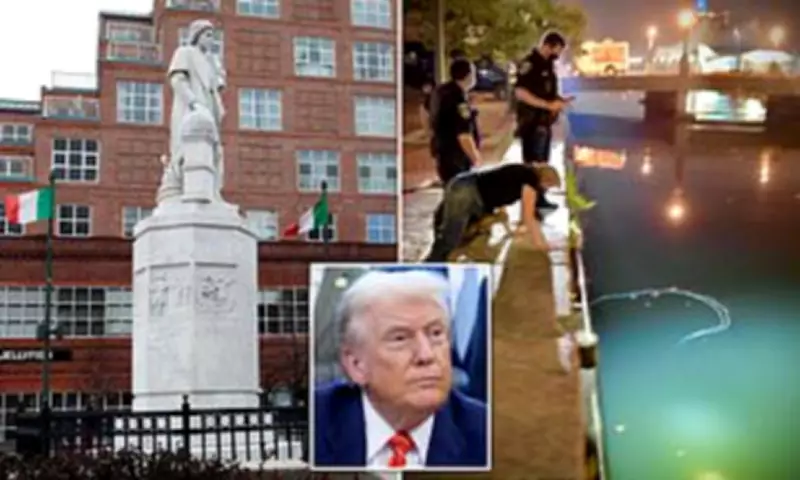
Former President Donald Trump is advancing plans to install a reconstructed statue of Christopher Columbus on the grounds of the White House, a move that reignites the contentious cultural debates of recent years. The statue, which was pulled down and thrown into Baltimore Harbor during the Black Lives Matter protests in July 2020, is set for a symbolic revival under Trump's administration.
Statue Restoration and Proposed Location
According to a report by The Washington Post, citing three sources familiar with the proposal, the rebuilt Columbus statue will likely be erected on the White House's south grounds. The specific area is near E Street N.W., just north of the Ellipse, positioning it as a prominent feature visible to visitors and the public.
The original statue had been on display in Baltimore's Little Italy neighborhood until protesters toppled it on Independence Day in 2020, leaving only the pedestal behind. Baltimore Police officers were seen inspecting the submerged statue after the incident, highlighting the dramatic fall and now its planned resurrection.

Political and Cultural Context
Trump has embraced Columbus as part of his broader anti-woke agenda, which includes efforts to rename military bases to reflect their Confederate past and remove what he terms 'divisive' or 'ideological' content from institutions like the Smithsonian museums. This statue project aligns with his ongoing cultural battles, which he previously leveraged during the 2020 presidential election by decrying the destruction of statues amid protests.
In a statement to The Washington Post, White House spokesperson Davis Ingle affirmed this stance, saying, 'In this White House, Christopher Columbus is a hero. And he will continue to be honored as such by President Trump.' The White House declined further comment on the plans to both The Post and the Daily Mail.
Controversial Legacy and Alternative Observances
While Columbus is traditionally credited with discovering the Americas, his legacy has become increasingly scrutinized in modern times due to his history of enslaving people and bringing disease and conflict to Native American populations. This has led some states to replace Columbus Day with Indigenous Peoples' Day each October, a shift that President Joe Biden formally recognized in 2021, making him the first president to mark the alternative observance.
In contrast, Trump signed a proclamation in October celebrating only Columbus Day, referring to the explorer as the 'original American hero.' During an Oval Office event, he declared, 'We're back, we're back, Italians,' underscoring the ethnic and political dimensions of the issue.
Restoration Efforts and Funding
The restoration of the Columbus statue has been spearheaded by Italian-American supporters who pooled resources to bring it back to life. Bill Martin, an Italian American businessman involved in the project, told The Post that he and his allies spent over $100,000 to recover and restore the statue. It is currently being held at a warehouse on Maryland's Eastern Shore, awaiting its potential move to the White House.
Martin downplayed the politicization of the explorer, stating, 'It's not about Columbus 'discovering America' … it's about the Italian immigrants who came here and looked to Columbus as a hero.' This perspective highlights the statue's significance to some communities as a symbol of heritage rather than controversy.
Political Reactions and Broader Implications
Nino Mangione, a Republican member of the Maryland House of Delegates involved in the statue project, criticized those who toppled the statue nearly six years ago. She told The Post, 'This proves that gangs, thugs and people of that ilk don't control things by mob rule. In America the people rule and our voices are heard.' Her comments reflect the ongoing partisan divide over historical monuments and protest actions.
The Trump administration had contacted Martin at the end of Trump's first term with the idea to relocate the statue to the White House grounds, but at that time, it had not yet been restored. Since Trump returned to office in January, there has been a renewed push for such cultural symbols, as seen with the reinstalled statue of Albert Pike in Washington, D.C., near Judiciary Square, which memorializes a Confederate figure.

This statue initiative is part of a larger pattern where Trump uses historical figures and monuments to engage in culture wars, appealing to his base while challenging progressive narratives. The planned installation of the Columbus statue on White House grounds symbolizes a continued effort to reshape public memory and national identity in line with his political vision.