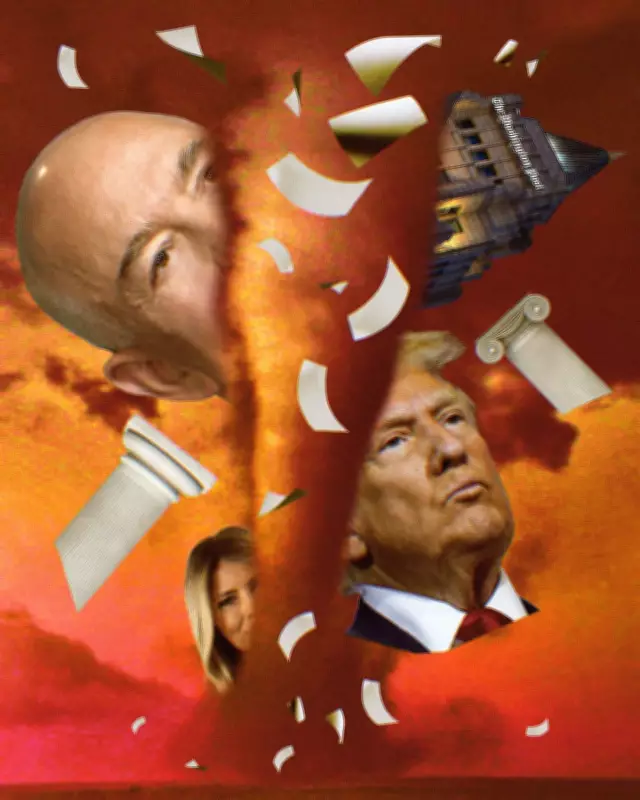
Historic Newspaper Faces Crisis as Bezos Axes Over 300 Positions
These are historic times, with a cyclone bearing down on the world order and the American system of government. This is precisely when journalism matters most, yet The Washington Post finds itself in turmoil after owner Jeff Bezos eliminated more than 300 jobs, nearly a third of its workforce. The move has ignited fears about the resilience of American democracy to withstand attacks from former President Donald Trump.
Warzone Correspondent Laid Off Amid Conflict
The email arrived in Lizzie Johnson's inbox in Ukraine just before 4pm local time. It came at a brutal moment for the reporter: Russia had been repeatedly striking the country's power grid, and days earlier, she had been forced to work from her car without heat, power, or running water, writing in pencil because pen ink freezes too readily.
"Difficult news," was the subject line. The body text stated: "Your position is eliminated as part of today's organizational changes," explaining it was necessary to meet the "evolving needs of our business." Johnson's response may go down in American media history: "I was just laid off by The Washington Post in the middle of a warzone. I have no words."
Outcry from Post Legends and Staff
The bloodletting swept away the paper's entire sports department, much of its culture and local staff, and all journalists in arid news zones like Ukraine and the Middle East. Prominent figures voiced their dismay.
- Don Graham, son of the Post's legendary Watergate-era owner Katharine Graham, broke his silence since selling the paper to Bezos for $250 million in 2013, saying, "It's a bad day."
- Bob Woodward, one-half of the Watergate-exposing duo, lamented, "I am crushed."
- Marty Baron, the Post's former editor in chief, called it "among the darkest days in the history of one of the world's greatest news organizations," criticizing Bezos for "sickening efforts to curry favor with President Trump."
Several hundred people rallied in front of the Post's offices, with engineer Patrick Nielsen stating, "It's disappointing on an immense scale. They don't seem to give a damn about this institution and the people that make it run."
Bezos's Shifting Stance and Business Motives
Robert McCartney, a 39-year veteran of the Post, noted the stark contrast between Bezos's handling during Trump's first term and now. "We saw him as a savior. He pumped money into the Post, didn't meddle in the newsroom, and stood up to Trump," he recalled. Fast-forward to 2026, and a different Bezos has emerged.
In 2017, the Post introduced its strapline: "Democracy dies in darkness." At the end of this week, America looks notably darker. Marcus Brauchli, the Post's former executive editor, emphasized, "These are historic times... This is when journalism matters most. I mean, laying off reporters in Ukraine, now."
Bezos, the fourth-richest person with a $245 billion fortune, could cover five years of the Post's $100 million annual losses with a single week's earnings, as noted by Peter Baker of the New York Times. The optics were diabolical: Bezos was absent during the layoff announcement, delegated to editor Matt Murray, yet was seen beaming with Trump's defense secretary earlier in the week.
Appeasement Theories and Media Landscape
McCartney speculated that Bezos may be appeasing Trump after Amazon lost a $10 billion Pentagon contract during Trump's first term, potentially retaliating for the Post's critical coverage. "It's very likely that the desire to appease Trump, to placate him, is playing a role in these decisions," he said.
This comes amid a parlous state for US media. Since 2000, 3,500 newspapers have closed, leaving one in four Americans in news deserts. The Pittsburgh Post-Gazette, founded in 1786, will publish its final edition in May. Other papers, like the Los Angeles Times, have fallen to wealthy owners who see journalism as a monetizable asset.
Trump's Media Vendetta and Democratic Threats
Trump has escalated his vendetta against the media, stripping NPR and PBS of over $1 billion in funding, attacking journalists, and bullying corporate owners. CBS News exemplifies this: after a lawsuit, Paramount settled, and new CEO David Ellison appointed anti-woke commentator Bari Weiss as editor, pulling segments critical of Trump policies.
The cumulative malaise leaves democratic institutions vulnerable. Trump feels unchained, peddling racism, deploying paramilitary forces, and preparing attacks on the ballot box. Paradoxically, the norms he obliterates, like Department of Justice independence, were established post-Watergate—exposed by that same Washington Post.
As historian Simon Schama wrote, Bezos's actions for Melania while gutting his newspaper may be seen as "the most glaring symptom of cultural collapse in a democracy hanging on to truth by the barest of threads." In these historic times, the layoffs at The Washington Post signal a profound threat to journalism and democracy itself.