

The Rise of White House Slopaganda: AI Images as Political Weapons
In an unprecedented shift in official government communication, the White House under Donald Trump has fully embraced artificial intelligence to produce a stream of provocative, meme-inspired imagery. Academics have coined the term "slopaganda" to describe this phenomenon – a fusion of readily available AI tools with deliberate political messaging designed to dominate online discourse.
From Fringe to Mainstream: Institutional Shitposting Arrives
What began as crude online trolling on platforms like 4chan and Reddit has now become official White House strategy. According to Don Caldwell, editor of Know Your Meme, this represents "institutional shitposting" – the publishing of deliberately provocative content as government communication. The Trump administration has not only granted the AI industry significant regulatory freedom but has weaponised the technology for its own political purposes.
Ten Defining AI Images from the White House
Trump as King (19 February 2025)

The first AI image posted by the White House X account featured Donald Trump as a monarch on a fake Time magazine cover. This accompanied an announcement about repealing New York City's congestion pricing and played into fears about authoritarian governance. New York Governor Kathy Hochul famously held up the image during a press conference, declaring: "New York hasn't laboured under a king in over 250 years. We sure as hell are not going to start now." The congestion charge remains in effect despite the administration's efforts.
Studio Ghibli Deportation Meme (27 March 2025)
Demonstrating remarkable speed in capitalising on online trends, the White House applied OpenAI's Studio Ghibli-inspired meme generator to an image of a woman being arrested by ICE agents before deportation. Caldwell notes the administration's impressive response time: "The Studio Ghibli meme trend kicked off on March 25 on X; we covered it the following day; and then the White House covered it the day after that." This illustrates how White House staffers likely monitor meme culture platforms regularly.
Trump as Pope (3 May 2025)
This controversial image, posted during the period between Pope Francis's death and the election of a new pontiff, demonstrates Trump's ability to insert himself into unrelated conversations. Catholic groups expressed outrage, with the New York State Catholic Conference stating: "There is nothing clever or funny about this image, Mr President." Trump responded by claiming Catholics loved the image while blaming media criticism.
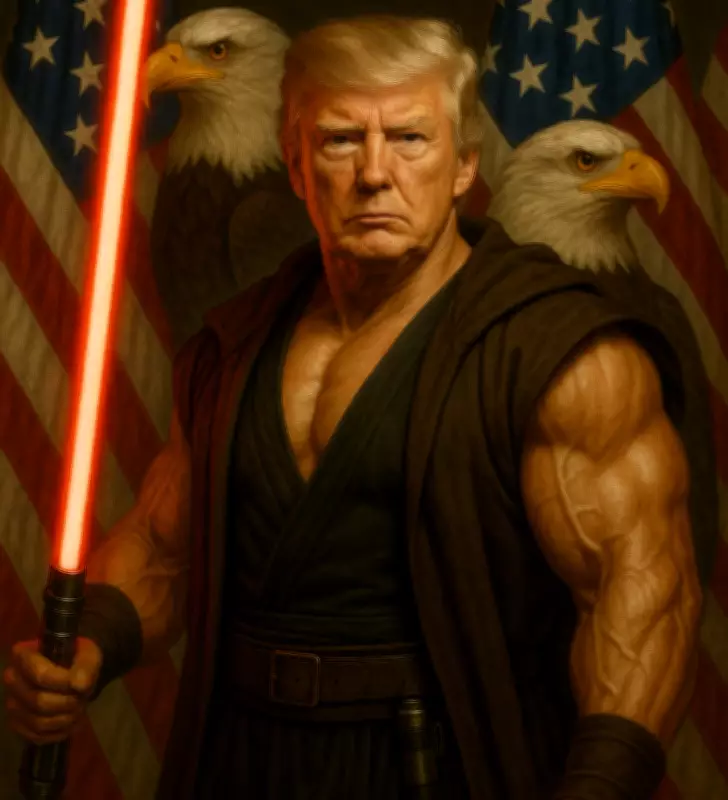
Trump as Jedi (4 May 2025)
Crashing Star Wars Day celebrations, the White House posted an image of Trump as a muscular Jedi knight surrounded by flags and eagles. This continues a pattern of flattering fan art that began with digital trading cards and includes previous images grafting Trump's face onto superhero bodies. The administration claimed to represent the Rebellion rather than the Empire, despite the obvious contradictions.
Hakeem Jeffries as Mexican Stereotype (29 October 2025)
This offensive image depicting Democratic leaders Hakeem Jeffries and Chuck Schumer in sombreros holding tacos illustrates the difficulty of responding to such content. It followed a deepfake video Trump posted a month earlier applying similar racist filters to Jeffries. When criticised, the administration doubled down by playing the video on loop in the White House briefing room.
Welcome to the Golden Age (1 January 2026)
An AI video showing a golden White House facade with showering gold coins accompanied Bruno Mars's 24K Magic track. This represents what researchers call "wishcasting" – presenting desired outcomes as reality. Academic research suggests such false information continues influencing beliefs even after correction, as neural representations of falsehoods persist.
Which Way, Greenland Man? (14 January 2026)

This seemingly straightforward post about Trump's interest in acquiring Greenland contains darker undertones. The slogan references a 1978 neo-Nazi text, Which Way, Western Man?, which advocated violence against Jews and Black people. Heidi Beirich of the Global Project Against Hate and Extremism called it "absolutely shocking" to see such imagery deployed officially.
Stand with ICE Propaganda Poster (15 January 2026)
Daniel de Zeeuw, assistant professor in digital media culture at the University of Amsterdam, explains: "AI is very good at constantly reiterating images from the past, so it can create this nostalgic imagery of traditionalism." This allows extremist messages about ICE's militarised policing to be inserted into reassuring graphic styles like patriotic recruitment posters.
Arrest of Nekima Levy Armstrong (22 January 2026)
This represents a significant escalation – an AI-manipulated image purporting to be an authentic photograph. The White House altered an image of civil rights lawyer Nekima Levy Armstrong to make her appear more distressed, with darkened skin tone. Unlike previous obviously fake images, this omission of AI disclosure moves into deepfake territory. White House deputy communications director Kaelan Dorr responded: "Enforcement of the law will continue. The memes will continue."
The Nihilistic Penguin (23 January 2026)
This image of Trump walking with a penguin toward a Greenland flag riffs on the viral "nihilist penguin" meme from Werner Herzog's documentary. Robert Topinka of Birkbeck, University of London, explains these posts function as "emotional hooks" rather than legitimate arguments. De Zeeuw connects it to what Naomi Klein and Astra Taylor call "end times fascism" – a joyful march toward potential oblivion.
The Psychological Impact and Future Implications
The White House's embrace of AI-generated content represents more than mere trolling. It demonstrates how governments can weaponise digital tools to shape narratives, provoke reactions, and bypass traditional media channels. As these technologies become more sophisticated and accessible, the line between official communication and online provocation continues to blur, creating new challenges for democratic discourse and public trust in institutions.





