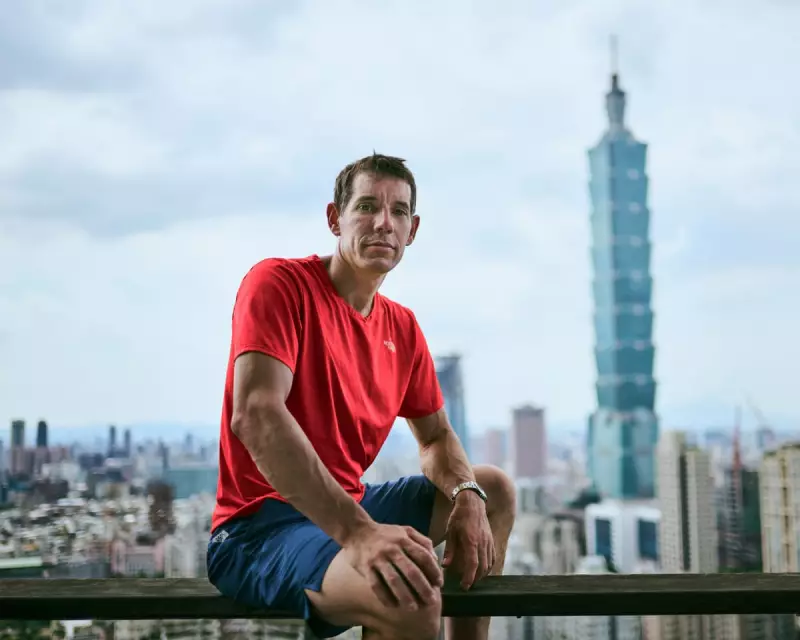
Alex Honnold, the renowned climber celebrated in the Oscar-winning documentary Free Solo, is poised to undertake one of his most audacious feats yet: free soloing the towering Taipei 101 skyscraper in Taiwan. This live broadcast event, set for global streaming on Netflix, has ignited a mixture of admiration and concern within the climbing community and beyond.
Preparing for the Ultimate Ascent
Honnold has dedicated the past three months to rigorous training for this momentous climb, which stands as the realisation of an ambition he has harboured for over a decade. The ascent of Taipei 101, one of Asia's tallest structures at 1,667 feet (508 metres), will be executed without ropes, harnesses, or any safety gear, relying solely on Honnold's skill and nerve.
In a recent episode of his podcast, Climbing Gold, Honnold described the simplicity and peril of the endeavour. "You walk up to the base, you hop on to the building, you climb all the way to the top," he stated. "No ropes. No gear. No margin of error." The event, scheduled for 9am local time in Taipei on Saturday (8pm ET Friday in the US), is expected to last approximately two hours, with Honnold aiming to complete it in around 75 minutes based on current prediction market odds.

Netflix's Foray into Live Sports Programming
This broadcast, titled Skyscraper Live, represents Netflix's latest venture into live sports content, following similar moves by competitors like Apple, Amazon Prime, and YouTube. Richard Deitsch, a veteran sports media journalist, noted that Netflix's strategy focuses on "eventizing sports"—prioritising one-off spectacles over extensive inventories to attract viewers to their broader catalogue.
Deitsch emphasised the ethical considerations for streamers in such high-risk broadcasts. "They owe you honesty," he argued. "Here are the dangers. Let the audience know this is not 100% foolproof." In response, Netflix has implemented a viewer-discretion advisory and a 10-second delay for the live stream, allowing producers to cut the feed if necessary, while Honnold maintains constant communication with his camera crew.
Backlash and Ethical Concerns
The decision to livestream the climb has provoked significant backlash, with critics labelling it "voyeuristic, ghoulish, and irresponsible." Concerns have been amplified by recent incidents, such as the death of an Alaskan climbing influencer during a TikTok livestream last year. Some within the climbing community, including amateur climbers in Taiwan, have expressed unease about watching the event live, preferring to check outcomes via news reports first.
At a climbing gym in Taipei's Zhonghe district, teacher Tse Hsiao-yang, who has six years of climbing experience, voiced opposition to the live broadcast. "I don't understand why it has to be done this way, other than for commercial reasons," he said. "If he falls, the price is huge." Conversely, his friend Yen Shin-chou, a climber of 24 years, views the event as an opportunity to elevate Taiwan's global profile, trusting in Honnold's calculated approach.
Architectural and Psychological Challenges
Taipei 101's distinctive "bamboo box" design, featuring stacked segments with balconies every eight floors, offers predictable resting points akin to a multipitch rock climb. Honnold explained to Netflix that skyscraper ascents test endurance more than technical skill, with the primary challenge lying in overall physicality rather than isolated difficult moves.
Alain Robert, the French climber known as "Spiderman" who scaled Taipei 101 on top rope in 2004, expressed confidence in Honnold's abilities. "I know Alex," Robert said. "He has already planned his limits. There is not even a one-in-100-million chance that this will be his last climb." He dismissed concerns about witnessing potential accidents, noting that livestreams of wars and conflicts are commonplace, with death being an inherent part of life.

Mental Preparation and Audience Impact
Dr Jamie Shapiro, a professor of sport and performance psychology at the University of Denver, highlighted the importance of Honnold's mental preparation, including techniques like visualisation and self-talk. "You can't predict every challenge," she noted. "But you can trust your training and your competence. He has enough experience to stay composed if something unexpected happens."
Shapiro added that such events can inspire audiences by showcasing elite athletes pushing human limits, encouraging viewers to pursue their own goals. Despite the risks, many, including Yen Shin-chou, plan to tune in, anticipating a historic breakthrough in climbing. "Anyone who has climbed that long has a calm mind," Yen remarked. "It will be a breakthrough."
As the world watches, Honnold's ascent of Taipei 101 not only tests the boundaries of free solo climbing but also sparks broader conversations about ethics, media, and the human spirit in the face of extreme challenges.