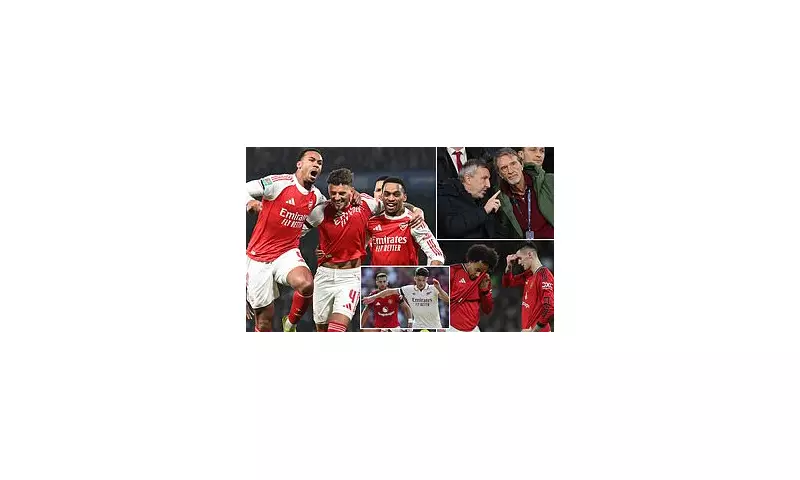
It was on a Tuesday evening, just moments before Arsenal's Champions League fixture against Inter Milan kicked off, that an intriguing hypothetical question emerged during punditry duties. Theo Walcott posed a compelling scenario to Wayne Rooney, asking which team would triumph in a clash between the current brilliant Arsenal side and the dominant Manchester United squad of 2008. Rooney, never one to miss an open goal, responded with characteristic confidence: 'We'd batter them.'
The Comfort Zone of History
On balance, most observers would likely agree with Rooney's assessment, though his answer highlighted for the umpteenth time that Manchester United's comfort zone remains firmly anchored in the past. Their refuge exists in historical achievements, in triumphs that feel increasingly distant from current realities and require a vast overhaul to become recurring features once more. For former stars like Rooney, these nostalgic reflections have become bittersweet reminders of what has been lost.
United's present circumstances make them a deliciously easy target for criticism and analysis. Beyond the acquisition of a pair of underwhelming strikers purchased at considerable expense during the summer transfer window, there exists little common ground between the respective versions of Manchester United and Arsenal as we approach 2026. When these historic rivals face off at Emirates Stadium this Sunday, those disparities could be conclusively emphasised for all to see.
A Blueprint from North London
Yet within this fixture exists a potential blueprint for how Manchester United might navigate their way out of the current wasteland. The solution, in essence, involves studying and emulating Arsenal's approach. Under the leadership of Declan Rice on the pitch and Mikel Arteta in the dugout, Arsenal have constructed a model that demonstrates how to rebuild successfully from challenging circumstances.
Manchester United, by contrast, represents an operation that has lost itself in a self-loathing brand of nostalgia, constantly measuring itself against past glories rather than building toward future successes. All of this analysis comes easily when discussing a club like Arsenal that currently tops tables both domestically and in European competition.
Parallel Challenges, Divergent Paths
If it has become accepted wisdom that United remain lost in the considerable shadow of Sir Alex Ferguson, then it should equally be acknowledged that no other elite English club in the modern era can empathise more profoundly than Arsenal. Both institutions faced the monumental challenge of moving on from all-encompassing, autocratic figures who defined their clubs for generations.
Yet where one operation has pivoted erratically, panicked in decision-making, rotated managers frequently, spent good money after bad, and ultimately lost itself in that self-loathing nostalgia, Arsenal have progressed steadily since the departure of Arsène Wenger. Too much has perhaps been made of the faith Arsenal showed in Mikel Arteta during those early difficult days.
The Recruitment Divide
Upon his appointment six years ago, Arsenal languished in tenth position in the Premier League table. Arteta promptly won the FA Cup in his first season, making it hardly the egregious gamble of popular depiction when the club decided to keep him after finishing eighth in his second campaign. His arrival at this current opportunity might be painted as vindication, yet it is in the crucial area of recruitment where the differences between these two clubs are most profoundly felt.
If Arsenal do win the Premier League title this season, it will have been achieved through the meticulous accumulation of a squad built specifically to weather storms, endure challenges, and ultimately conquer opponents. They have developed two elite options for nearly every position, with perhaps the exception being the evidence surrounding Viktor Gyokeres.
The Financial Contrast
Where this damns Manchester United, beyond the obvious performance disparities, is in how they have utilized almost identical levels of spending since a pivotal moment for each club. Drawing a line back to the 2020-21 season, when United last found themselves within the same postcode of a title challenge and Arteta was facing his heaviest scrutiny, the numbers reveal a telling story.
An estimated £1.04 billion has been spent on new recruits at Old Trafford during this period. For Arsenal, the comparable figure stands at £930 million. These financial details expose the underlying dysfunction at Manchester United, as do the specific transfer decisions made by each club.
Case Studies in Midfield Investment
Where Arsenal faced criticism for their substantial £105 million outlay on Declan Rice, an investment that is ageing as spectacularly as any in European football, United have been dreadfully neglectful in that same key area of the pitch. The arrival of Casemiro for £70 million at age 30, with wages of £375,000 per week for a similar midfield role, represents perhaps the most costly example of a broken system at Old Trafford.
Casemiro can at least leave the club next summer with the pride of knowing he reshaped his narrative during his time in Manchester. He was initially considered a flop, then he wasn't, but he was never a sustainable solution for a club that has too often pivoted toward big names, overspent on prospects, or too heavily backed the whims of individuals in transient managerial roles.
Managerial Stability Versus Flux
Manchester United persisted for too long with Ruben Amorim, but not before accommodating his specialised tactical design featuring two narrow number tens in a 3-4-3 formation. Now that they have Michael Carrick in temporary control, his preferred 4-2-3-1 system might only have room for one of Matheus Cunha and Bryan Mbeumo. Both are undoubtedly good players, but one or the other will perhaps find himself vulnerable at a club now paying the price for flip-flopping on their strategic plan.
Arteta's longevity at Arsenal has permitted precisely the opposite approach. His continued presence has been complemented by the clear thinking of those in positions above him, particularly when compared to the assortment of director-level figures at Sir Jim Ratcliffe's Manchester United. Arsenal's sturdiness at the top of their organizational structure has permitted all other facets of the club to root themselves in firm ground, with transfer strategy being a prime example.
The Interim Question
Perhaps Michael Carrick will make a mockery of all this analysis during this afternoon's encounter. Perhaps he will prove to be more than an interim solution and demonstrate himself as the manager Manchester United have been searching for throughout their prolonged period of transition. During his last caretaker spell in 2021, he signed off with a victory against Arteta's Arsenal, a fact worth remembering.
Yet rather a lot has happened at both clubs since that particular moment. Only one of them has demonstrably gotten their approach right, building systematically toward sustained success while the other has wandered in the wilderness of nostalgia. As these two historic rivals prepare to clash once more, the contrast between their trajectories has never been more apparent or more instructive for those willing to study it closely.