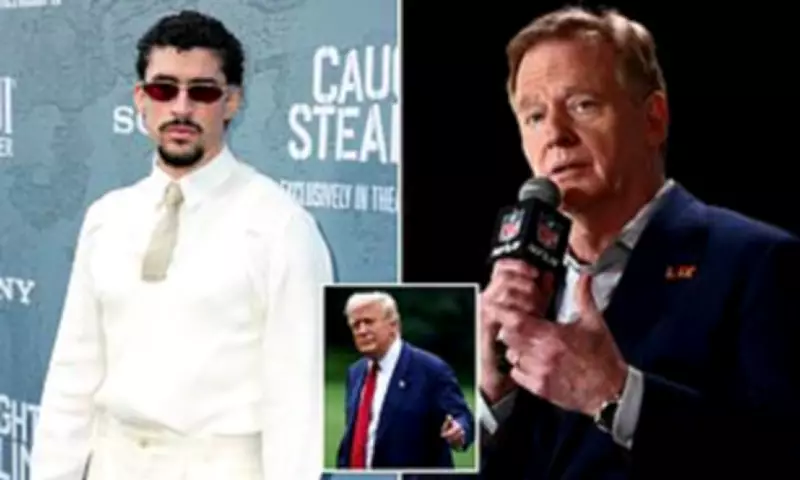
The National Football League's decision to select Puerto Rican superstar Bad Bunny as the headline act for the Super Bowl LX halftime show has ignited significant internal friction within the organisation, according to a bombshell report. The announcement, made in late September, immediately propelled the artist into a political firestorm, drawing criticism from high-ranking officials and former President Donald Trump.
Owner Warns Commissioner of Political Fallout
A recent ESPN investigation reveals that at least one NFL franchise owner privately expressed serious concerns to Commissioner Roger Goodell about the selection. The owner reportedly warned that choosing Bad Bunny could have severe political ramifications, specifically fearing it might jeopardise government antitrust approval for a major media deal. This deal involves the NFL selling several assets, including the NFL Network, to ESPN in exchange for a ten percent stake in the media giant.
According to a source familiar with the exchange, the owner told Goodell he 'should've thought through that better.' This private rebuke underscores the palpable tension between the league's commercial ambitions and the politically charged environment surrounding its entertainment choices. The criticism stems largely from Bad Bunny's past vocal criticisms of U.S. immigration policies, which have made him a controversial figure for some.
League Leadership Stands Firm Despite Pressure
Despite this internal warning, the NFL's leadership has shown no indication of reversing its decision. At an October meeting with reporters in Manhattan, Commissioner Goodell firmly defended the choice. He highlighted Bad Bunny's immense global popularity and insisted the selection process is always meticulously considered.
'He's one of the most popular entertainers in the world,' Goodell stated. 'It's carefully thought through. I'm not sure we've ever selected an artist where we didn't have some blowback or criticism. I think it's going to be exciting and a united moment.'
The league's chief marketing officer, Tim Ellis, was even more forthright during a marketing conference, bluntly addressing the controversy by saying, 'Well, not everyone has to like everything we do. Bad Bunny is f***ing awesome.'
Strategic Focus on Global and Latino Audiences
While individual owners may harbour reservations, the issue has not become a major point of contention in formal league-wide meetings. Instead, the NFL appears strategically focused on its broader objective of international expansion and engaging Latino audiences. Three club executives confirmed to ESPN that they believe the artist aligns perfectly with the NFL's long-term goal of global growth.
For many within the league office, the potential for significant brand expansion and reaching new demographics outweighs the risk of political backlash. This strategic calculus is shared by prominent figures like Dallas Cowboys chief brand officer Charlotte Jones, who has publicly endorsed the decision.
On a recent podcast, Jones emphasized the NFL's global platform, stating, 'I think our Latina fan base is amazing. And I think when you think about the Super Bowl, you want the No. 1 performer in the world to be there... We're on a global stage and we can't ever forget that.'
Attempting an Apolitical Stance Amid Past Controversies
As the Super Bowl at Levi's Stadium approaches, the NFL is reportedly striving to maintain an apolitical stance to avoid the chaos witnessed in previous years, such as the 2017 national crisis ignited by player protests during the national anthem. League executives have drawn lessons from past interactions with political administrations and are attempting to be less reactionary.
'Those are probably just lessons learned,' one executive remarked. 'Drawing the president's ire, there's so many things that happen on a daily basis. I think people just have a different opinion this time around.'
Another executive contrasted the current situation with the Kaepernick controversy, noting, 'Last time with Kaepernick, that was players and owners and the president. Bad Bunny doesn't affect any of that... It's just a halftime show.'
Trump's Absence and Security Concerns
The political dimension was further highlighted when former President Donald Trump confirmed he would not attend the Super Bowl, citing the distance, though his decision follows his public criticism of Bad Bunny's selection. Trump, who attended the 2025 Super Bowl in New Orleans, stated, 'It’s just too far away. I would (have gone otherwise).'
Adding another layer to the saga, Bad Bunny had previously refused to perform in the United States over fears of Immigration and Customs Enforcement (ICE) raids at his concerts. However, new reports confirm that ICE agents will not be patrolling around Levi's Stadium on Super Bowl Sunday. This news follows recent promises from the administration to de-escalate tensions in certain regions.
The internal NFL friction over Bad Bunny encapsulates the complex balancing act the league faces: pursuing aggressive global growth and audience diversification while navigating an increasingly polarised political landscape. With the showpiece event just days away, all eyes will be on whether the performance unites or further divides audiences.