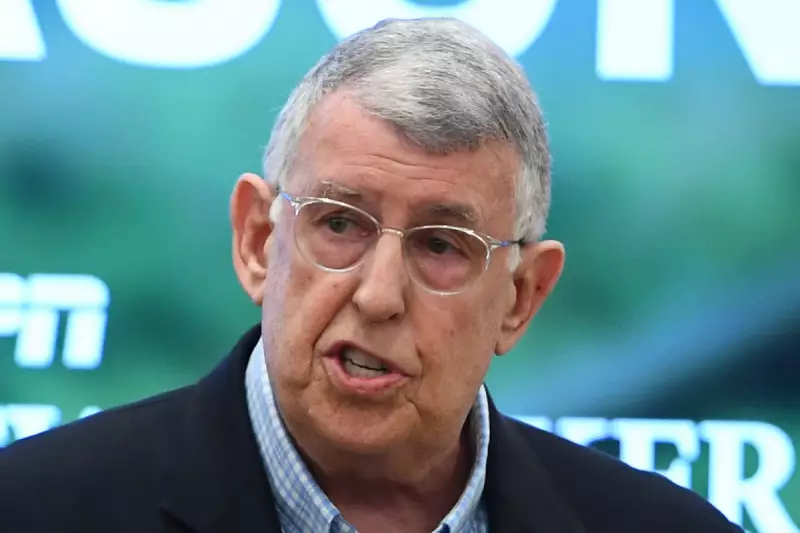
Geoffrey Mason, the esteemed television producer whose five-decade career was most famously defined by his role coordinating ABC's coverage of the 1972 Munich Olympics hostage crisis, has passed away at the age of 85.
A Broadcasting Giant's Legacy
ESPN confirmed that Mason died on Sunday in Naples, Florida, from natural causes. His death marks the end of an era for sports broadcasting, a field he helped shape through his visionary work and leadership.
Former ESPN President Steve Bornstein paid tribute, stating: "Geoff was a giant visionary in television, never seeking credit. He preferred leading and mentoring teams, connecting people to projects, and was devoted to people and recovery of all sorts. He was a great teacher and mentor to everyone who came in his orbit."
The Defining Moment: Munich 1972
Mason's career reached its most dramatic point on September 5, 1972, when as a young producer he found himself in the ABC control room in Munich. The Palestinian militant group Black September had stormed the Olympic village, taking members of the Israeli Olympic team hostage.
ABC provided continuous coverage for 22 hours, a marathon broadcast that culminated in the tragic news of a failed rescue attempt. Veteran broadcaster Jim McKay delivered the heartbreaking update to the world: "They're all gone," after six Israeli coaches and five athletes lost their lives.
The international broadcast centre in Munich was situated a mere 100 yards from where the hostage crisis unfolded in the Olympic village, placing Mason and his team at the heart of the unfolding tragedy.
Recreating History for the Screen
In 2024, Mason served as a consultant on the feature film September 5, which meticulously recreates the experience inside the ABC control room during those tense hours. The film depicts the moment when West German police stormed the control room, pointing guns at Mason's face after one of ABC's cameras inadvertently revealed a tactical squad's position on a roof above the hostages.
Actor John Magaro, who portrayed Mason in the film, recalled in 2025: "Geoff told me that day there was no chance to think. Their singular goal was to stay on the air to keep the story going, to do their job as sports broadcasters. Once the clock starts ticking, there's no chance to think."
It is estimated that nearly 900 million people worldwide viewed ABC's coverage of the crisis at some point, making it one of the most-watched news events in television history.
A Prolific Career Across Sports
Mason's remarkable career spanned multiple networks and countless major sporting events:
- He worked on eight Olympic Games throughout his career
- His tenure included work on Super Bowl 25 and Monday Night Football
- He produced coverage of the World Series and horse racing's Triple Crown
- His portfolio included the Indianapolis 500 and FIFA Men's and Women's World Cup tournaments
- He was known for his coverage of the 1986-87 America's Cup from Fremantle, Australia
Beginning as a production associate at ABC Sports in 1967, Mason worked on iconic programmes like Wide World of Sports and the 1968 Winter and Summer Olympics. Over the years, he accumulated an impressive 24 Emmy Awards and was inducted into the Sports Broadcasting Hall of Fame in 2010.
Industry Tributes and Personal Commitment
Bob Iger, CEO of The Walt Disney Company which owns ABC and ESPN, honoured his colleague: "Geoff Mason was a friend and a colleague who had a storied career, touching just about every corner of the sports television industry. He had a passion for the business, which was evidenced in his prodigious work ethic and the constant love and enthusiasm he exhibited on everything he worked on."
Beyond broadcasting, Mason demonstrated deep personal commitment to charitable causes. He was selected by Jim Valvano as a founding board member of the V Foundation for Cancer Research and served as a longtime board member of the Hazelden Betty Ford Foundation, even delivering a eulogy during Betty Ford's funeral in 2011.
Early Life and Family
A veteran of the U.S. Navy, Mason graduated from Duke University with a Bachelor of Arts in sociology in 1963. He is survived by his wife Chris, son Geoff Jr., and brother David, leaving behind a legacy that extends far beyond the control rooms where he made broadcasting history.
Geoffrey Mason's passing represents the loss of a true pioneer in sports television, a professional whose calm leadership during one of sport's darkest hours helped define how breaking news is covered to this day.