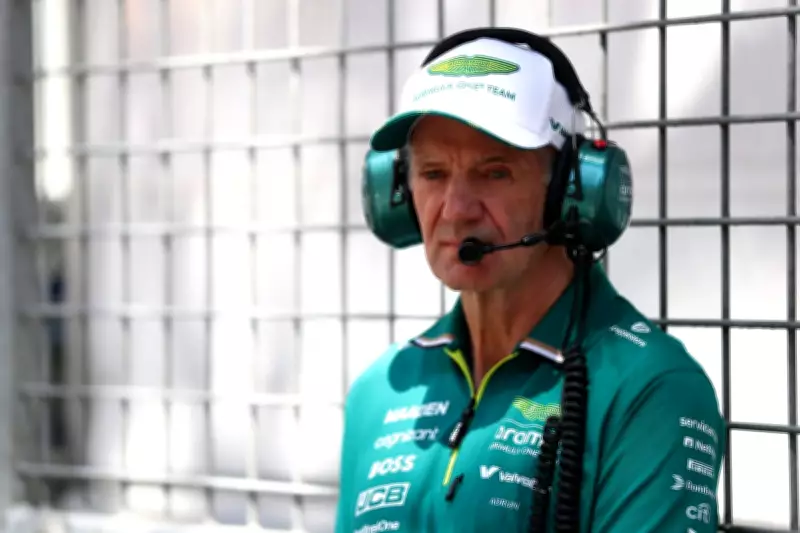
Adrian Newey Voices Uncertainty Over Aston Martin's Radical 2026 F1 Design
Formula 1 design legend Adrian Newey has openly admitted to harbouring doubts about the design philosophy behind Aston Martin's 2026 F1 car, following its dramatic and last-minute unveiling during pre-season testing in Barcelona. The revelation comes as the celebrated engineer discusses his unique approach for the first time since taking the helm as team principal.
A Dramatic and Unconventional Reveal
Aston Martin's new challenger, the AMR26, made a shock appearance on the penultimate day of last week's private pre-season test, having only featured for one full day. The car immediately stood out from the rest of the field with its highly distinctive features.
- A notably wider nose section
- Thin sidepods featuring a heavy undercut design
- A radically cut-away engine cover
This unconventional appearance has set the AMR26 apart from its competitors, signalling a bold departure from established design norms.

Navigating Uncharted Regulatory Waters
Newey, who made the high-profile move from Red Bull after two decades last March and assumed the team principal role at the end of the 2025 season, acknowledged the inherent uncertainty surrounding the sport's new engine and chassis regulations. The £20 million-a-year technical mastermind expressed caution about the path his team has chosen.
"With a completely new set of regulations, nobody is ever sure what the right philosophy is," Newey stated on Aston Martin's official website. "We certainly aren't sure what the best interpretation of the regulations is and therefore the best philosophy to follow."
He elaborated on the team's compressed development timeline, revealing that a model of the 2026 car did not enter their new wind-tunnel until April of the previous year. "That put us on the back foot by about four months, which has meant a very, very compressed research and design cycle," Newey explained. "The car only came together at the last minute."
A Holistic Approach Under Pressure
Newey described the design process as a holistic endeavour, focused on creating specific flow fields to suit the new regulations. "We took a really close look at the regulations and what we believe we want to achieve from a flow field perspective," he said. "From there we started to evolve a geometry that attempts to create the flow fields that we want."
However, he emphasised that the team had to commit to a direction despite the unknowns. "Because of our compressed timescale, we decided on a particular direction and that's the one we've pursued. Whether that proves to be the right one or not, only time will tell. But you have to choose your path and get on with it."
Swerving the 'Aggressive' Label
The radical design has led many observers to label Newey's approach as aggressive, particularly as he aims to propel drivers Fernando Alonso and Lance Stroll up the competitive order. Newey, however, distanced himself from such characterisations.
"I never look at any of my designs as aggressive. I just get on with things and pursue what we feel is the right direction," he asserted. "The direction we've taken could certainly be interpreted as aggressive. It's got quite a few features that haven't necessarily been done before. Does that make it aggressive? Possibly. Possibly not."
Instead, he framed the design as focused on long-term development potential. "We've attempted to build something that we hope will have quite a lot of development potential," Newey explained. "What you want to try to avoid is a car that comes out quite optimised within its window but lacks development potential. We've tried to do the opposite."
The Road Ahead to Melbourne
Despite the late reveal and admitted uncertainties, Newey expressed confidence in the team's efforts. "The team put in a huge amount of work to get the car ready," he said, acknowledging the nervous moment when any new car hits the track. "There's more to come – and lots to learn – but those first couple of days at the track have been important."

Aston Martin now faces a crucial testing period in Bahrain, with two scheduled windows from 11-13 February and 18-20 February, alongside the other ten teams. This provides a maximum of six days to refine the AMR26 before the 2026 season officially commences with the Australian Grand Prix in Melbourne on 8 March. The F1 world will be watching closely to see if Newey's radical gamble pays dividends in this new regulatory era.