Matt Weston's Ice-Cold Dominance Ends Team GB's Medal Drought with Skeleton Gold
The seventh day of the Winter Olympics, falling on Friday the 13th of February 2026, proved to be anything but unlucky for Team Great Britain. After a series of near-misses and morale-draining fourth-place finishes, the nation's medal curse was decisively broken by the ice-cool performance of skeleton racer Matt Weston in Livigno.
A Nation's Hopes Restored by Record-Shattering Runs
Team GB arrived at these Games with several medal favourites, but the pressure of Olympic competition had seen some struggle, with winter sports proving their capricious nature. The day began poorly as snowboarder Charlotte Bankes fell victim once again to her Olympic quarter-final curse. With anxiety swirling over the feasibility of UK Sport's target of four to eight medals, after what had been dubbed Blue Monday, Terrible Tuesday, and Worrying Wednesday, Matt Weston emerged as the nation's saviour.
The 28-year-old reigning world champion and World Cup winner has been the dominant force in skeleton over the last two seasons. Remarkably, he tore his quadriceps just eight weeks before the start of the 2025/26 season but returned in utterly imperious form, winning five of seven World Cup races and becoming the first British man to secure three overall titles. A three-time European champion, Weston approached the Olympic competition with ruthless determination.

Four Consecutive Track Records Seal Historic Victory
On the brand-new Olympic track in Cortina d'Ampezzo, where he had won the season's first World Cup, Weston delivered a performance for the ages. He broke the track record in each of his four runs, a feat never before accomplished in Olympic skeleton competition. Even after a minor error in his first heat on Thursday, he recovered to set blistering times.
In his second heat, he became the first slider to go under 56 seconds, taking a commanding three-tenths of a second advantage into Friday's final runs. His third heat produced a ludicrous time of 55.63 seconds, after which he celebrated briefly before resetting with laser focus. The BBC commentary team remarked that the rest of the field "may as well pack up and go home."
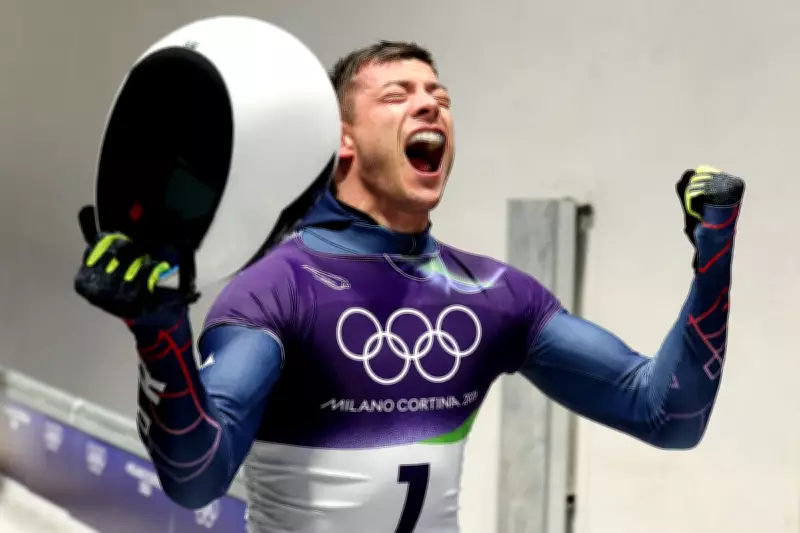
As temperatures dropped to -3 degrees Celsius, making the technical track faster, Weston took to the ice as the last of 24 sliders for his final run. True to form, he delivered another track record: an astonishing 55.61 seconds. His winning total time of 3:43.33 was 0.88 seconds quicker than his nearest rival and over a full second clear of the third-place finisher.
Emotional Celebration Caps Years of Preparation
When victory was confirmed, Weston collapsed to the ice in delight before leaping into his coach's arms. He dropped to his knees, roaring at the flag-waving British crowd in an emotional release of four years of pain, suffering, frustration, and ultimate elation. The 1,440 meters of ice, with its 16 curves and chicanes and 170-meter elevation drop, had been completely tamed by Britain's first-ever men's skeleton Olympic champion.
Germany's Axel Jungk, the Beijing silver medallist, took silver with a time of 3:44.21, while his compatriot and defending champion Christopher Grotheer claimed bronze in 3:44.30. Weston's teammate Marcus Wyatt finished ninth, 2.44 seconds behind the champion's benchmark time.
Weston's performance not only delivered Team GB's first gold medal of these Games but also demonstrated how Great Britain, not traditionally a winter sports nation, has become a disruptive force at elite level. His ability to bend the occasion to his will, remaking skeleton in his image through sheer dominance, has rewritten the record books and restored Olympic hope to a nation.