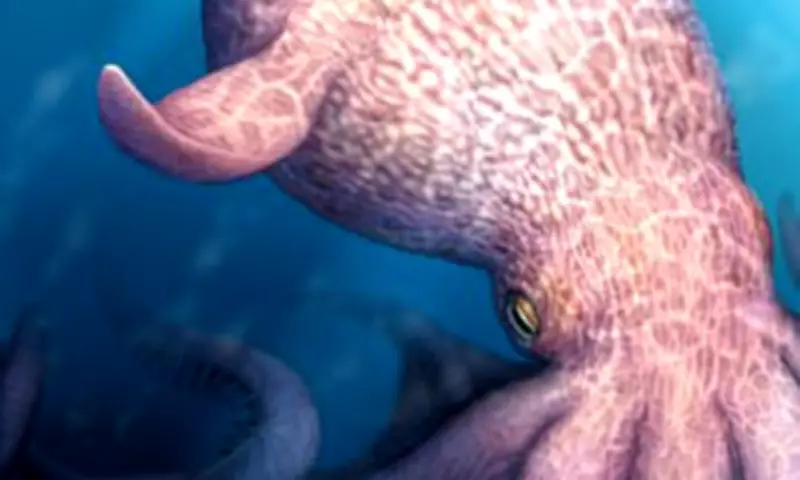
New research reveals that ancient oceans were once dominated by colossal octopuses, some measuring up to 62 feet (19 meters) in length. These creatures, which lived between 72 and 100 million years ago during the Late Cretaceous period, competed with—and possibly preyed upon—large marine apex predators such as the ferocious mosasaur.
Discovery of Giant Octopus Fossils
A team of scientists from Hokkaido University re-examined 15 large fossil jaws from ancient octopus relatives, identifying two new species. One of these, Nanaimoteuthis haggarti, exhibited extensive wear on its jaws, suggesting it was an active carnivore that routinely crushed hard shells and bones with powerful bites. The researchers believe these octopuses used their long, flexible arms to seize large prey while dismantling it with their strong beaks—a behavior linked to advanced intelligence.
The other newly discovered species, Nanaimoteuthis jeletzkyi, was also a predator but smaller, growing up to 26 feet (8 meters) in length.

Size Comparison
To put the size of N. haggarti into perspective: humans average 5 feet 6 inches (1.7 meters) tall, elephants reach around 10 feet (3 meters), and a London bus is about 36 feet (11 meters) long. The giant octopus would have eclipsed a bus, rivaling a sperm whale at 66 feet (20 meters) but falling short of a blue whale, which can grow up to 90 feet (27 meters).
Implications for Marine Ecosystems
The researchers noted that these findings suggest the two species were not merely prey but highly active participants in shaping marine ecosystems, occupying roles previously attributed only to large vertebrates such as sharks. The wear and tear on the fossilized jaws indicate dynamic crushing of hard skeletons, with long scratches distributed across wide areas reflecting the use of the entire jaw for dismantling prey.
Interestingly, the loss of jaw edges was uneven on each side, suggesting the octopuses had a preferred side for chewing—a trait linked to highly developed brain function and cognition. This indicates that the earliest octopuses already possessed advanced intelligence.
Comparison with Other Ancient Octopus-like Predators
Other ancient octopus-like predators include the oldest known ancestor of the vampire squid, which had extra-long suckers and hair-like strands on its arms used to trap prey. A research team from Sorbonne University in France used 3D imaging on a 164-million-year-old fossilized specimen, finding evidence of muscular suckers on the tips of two specialized long dorsal arms, suggesting active predatory hunting.
Octopus Defense Mechanisms
Modern octopuses employ various defense mechanisms, including camouflage through specialized pigment cells that allow them to control skin color and texture. They also use jet propulsion to escape predators, releasing ink to confuse enemies. Their powerful suckers drag prey toward a sharp beak. Recent studies have shown that octopuses can detect ultrasonic waves preceding volcanic eruptions or earthquakes, giving them time to escape.
The study concludes that long after the rise of vertebrate top predators, octopuses evolved body plans capable of rivalling them, as demonstrated by these giant Cretaceous species.