The Australian Open's Controversial 'Party Court'
For the remaining singles stars in the men's and women's draws at the Australian Open, there is no greater stage than the iconic Rod Laver Arena. The tournament's premier show court, named in honour of Australia's multiple Grand Slam champion, will host the remaining finals where players must contend with a boisterous home crowd, regardless of their opponent. British number one Jack Draper has highlighted what is required to perform well in front of an Australian audience, noting the need for a 'thick skin' after his 2025 encounter with home favourite Thanasi Kokkinakis.
From Quiet Court to Rowdy Venue
While playing on Rod Laver Arena brings its own immense pressures, nowhere at Melbourne Park demands thicker skin than on Court 6, the tournament's infamous 'party court'. Previously indistinguishable from other non-show courts, Court 6 underwent a dramatic transformation two years ago when tournament director Craig Tiley announced the creation of a courtside bar to provide an 'elevated experience' for fans.
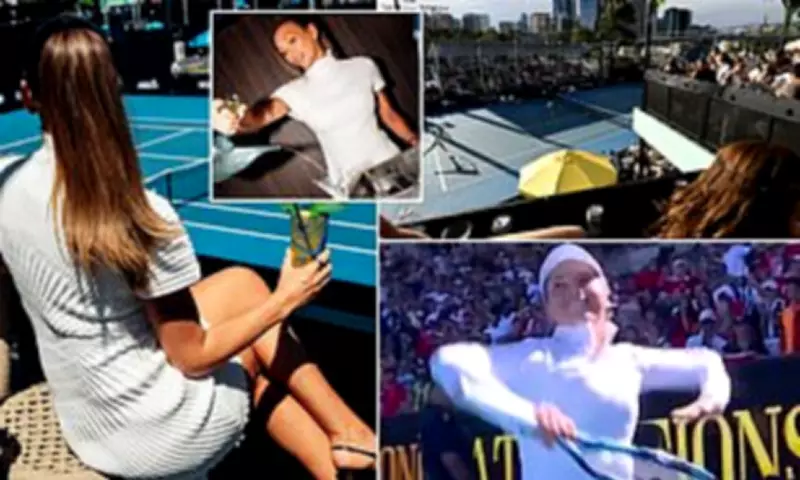
From the two-storey structure flanking the court, spectators and influencers alike can sip sponsored Grey Goose 'Lemon Ace' cocktails at AUD $23 (£11) each while enjoying snacks from Melbourne's Porcine Bistro. Tournament organisers aimed to attract a more refined clientele with high-end offerings including leek and lobster quiches (£16.80), tomato and cucumber salads (£10.62), and truffle honey custard tarts (£6.85).

Influencer Launch and Player Backlash
This year's bar offering launched the week before the tournament began with a special party for Melbourne-based influencers featuring roving caviar and fried chicken stations, Grey Goose bottle-toting waiters, and DJ sets as sunset fell over Melbourne Park. However, the reality of bringing bar-going fans closer to the action has created an atmosphere far removed from the hushed, respectful quiet of Wimbledon's hallowed lawns.
Yulia Putintseva, already known as one of the tour's bigger 'brats', was overwhelmed by the wall of sound and chatter within minutes of starting her first-round match against Brazil's Beatrice Haddad Maia. Her protests to the umpire proved catnip for fans, resulting in a chorus of boos from the crowd. Putintseva responded to her victory by shaking her body as if on a dancefloor and performing an exaggerated bow to the spectators, earning her the label of 'first-class s*** stirrer'.
Nightclub Comparisons and Player Complaints
French star Arthur Rinderknech, who played on Court 6 in 2024, described the venue as more akin to a nightclub than a setting for high-quality tennis. He took umbrage with the approximately 400 fans at the bar, shushing them repeatedly and nearly losing his temper completely when he fired a ball toward a ball kid.
In his post-match interview, Rinderknech alleged enduring a torrent of abuse from drunken spectators who shouted at him every time he missed his first serve. "I mean, we're playing in a nightclub," he added. "That's OK. I thought it was only at the US Open we could play in a nightclub. It was just food, drinks, laughing, talking, music, different music. Everything was happening on the court."
Growing Discontent Among Competitors
Other players have been less amused by the bar-side experience. Stefanos Tsitsipas complained that the hijinks of drinking spectators affected his concentration, while Paula Badosa went further, stating: "It's not very comfortable for the players to play there. In my opinion, I don't really like it because there's a lot of noise. I cannot listen to my team either if they want to say something or if I want to talk to them."
No player suffered worse during the bar's debut year than Anastasia Pavlyuchenkova, who during her defeat to Badosa endured particularly disturbing behaviour. "There were a couple of guys, I think they got drunk and they started to scream and meow at me," she complained. "It was really disturbing. It was not nice to be honest. I was really annoyed at the start of the match."

Organisers Undeterred by Criticism
Despite player complaints, tournament organisers remained undeterred, and the following year Court 6 appeared to have learned no lessons. If anything, conditions worsened. During British star Jacob Fearnley's match against Arthur Cazaux, the volume became so loud that another match on Court 8 between Felix Auger-Aliassime and Alejandro Davidovich Fokina had to be moved during their first set.
Fearnley himself appeared mostly unbothered by the hubbub after beating his French opponent, even acknowledging that most supporters for the late-night tie were 'extremely drunk'. "I actually didn't really look at the court before I went on, so when I saw the bar, I was thinking it's going to be a pretty rowdy atmosphere," Fearnley admitted. "But as I settled into the match, I kind of blocked it out as much as I could."
British Players Embracing the Atmosphere
Perhaps reflecting a uniquely British attitude toward public drunkenness, Fearnley did not seem overly ruffled by the experience. Fellow countryman Cameron Norrie even welcomed a return to Court 6 after his victory against Emilio Nava last week. "I would say it is the best atmosphere at the Australian Open," Norrie declared after bypassing the American in four closely contested sets. "The big question is: where's the after party?"
Norrie added that he 'could look anywhere, and someone was getting fired up' for him, demonstrating how some players can harness the unruly crowd and even use it against their opponents.
The Future of Grand Slam Commercialisation
Like it or loathe it, Court 6 appears here to stay. Just as the US Open has turned their custom Grey Goose 'Honey Deuce' cocktail into a tournament symbol alongside champions like Carlos Alcaraz or Jannik Sinner lifting trophies, the commercialisation of Grand Slams and their emphasis on fan experience will only continue growing.
Retired Australian tennis player John Millman noted after playing doubles on the court in 2024: "It's a sign that the times are changing a little bit. It's high entertainment, the consumers and the patrons are the ones that are paying the bills and I think the players have got to live with it. It's just the reality of playing tennis in this day and age."
For those players who cannot tolerate the heat, they must adapt to changing times and learn to block out the racket. As Alexander Bublik remarked when asked about the challenging Australian atmosphere: "No, you're fine. You should play a Frenchman at Bercy. I believe there's nothing like it. There's nothing at that level. You can't be as hated as when you play a Frenchman at Bercy."