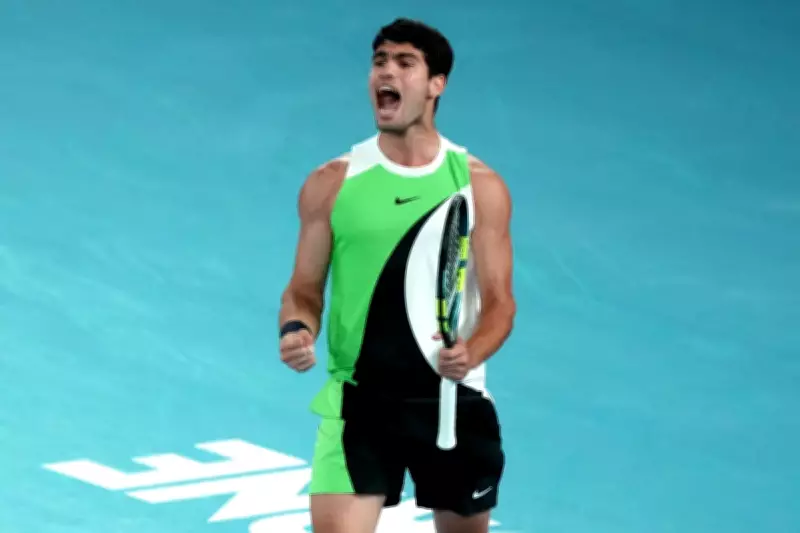
In a monumental clash that will be remembered for generations, Carlos Alcaraz has cemented his place among tennis's all-time greats by defeating Novak Djokovic to claim his first Australian Open title. This historic victory completes the career grand slam for the Spanish prodigy, making him the youngest man in history to achieve this remarkable feat at just 22 years and 272 days old.
A Seismic Final with Historic Stakes
The stage was set for an epic confrontation at Melbourne's Rod Laver Arena, with both players carrying immense historical weight on their shoulders. For Djokovic, the match represented an opportunity to secure a record-breaking 25th grand slam singles title and become the oldest champion in history at 38 years old. For Alcaraz, it was the chance to complete his collection of major titles and etch his name into the record books.
After dropping the first set 2-6, Alcaraz demonstrated the resilience and shot-making brilliance that has defined his rapid ascent through the tennis ranks. He stormed back to take the next three sets 6-2, 6-3, 7-5, overcoming Djokovic's formidable challenge in a match that showcased the very best of modern tennis.

Joining Tennis's Most Exclusive Club
With this victory, Alcaraz joins an illustrious group of just nine men who have completed the career grand slam in the Open Era. He surpasses Rafael Nadal's previous record as the youngest to achieve this milestone, beating his compatriot's mark by more than a year. The full list of career grand slam champions now includes:
- Carlos Alcaraz: 22 years 272 days (2026 Australian Open)
- Don Budge: 22 years 363 days (1938 French Championships)
- Rod Laver: 24 years 32 days (1962 US National Championships)
- Rafael Nadal: 24 years 102 days (2010 US Open)
- Fred Perry: 26 years 15 days (1935 French Championships)
- Roy Emerson: 27 years 244 days (1964 Wimbledon Championships)
- Roger Federer: 27 years 303 days (2009 Roland Garros)
- Novak Djokovic: 29 years 15 days (2016 Roland Garros)
- Andre Agassi: 29 years 68 days (1999 Roland Garros)
Fittingly, Nadal himself was present in the front row to witness his countryman's historic achievement, symbolizing the passing of the torch between Spanish tennis legends.
Overcoming Physical and Emotional Challenges
Both finalists faced extraordinary physical challenges coming into the championship match. Alcaraz had endured a marathon five-hour, twenty-seven-minute semi-final against Alexander Zverev - the third-longest match in Australian Open history. Djokovic had similarly battled through an epic four-hour, nine-minute contest against Jannik Sinner that finished well after midnight, leaving him with minimal recovery time.
Alcaraz also navigated significant emotional turbulence, having recently parted ways with his long-time coach Juan Carlos Ferrero during the off-season. "It was a little bit rollercoaster, emotionally, what we went through," the champion acknowledged, praising his support team for helping him maintain focus amid the distractions.
The Match That Defined a Generation
Djokovic began the final in blistering form, serving with precision and striking powerful forehands reminiscent of his semi-final performance. He claimed the first set with just four unforced errors in thirty-nine minutes of dominant play. However, the momentum shifted dramatically in the second set as Alcaraz began to control the baseline exchanges and Djokovic's serving accuracy diminished.
The match featured several pivotal moments that will be replayed for years to come. In the third set, Alcaraz produced a magical response to a Djokovic backhand winner around the net post, retrieving a seemingly impossible ball from the baseline and breaking serve to move within one set of history.
The fourth set saw Djokovic mount a courageous comeback attempt, saving six break points in a grueling twelve-minute service game and later creating break point opportunities of his own. But Alcaraz demonstrated the mental fortitude that has become his trademark, withstanding the pressure and closing out the match with a spectacular twenty-four-shot rally that showcased his finest ball-striking of the contest.

Mutual Respect Between Champions
Following the match, Djokovic offered gracious praise for his young opponent, describing Alcaraz's achievement as "historic, legendary" and predicting many more encounters between them in the coming decade. The Serbian champion acknowledged the significance of the moment while expressing optimism about their future rivalry.
For Alcaraz, the victory represented the culmination of years of dedication and hard work. "Nobody knows how hard I've been working to get this trophy, to chase this moment," he reflected emotionally after the match. His simple social media message captured the magnitude of his accomplishment: "Job finished. 4/4 completed."
This Australian Open triumph not only completes Alcaraz's career grand slam but also establishes him as the dominant force in men's tennis for the foreseeable future. By defeating the greatest player of all time in a grand slam final for the third time and ending Djokovic's perfect record in ten previous Australian Open finals, Alcaraz has firmly announced his arrival at the pinnacle of the sport.