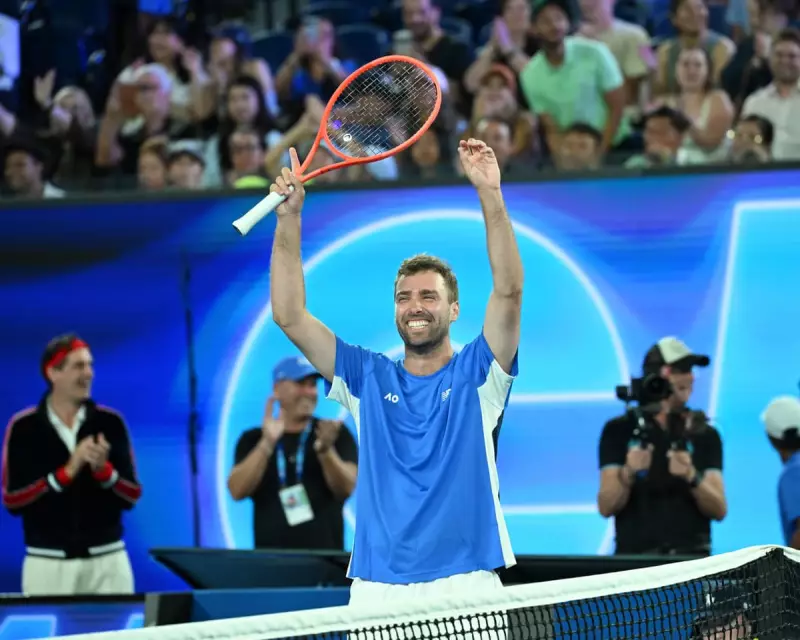
In a stunning upset that captivated the Rod Laver Arena crowd, a 29-year-old tennis coach from Sydney has become an overnight millionaire by winning the Australian Open's inaugural One Point Slam. Jordan Smith, a former US college player, defeated a field featuring the likes of Jannik Sinner, Carlos Alcaraz, and Iga Swiatek to claim the unprecedented A$1 million prize on Wednesday.
A New Format Captivates Melbourne Park
The real winner of the evening, however, may have been Tennis Australia itself. The governing body's bold new concept, despite a sometimes confusing format and a duration stretching close to three hours, succeeded in drawing a full house during the tournament's opening week. The event represents a clear push by organisers to explore non-traditional avenues for attracting fans to Melbourne Park.
The knockout tournament's unique premise was simple yet dramatic: every match was decided by a single, winner-takes-all point. To level the playing field for amateur participants, professional players were restricted to just one serve. The server for each decisive point was determined by a quick game of rock-paper-scissors, adding a layer of unpredictable theatre to the proceedings.

The Fairytale Run of Jordan Smith
Smith's victory, which included a third-round win over world number four Jannik Sinner, cut through the event's promotional gloss with a genuine human story. The former player, whose career-high ATP ranking was 1,141 and who now works at his family's tennis academy, was visibly overwhelmed. "I can't even speak, it's unbelievable," he said at the night's conclusion, pledging to invest the life-changing sum or buy property in Sydney's expensive market—a prospect he had earlier joked might only secure him "half a house."
His family and girlfriend, who light-heartedly requested half the prize money mid-event, provided a relatable and emotional core, momentarily relegating the sport's global superstars to supporting roles. The contrast in perspectives was highlighted when professional player Donna Vekic was asked about the prize; she simply replied, "I like diamonds."
Format Highlights and Growing Pains
The 48-player field was a eclectic mix, with half being current professionals—headlined by Carlos Alcaraz and Coco Gauff—and the other half comprising local celebrities and qualifiers like Smith. Notable participants included breakfast TV hosts, a former jockey, Nick Kyrgios, and Taiwanese megastar Jay Chou, who had pledged to donate the prize to charity before losing in the first round.
The experimental format, likened by some to a 'TikTokification' of tennis, showed both potential and rough edges. A significant number of first-round matches ended with service faults, and the evening's pacing was often slowed by awkward exchanges with an on-court MC and frequent commercial breaks. By the final, nearly a quarter of the seats had emptied.
Yet, it demonstrated genuine appeal. Unlike traditional 'Battle of the Sexes' exhibitions, women were given no special advantages, and six reached the quarter-finals on merit. A thrilling point between Iga Swiatek and Flavio Cobolli was hailed as the best tennis of the night.
Most professionals embraced the spectacle. Alexander Zverev called it a "brilliant" experiment to try "before it gets serious," while Elena Rybakina remarked on the "unbelievable" turnout. The final itself saw Smith face Taiwan's world No. 117, Joanna Garland, who had won over the crowd with her gracious demeanour. Her pre-final comment—"there are three winners here tonight: one is tennis, the others are me and him"—perfectly captured the event's spirit.
In the end, the pressure of the single serve proved decisive, with most players opting to receive. The exception was France's Arthur Rinderknech, who faulted with a huge serve and declared, "Go big or go home… I go home," before exiting the arena to laughter. For Jordan Smith, however, the gamble of a lifetime paid off in spectacular fashion, writing a modern fairytale in the heart of Rod Laver Arena.