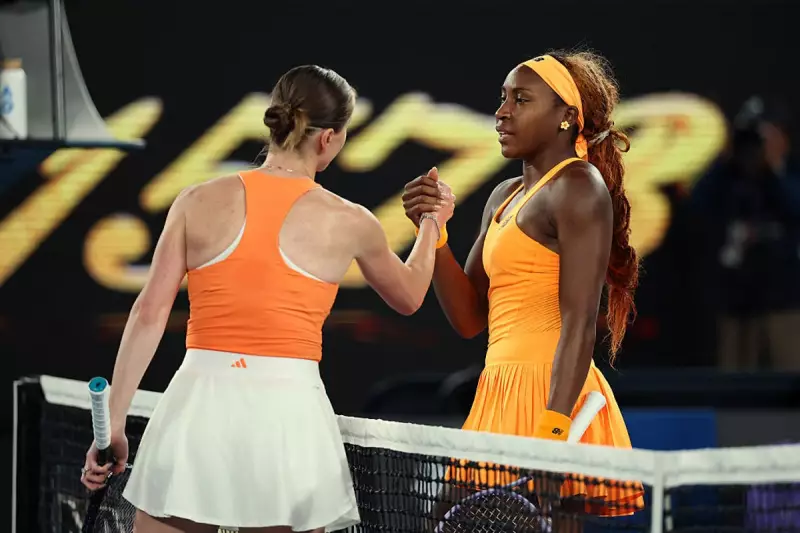
American tennis star Coco Gauff has voiced significant frustration over what she perceives as a serious invasion of privacy at the Australian Open. The incident occurred after her comprehensive quarter-final defeat to Ukraine's Elina Svitolina, when footage of Gauff smashing her racket in a private area was broadcast to the public.
A Day to Forget on Court
The world number three endured a brutally difficult match on Rod Laver Arena, succumbing to a 6-1, 6-2 defeat in just fifty-nine minutes. Gauff's game completely unravelled against the precise and aggressive play of the twelfth seed, resulting in a staggering twenty-six unforced errors from the French Open champion. The twenty-one-year-old was visibly distressed throughout the contest as her usually reliable groundstrokes repeatedly failed her.
Private Moment Made Public
Seeking a moment of solitude after the match, Gauff believed she had found a private space away from the public eye. In an attempt to release her mounting frustration, she repeatedly smashed her racket against a concrete ramp. Unbeknownst to her, this area was fitted with the tournament's extensive network of behind-the-scenes cameras, which captured the entire incident.

The footage was quickly broadcast by television networks and proliferated across social media platforms, drawing immediate attention and commentary. This has ignited a fresh debate about the boundaries of athlete privacy in modern sports broadcasting, particularly concerning moments of raw emotion away from the competitive arena.
History Repeats Itself
This is not the first time such an incident has occurred involving Gauff and broadcast ethics. Following her victory over Aryna Sabalenka in the 2023 US Open final, similar footage emerged showing Sabalenka smashing her racket in a training room. That broadcast was criticised at the time by prominent tennis figure Judy Murray, who questioned the necessity of airing such private moments.
Gauff directly referenced this precedent in her post-match comments, highlighting a concerning pattern. "I kind of have a thing with the broadcast," Gauff explained. "I feel like certain moments - the same thing happened to Aryna after I played her in final of US Open - I feel like they don't need to broadcast."
Athlete's Perspective on Emotional Release
The young champion was candid about her emotional state and the reasoning behind her actions. "I tried to go somewhere where I thought there wasn't a camera, because I don't necessarily like breaking rackets, but I lost [6-1 and 6-2]," she stated. Gauff emphasised that she consciously avoids such displays on court, particularly in view of younger fans, considering it a poor representation of sportsmanship.
She revealed that after breaking a racket during a previous French Open match, she had vowed never to repeat the act in public view. "I said I would never do it again on court, because I don't feel like that's a good representation," Gauff recalled.
Calls for Privacy Reform
Gauff's experience has prompted her to call for clearer boundaries regarding athlete privacy at major tournaments. "Maybe some conversations can be had," she suggested, "because I feel like at this tournament the only private place we have is the locker room." This statement underscores the increasingly limited spaces where players can experience genuine privacy amidst the omnipresent media coverage of modern grand slam events.
Technical Analysis of the Defeat
Reflecting on the match itself, Gauff did not shy away from analysing her performance honestly. "I just felt like all the things I do well, I just wasn't doing well today," she admitted. "The backhand wasn't firing. Forehand wasn't really firing. Returns. There was just a lot that didn't go well today."
She generously credited Svitolina's exceptional performance, acknowledging that her opponent's relentless pressure forced the errors. "I credit it to her because she forced me to play like that. It's not like I just woke up and, yeah, today was a bad day, but bad days are often caused by your opponent. So she did well."

The Importance of Emotional Venting
Gauff defended her need to release frustration in a controlled manner, arguing it prevents negative emotions from affecting her support team. "I don't think it's a bad thing," she asserted. "Like I said, I don't try to do it on court in front of kids and things like that, but I do know I need to let out that emotion."
She explained that containing such powerful emotions would likely make her "snappy with the people around me," and she wishes to avoid unfairly taking her frustrations out on her team. "They're good people. They don't deserve that, and I know I'm emotional," Gauff reflected. "They did their best. I did mine. Just need to let the frustration out."
This incident raises profound questions about the balance between providing behind-the-scenes access for fans and respecting the private, emotionally charged moments of elite athletes. As broadcasting technology becomes increasingly pervasive, the tennis world may need to establish clearer guidelines to protect players during their most vulnerable moments away from competitive play.