Tournament Protocol Proves Decisive as Sinner Escapes Melbourne Furnace
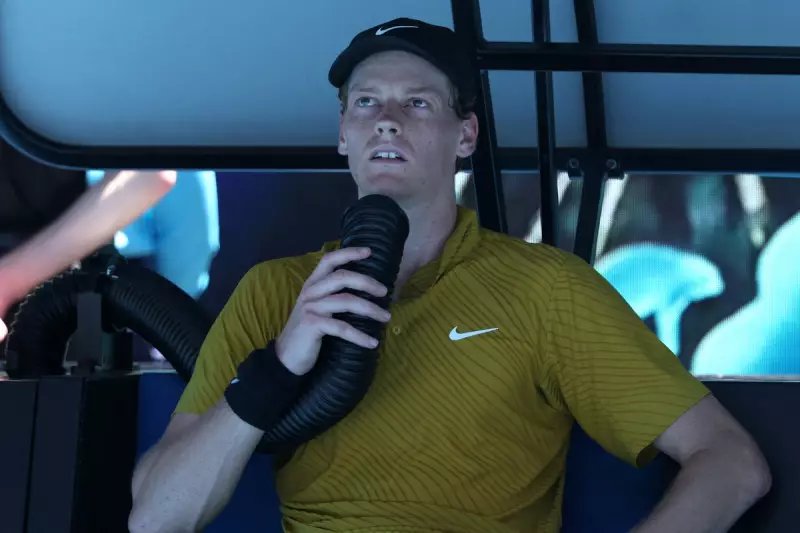
Defending champion Jannik Sinner experienced a remarkable reprieve at the Australian Open, with specific tournament regulations intervening at a critical moment to prevent what appeared to be an imminent shock exit. The Italian second seed, pursuing his third consecutive Melbourne title, found himself in severe physical distress during his third-round encounter against American qualifier Eliot Spizzirri, only for the competition's heat stress scale to trigger crucial relief measures.
Melbourne's Sweltering Conditions Test Champion's Limits
The match unfolded during the hottest period of the tournament fortnight, with temperatures soaring towards 40 degrees Celsius. Organisers had already implemented precautionary measures, bringing forward start times on the main showcourts by one hour in anticipation of extreme conditions. Sinner took to Rod Laver Arena shortly after midday, entering what would become an increasingly punishing environment.
The Italian's physical struggles became alarmingly apparent during the third set, with his movement visibly compromised by cramping that affected multiple muscle groups. After calling for medical treatment to address issues with his right calf, Sinner's difficulties intensified dramatically during the fourth game of the set, leaving him racked with pain and conceding a break of serve to trail 3-1.

Precise Timing of Heat Rule Intervention
At that exact moment, the tournament's sophisticated heat monitoring system registered a critical threshold. The heat stress scale, which calculates multiple environmental factors including air temperature, radiant heat, humidity and wind speed, ticked from 4.9 to the decisive level of five. This automatic trigger mandated the immediate closure of the retractable roof on Rod Laver Arena and activated the venue's air conditioning systems.
The timing proved extraordinarily fortunate for the struggling champion, who acknowledged afterwards that he "got lucky with the heat rule and the roof closing." His opponent Spizzirri responded to the intervention with a wry smile, recognising the significant shift in circumstances that had just occurred.
Dramatic Recovery in Controlled Environment
With conditions suddenly transformed from outdoor furnace to climate-controlled indoor arena, Sinner's prospects underwent a remarkable reversal. The Italian immediately broke back upon the resumption of play, capitalising on the changed environment to regain momentum. A crucial double fault from Spizzirri later in the set handed Sinner another break opportunity that would prove decisive.
Further recovery time arrived between sets as tournament protocols mandated a ten-minute heat break, providing additional opportunity for Sinner to address his physical issues. Though he continued to experience discomfort, his movement showed gradual improvement throughout the fourth set, enabling him to recover from another deficit to secure a hard-fought 4-6, 6-3, 6-4, 6-4 victory.
Historical Context of Sinner's Heat Vulnerabilities
This episode highlighted a known vulnerability in the champion's game, with Sinner having previously struggled in similar extreme conditions. During last year's Australian Open, his most challenging match came against Holger Rune in similarly hot weather. More recently, his last defeat on tour occurred in Shanghai last October when he was forced to retire against Tallon Griekspoor due to cramping issues.
The Italian reflected candidly on this aspect of his game, stating: "This is the sport, I know this is an area where I need to improve. Tennis is a very mental game, I just tried to stay as calm as possible. I'm here to fight."
Wider Tournament Impact of Extreme Conditions
The challenging weather affected multiple matches across the Melbourne Park complex. Play was suspended on all outdoor courts shortly after 2:30pm local time, with competitions not resuming for nearly five hours. This disruption proved particularly cruel for British junior Hollie Smart, who was forced to retire from her girls' singles match while leading in the third set after becoming completely overcome by cramping.

Meanwhile, Sinner's compatriot Lorenzo Musetti demonstrated greater resilience to the conditions, battling through a five-set marathon against Tomas Machac that lasted four hours and twenty-seven minutes. This victory helped create a historic moment for Italian tennis, with three men from the nation reaching the Australian Open fourth round simultaneously for the first time.
Opponent's Perspective on Critical Intervention
Spizzirri, competing in his first Australian Open main draw, offered a gracious assessment of the pivotal moment, suggesting: "I wouldn't say he got saved by it. He's too good of a player to say that but, at the same time, it was challenging timing, and that's just the nature of the sport." The American acknowledged smiling when the heat rule came into effect, recognising the extraordinary coincidence of its timing.
Sinner now advances to face fellow Italian Luciano Darderi in the fourth round, having survived what he described as one of those "tough matches" that characterise every major tournament. The champion expressed hope that this dramatic escape might provide positive momentum as he continues his title defence in Melbourne.