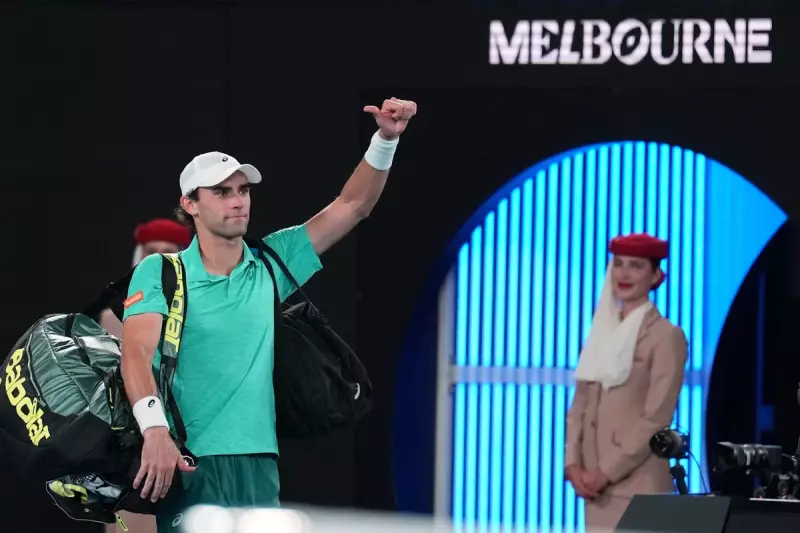
Eliot Spizzirri has acknowledged the "funny timing" of the Australian Open's extreme heat rule but accepted its application after his loss to Jannik Sinner in a dramatic third-round match. The American was leading a struggling Sinner when the rule was enforced, leading to a significant shift in momentum that ultimately saw the two-time defending champion advance.
A Crucial Break and an Untimely Pause
Spizzirri knew the extreme heat rule would come into effect regardless of the outcome in the third game of the third set. Despite this, he broke Sinner's serve to take a 3-1 lead, gaining confidence and momentum just as the eight-minute break began for the roof closure over Rod Laver Arena.
After the interruption, the match dynamics changed entirely. Sinner, who had been staggering with cramps and appeared completely distracted before the interval, remarkably regained his composure. This recovery continued through a subsequent 10-minute "cooling break" before the fourth set, allowing him to secure a 4-6, 6-3, 6-4, 6-4 victory and advance to the round of 16.

Social Media Backlash and Player Reactions
The timing of the roof closure sparked considerable backlash on social media, with many fans and commentators questioning its impact on the match's outcome. Sinner later admitted he might have been fortunate with the rule's timing, adding to the controversy.
However, Spizzirri adopted a pragmatic approach to the situation. "Yeah, I don’t know if he got saved by it," the 24-year-old said. "I smiled a little bit when the heat rule went into effect, just because it was kind of funny timing as I went up 3-1. But at the same time, you know, the game at 2-1 in the third set was when the heat scale hit 5.0."
He elaborated further, noting: "So whenever that game was over, whether I broke or whether he held, we were going to close the roof. It was just funny that right when I broke and he was wobbling, that it happened to happen that way."
Rules Are Rules: A Matter-of-Fact Acceptance
Spizzirri emphasised his acceptance of the tournament regulations, stating simply: "That’s the rules of the game. And, you know, you got to live with it." He referenced Sinner's previous recovery under similar circumstances against Holger Rune at a past Australian Open, suggesting the world No. 2 had developed effective strategies to combat cramps.
Experience in Extreme Conditions
Having played college tennis in Texas, Spizzirri noted that conditions he experienced in Austin and Florida were often worse than Saturday's dry, hot day in Melbourne. On the professional tour, he recalled playing in China last year where court temperatures soared to 123 degrees Fahrenheit (51 Celsius).
"I don’t think it was even ballpark close to that today," said Spizzirri, who made his main draw debut at Melbourne Park this year. "So, yeah, I felt pretty fresh, to be honest, and felt like I could have gone a lot longer."
The temperature reached around 35 degrees Celsius (95 Fahrenheit) when the tournament’s heat scale hit its maximum level of 5, slightly below the forecasted 40 degrees Celsius (104 Fahrenheit).
Support for Player Protection Measures
While confident in his ability to perform in extreme heat, Spizzirri expressed support for the tournament's protective rules. "I’ve played in way worse conditions. I’ve trained in way worse conditions. In college we played in brutal conditions at times in Austin," he reflected. "Maybe that’s just a good thing to have under my belt."
He added a broader perspective on player welfare: "But at the same time, this rule is protection for us. I think it will hopefully promote guys to stay healthier for a longer period of time throughout the season, because playing these matches in this heat for an extended period of time over and over, day after day, is really tough on the body."
The match highlighted the ongoing challenges and debates surrounding heat management in professional tennis, particularly at Grand Slam events like the Australian Open where extreme weather conditions are not uncommon.