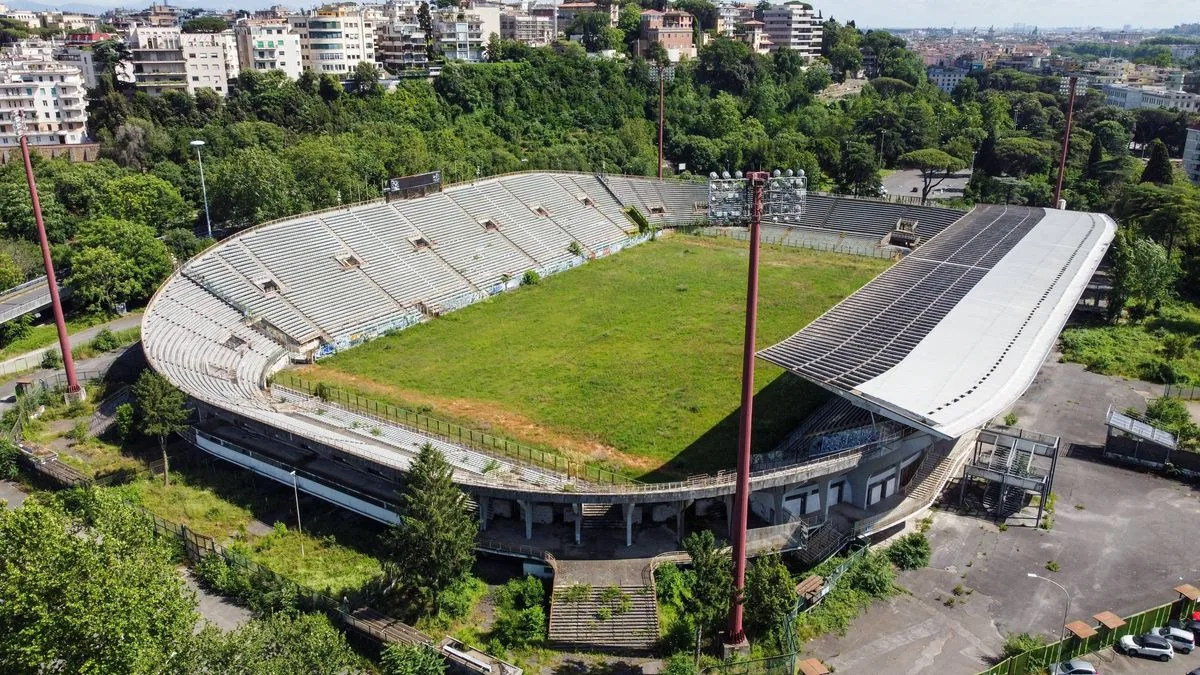
Abandoned Six Nations Stadium Crumbles as Nature Reclaims Historic Rome Venue
Abandoned Six Nations Stadium Crumbles in Rome

The Eerie Decline of Rome's Historic Rugby Arena

Once a bustling hub of international rugby, Italy's Stadio Flaminio now stands as a haunting relic of sporting history. The 30,000-capacity stadium in Rome, which hosted Six Nations fixtures for more than a decade, has been completely abandoned and left to crumble into disrepair. Recent images reveal the venue in tatters, with nature slowly reclaiming the concrete structure that once echoed with the cheers of passionate fans.

A Stadium Built for Olympic Glory

The Stadio Flaminio first opened its gates in 1959, constructed specifically for the 1960 Summer Olympics held in Rome. While originally designed as a football venue, its destiny changed dramatically in 2000 when it became the home of Italian rugby union, coinciding perfectly with Italy's entrance into the prestigious Six Nations Championship. For twelve years, this historic arena served as the battleground for some of European rugby's most memorable contests.

During its active rugby period, the Stadio Flaminio remained the tournament's smallest venue, creating an intimate atmosphere that players and fans cherished. However, this very intimacy ultimately led to its downfall when Italian rugby authorities decided to relocate major international fixtures to the substantially larger Stadio Olimpico nearby. The last rugby match was played here in 2012, and since that departure, the stadium has deteriorated at an alarming rate.

Memorable Matches and Historic Moments

The stadium witnessed numerous significant rugby encounters during its heyday. Wales first played at the venue in April 2001, just one year after Italy entered the Six Nations. In that inaugural match, the Welsh team claimed a hard-fought 33-23 victory, with Gareth Cooper scoring once and Scott Gibbs crossing the line twice to secure the win.

Italy celebrated their first-ever victory against Wales at the Flaminio in 2003, a triumph they managed to replicate four years later in 2007. Wales themselves clinched victory at the venue three more times, making their overall record four wins and two losses at what is now a deserted arena. Other notable matches include Italy's 34-20 victory over Scotland in their inaugural Six Nations match at the stadium in 2000, as well as a thrilling 23-20 win over the Scots in 2008, courtesy of a last-minute drop goal by Andrea Marcato.

Beyond Rugby: A Multi-Purpose Venue

The Stadio Flaminio's history extends far beyond rugby union. During the 1989-1990 Serie A season, both Roma and Lazio used it as a temporary home while renovations were underway at the Stadio Olimpico. The stadium also hosted legendary music acts, with David Bowie performing to a crowd of 45,000 fans in 1987, while Pink Floyd and Bruce Springsteen have also graced its stage.

Despite undergoing refurbishment in 2008, the Stadio Flaminio has sadly fallen into severe disrepair since rugby matches and regular concerts ceased. YouTube footage reveals how weeds and plants have slowly reclaimed the site over recent years, creating an eerie atmosphere where sporting glory once reigned supreme.

Hope for Regeneration

By 2021, there were initial indications that redevelopment might be on the cards for the abandoned venue. In December 2024, Lazio president Claudio Lotito presented Rome's Mayor with a long-awaited proposal that could breathe new life into the crumbling structure. The ambitious plan proposes transforming the Stadio Flaminio into a dedicated 40,000-50,000-capacity ground for the historic football club.

While Lazio presently share the Stadio Olimpico with cross-city rivals Roma, the new proposal features a dedicated stadium complete with a retractable roof and significant regeneration of the wider neighbourhood. Rome's mayor welcomed the initial blueprints, stating that the project appeared beautiful and would be examined in detail through proper administrative procedures.

At the club's 126th anniversary celebrations earlier this year, Lotito announced that the £370 million scheme to reconstruct the stadium represents a 'top priority', suggesting three years constitutes a 'reasonable timeframe' for work to commence. For now, however, the Stadio Flaminio remains a ghost of its former self—a silent testament to the passage of time and changing sporting priorities in the Italian capital.