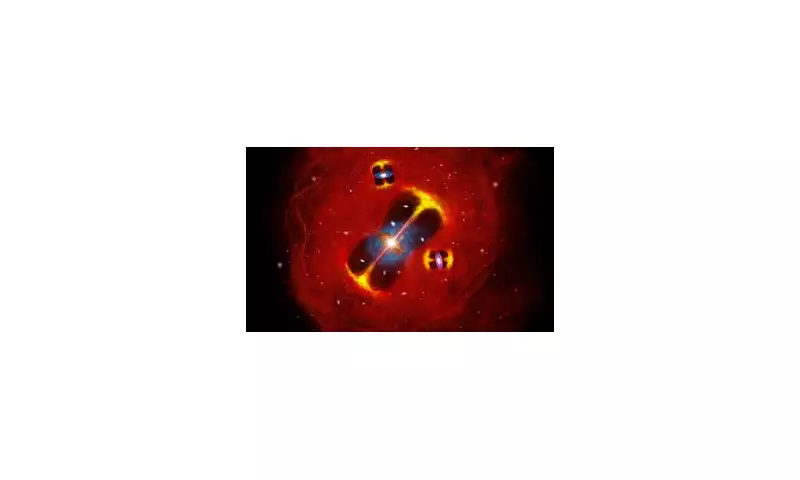
A colossal cosmic discovery is challenging fundamental theories of how the universe evolved. Astronomers have identified a galaxy cluster so young and so extraordinarily hot that it appears to possess 'something the universe wasn’t supposed to have'.
A Cosmic Toddler Defying the Laws
The galaxy cluster, known as SPT2349-56, was observed as it existed a mere 1.4 billion years after the Big Bang. Using the powerful Atacama Large Millimeter/submillimeter Array (ALMA) of telescopes, scientists peered 12 billion years into the past to study this infant structure. What they found was astonishing: the superheated gas filling the space between its galaxies, known as the intracluster medium, was burning at a temperature at least five times hotter than any leading cosmological model predicted for that epoch.
Dazhi Zhou, a PhD candidate at the University of British Columbia and co-author of the study published in Nature, expressed profound scepticism that turned to awe. 'We didn’t expect to see such a hot cluster atmosphere so early in cosmic history,' Zhou stated. 'In fact, at first I was sceptical about the signal as it was too strong to be real. But after months of verification, we’ve confirmed this gas is at least five times hotter than predicted.'

The Engine Behind the Inferno
Galaxy clusters are the universe's largest gravitationally bound structures, containing hundreds or thousands of galaxies, vast amounts of dark matter, and clouds of gas heated to hundreds of millions of degrees. Conventional wisdom held that this intracluster plasma heated up gradually over billions of years as immature clusters collapsed inward under gravity, reaching stable, mature states.
The discovery of SPT2349-56's extreme heat so early shatters that timeline. The cluster's core already spans over 500,000 light-years and hosts more than 30 ferociously active galaxies, birthing stars thousands of times faster than our Milky Way. The leading hypothesis for its unexpected furnace-like conditions points to a trio of cosmic powerhouses: supermassive black holes.
'We suggest it could be related to the three recently discovered supermassive black holes in the cluster,' explained co-author Professor Scott Chapman of Dalhousie University. These behemoths, each with masses at least 100,000 times that of our Sun, appear to have been 'already pumping huge amounts of energy into the surroundings and shaping the young cluster, much earlier and more strongly than we thought.'
Rewriting the Early Universe
This finding adds to a growing body of evidence that the infant universe was far more explosive and dynamic than previously imagined. It follows last year's James Webb Space Telescope discovery of a supermassive black hole growing inside a galaxy just 570 million years after the Big Bang, which was also disproportionately large for its host galaxy.
These observations suggest black holes in the early cosmos may have grown at breakneck speeds, outpacing their host galaxies and violently influencing their environments from the very beginning. 'Understanding galaxy clusters is the key to understanding the biggest galaxies in the universe,' Professor Chapman emphasised. 'Their evolution is heavily shaped by the very strong environment of the clusters as they form.'
The discovery of SPT2349-56 forces a major rethink of cosmic evolution models. It indicates that the processes which create the searing-hot atmospheres of modern galaxy clusters were already in full swing when the universe was only a tenth of its current age, potentially driven by the precocious and overwhelming influence of supermassive black holes.