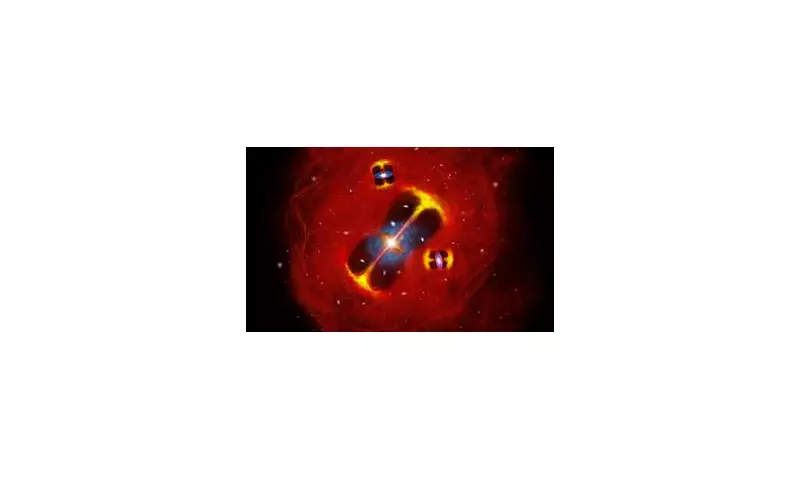
A groundbreaking astronomical discovery has thrown our understanding of the cosmos into question, as scientists have detected a galaxy cluster so hot and so young it defies all expectations. This 'baby cluster', observed just 1.4 billion years after the Big Bang, is burning at temperatures five times higher than current models predicted.
A Cosmic Anomaly Challenges Established Theory
The research, published in the prestigious journal Nature, centres on a distant cluster designated SPT2349-56. Using the powerful Atacama Large Millimeter/submillimeter Array (ALMA) observatory, an international team peered 12 billion years into the past. They found a cluster that, while still in its formative and unstable youth, was already colossal, with a core spanning over 500,000 light-years.
Within this infant structure, more than 30 hyperactive galaxies are producing stars at a rate over 5,000 times faster than our own Milky Way. But the real shock came when scientists measured the temperature of the superheated gas—known as the intracluster medium—that fills the spaces between the galaxies.

"We didn’t expect to see such a hot cluster atmosphere so early in cosmic history," said co-author Dazhi Zhou, a PhD candidate at the University of British Columbia. "In fact, at first I was sceptical about the signal as it was too strong to be real."
The Fiery Culprit: Supermassive Black Holes
Established theory suggested that such extreme heat, reaching hundreds of millions of degrees, only develops later as a mature cluster's gravity pulls galaxies together. This new finding suggests the early universe was far more explosive and energetic than previously imagined.
So, what is generating this immense, unexpected heat? The researchers point to a likely source: three recently discovered supermassive black holes lurking within the cluster's depths. These cosmic behemoths, with masses at least 100,000 times that of our Sun, are thought to be pumping vast quantities of energy into their surroundings.
"These black holes were already pumping huge amounts of energy into the surroundings and shaping the young cluster, much earlier and more strongly than we thought," explained co-author Professor Scott Chapman of Dalhousie University.
Rewriting the Story of Cosmic Evolution
This discovery aligns with a growing body of evidence suggesting supermassive black holes grew at an astonishing rate in the universe's infancy. Last year, the James Webb Space Telescope spotted a supermassive black hole growing in a galaxy a mere 570 million years after the Big Bang, far larger than its host galaxy should allow.
Professor Chapman emphasises the importance of this line of inquiry: "Understanding galaxy clusters is the key to understanding the biggest galaxies in the universe. Their evolution is heavily shaped by the very strong environment of the clusters as they form."
The existence of this scorching hot 'baby cluster' forces astronomers to reconsider the models of how the largest structures in the cosmos assemble and evolve. It paints a picture of a primordial universe where titanic forces, driven by ravenous black holes, shaped galaxies at a breakneck pace, rewriting the first chapters of cosmic history.