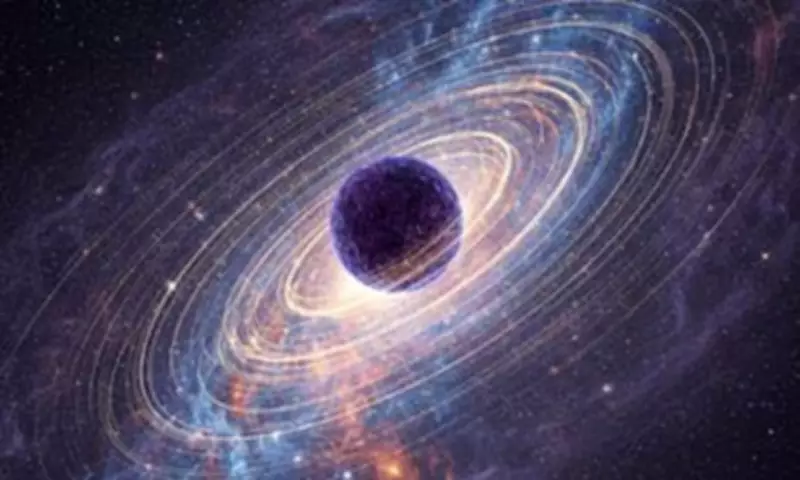
Milky Way's Core May Be Dark Matter, Not Black Hole, Scientists Claim
In a groundbreaking shift, scientists are challenging the long-held belief that a supermassive black hole resides at the centre of the Milky Way. Instead, they propose that our galaxy might rotate around an enormous clump of mysterious dark matter. This alternative theory, put forward by researchers from the Institute of Astrophysics La Plata, could redefine our understanding of galactic structure and dynamics.
Rethinking Galactic Fundamentals
Traditionally, astrophysicists have explained the Milky Way's behaviour through two key components: a supermassive black hole at its core and a diffuse halo of dark matter. The black hole's immense gravity accounts for the rapid orbits of S-stars, which whirl around the galactic centre at thousands of kilometres per second. Meanwhile, the gentle gravitational pull from the dark matter halo is thought to prevent the galaxy's rotation from slowing dramatically towards its outer edges.
However, the new study suggests these phenomena might stem from a single, continuous substance. Dark matter, an invisible material estimated to constitute over a quarter of the universe, could form a super-dense core enveloped by a diffuse halo, acting as a unified entity. This model aims to bridge vastly different scales, from the violent motions near the core to the galaxy's overall gentle rotation.

The Fermion Dark Matter Hypothesis
The key to this theory lies in a specific form of dark matter composed of particles called fermions—extremely light subatomic particles. In theory, these fermions could coalesce into a compact, dense core surrounded by an outer halo. Dr Carlos Argüelles, study co-author, emphasises: 'We are not just replacing the black hole with a dark object; we are proposing that the supermassive central object and the galaxy's dark matter halo are two manifestations of the same, continuous substance.'
This dense core would explain the frenetic dance of S-stars, while the outer halo accounts for broader galactic movements. Dr Argüelles notes: 'This is the first time a dark matter model has successfully bridged these vastly different scales and various object orbits.'
Compatibility with Observational Evidence
Critically, the dark matter theory aligns with one of the most significant observations of the Milky Way's inner core. In 2022, the Event Horizon Telescope Collaboration captured the first image of the galactic centre, revealing a bright halo of light encircling a dark region, believed to be the black hole Sagittarius A*. Any alternative theory must explain this image, and recent research by Dr Argüelles and collaborators suggests that matter swirling around a dense dark matter clump can produce a strikingly similar visual.
Valentina Crespi, lead author and a PhD student, explains: 'Our model not only explains the orbits of stars and the galaxy's rotation but is also consistent with the famous 'black hole shadow' image. The dense dark matter core can mimic the shadow because it bends light so strongly, creating a central darkness surrounded by a bright ring.'
Advantages and Future Investigations
According to the researchers, current observations of stars near the galactic core are equally compatible with both the black hole and fermion dark matter models. However, they argue the dark matter theory is preferable because it explains the Milky Way's structure and behaviour with a single, unified object, offering a more elegant solution.
To resolve this cosmic mystery, future observations will be essential. For instance, highly sensitive instruments might detect 'photon rings'—a tell-tale signature of black holes that would be absent in the dark matter scenario. As technology advances, more precise data could determine with certainty what lies at the heart of our galaxy, potentially overturning decades of astrophysical consensus.

Background on Sagittarius A*
Sagittarius A* has long been considered the supermassive black hole dominating the Milky Way's centre, with a mass equivalent to four million suns. Located 26,000 light years from Earth, it is one of the few black holes where scientists can observe nearby matter flow. Evidence for its existence dates back to 1931, when physicist Karl Jansky detected radio waves from the region. Despite its prominence, Sgr A* emits faint X-ray radiation, as most captured material is ejected before reaching the event horizon, allowing heat and angular momentum loss.
This new research invites a re-evaluation of such established facts, suggesting that what we perceive as a black hole might instead be a manifestation of dark matter, opening new avenues for exploration in astrophysics.