Astronomers have finally unravelled one of the most perplexing cosmic mysteries since the James Webb Space Telescope began its mission, identifying the enigmatic 'little red dots' spotted in the ancient universe as supermassive black holes in their violent infancy.
The Deep Space Puzzle
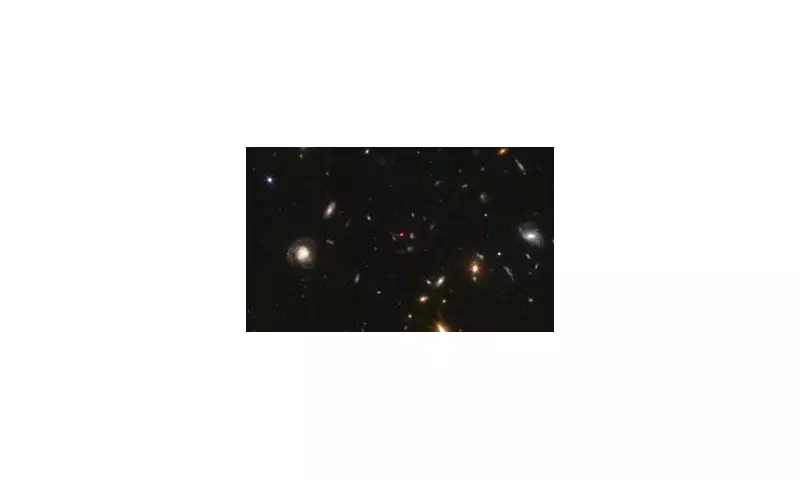
Ever since the JWST started peering back towards the dawn of time, its powerful instruments have detected hundreds of faint, crimson specks of light. These appeared in images from when the cosmos was a mere few hundred million years old, baffling experts who had no clear explanation for their origin or nature. The dots, visible from around 13 billion years ago, seemed to vanish from the record about a billion years later, deepening the enigma.
Initial theories suggested they could be very early galaxies. However, this clashed with established models of cosmic evolution, as the first galaxies shouldn't have been detectable that early. The alternative idea—that they were black holes—also presented a colossal problem: scientists couldn't explain how any black hole could have grown large enough so rapidly after the Big Bang.

Cocoons of Ionised Gas
Now, a groundbreaking study from the University of Copenhagen, published in the journal Nature, provides the definitive answer. The research reveals these dots are not galaxies but young supermassive black holes shrouded in thick 'cocoons' of ionised gas.
Lead author Professor Darach Watson explains that as these black holes voraciously feed on the surrounding gas, the swirling matter generates immense heat and radiation. This energy shines out through the gaseous shroud, creating the distinctive red glow observed by JWST. 'We have captured the young black holes in the middle of their growth spurt at a stage we have not observed before,' said Professor Watson. 'The dense cocoon of gas around them provides the fuel they need to grow very quickly.'
A Crucial Size Revision
The key breakthrough came from analysing the spectral 'fingerprint' of the light from several red dots. The data showed a significant absence of UV and X-ray radiation, indicating the light was being filtered through a massive cloud of gas. Crucially, this analysis proved the objects are far smaller than previously assumed—about 100 times less massive.
'They are quite small—only a few light days or weeks at most,' Professor Watson told the Daily Mail. 'The only mechanism we know in the universe that can dump that much energy in such a small volume is a black hole.' Despite this downsizing, these black holes remain colossal, with masses up to 10 million times that of our Sun and diameters exceeding 6.2 million miles.
This revised size is a critical piece of the puzzle. It makes their existence consistent with theories of how black holes formed and evolved in the early universe, resolving the previous timeline conflict.
Implications for Cosmic History
This discovery sheds vital light on one of astronomy's biggest questions: how did supermassive black holes appear so astonishingly fast after the Big Bang? The study suggests these young black holes are feeding at speeds approaching the maximum theoretical rate, known as the Eddington Limit.
This frenzied growth could explain how astronomers have already found billion-solar-mass black holes a mere 700 million years after the universe began. 'We found that the black hole masses are 10 to 100 times smaller than previously supposed, and that they are accreting gas at the limit,' says Professor Watson. 'These facts ease up very much on the problem of how they grow so fast.'
Professor Watson describes these objects as a 'missing link' between smaller stellar-mass black holes and the monstrous quasars that dominate later cosmic epochs. The resolution of the 'little red dots' mystery not only answers a pressing question but also provides a new framework for understanding the violent, rapid growth of the universe's most powerful objects in its formative years.