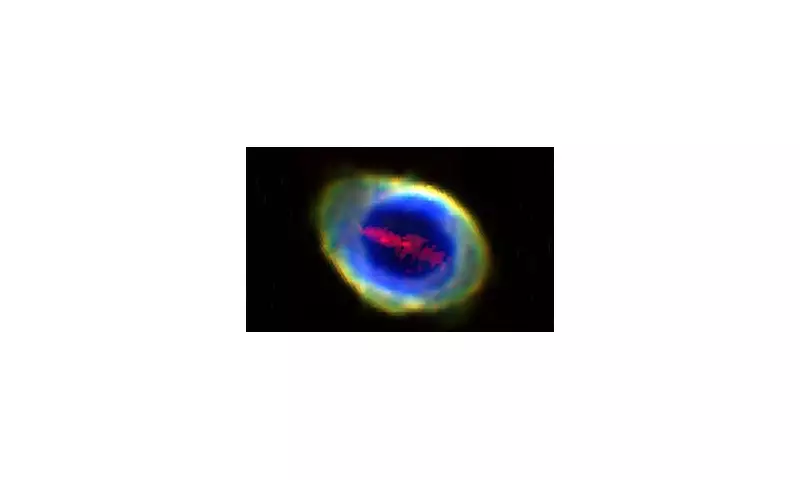
A startling cosmic discovery has given astronomers a potential glimpse into the distant, fiery fate of our own planet. Scientists have detected a mysterious bar of ionised iron at the heart of the nearby Ring Nebula, a structure never before seen, which may be the scorched remains of a rocky world consumed by its dying star.
A Glimpse of a Cosmic Crime Scene
The enigmatic feature was spotted within the Ring Nebula, located approximately 2,283 light-years from Earth. This spectacular cloud of gas, one of the closest and brightest planetary nebulae visible from our planet, formed roughly 4,000 years ago when a dying star violently expelled its outer layers. The main ring itself comprises around 20,000 dense clumps of molecular hydrogen gas, each with a mass comparable to Earth.
The discovery was made using a powerful new instrument called the Large Integral Field Unit (LIFU) on the William Herschel Telescope. This tool, essentially a bundle of hundreds of fibre-optic wires, allows scientists to capture the spectrum of light across the entire face of an object. Dr Roger Wesson of Cardiff University and University College London, who led the study, described the moment of discovery: "When we processed the data... one thing popped out as clear as anything – this previously unknown 'bar' of ionised iron atoms, in the middle of the familiar and iconic ring."

Two Theories for a Celestial Mystery
Researchers are currently baffled by the bar's origins but have proposed two leading scenarios. The first suggests it formed through some unknown process during the nebula's violent ejection. The second, and more tantalising, theory posits that it is an arc of plasma left behind after a rocky planet was utterly vaporised by its expanding host star.
"We know that there are planets around many stars, and if there were planets around the star that formed the Ring Nebula, they would have vaporised when the star became a red giant," Dr Wesson explained. He noted that the mass of iron in the bar is consistent with what would be expected from the destruction of a planet like Earth or Venus.
A Dire Preview of Earth's Ultimate Destiny
This discovery holds profound implications for understanding our own solar system's future. In about five billion years, our Sun will exhaust its nuclear fuel. Its core will shrink into a white dwarf, while its outer layers will balloon outwards in a Red Giant phase, expanding to hundreds of times its current size.
During this cataclysmic transformation, Earth will likely meet its end—either vaporised by intense heat or torn apart by gravitational forces. The iron bar in the Ring Nebula could be a direct analogue, showing what our planet's constituent materials might look like smeared across space after such an event.
However, the team cautions that more evidence is needed. "A vaporised planet is a possibility. But it's not the only possibility," said Dr Wesson. Co-author Professor Janet Drew of UCL emphasised the need for more data, stating, "We definitely need to know more - particularly whether any other chemical elements co-exist with the newly-detected iron."
The researchers now plan to use the LIFU instrument to hunt for similar features in other planetary nebulae, hoping to unravel the true nature of this cosmic iron bar and, in doing so, perhaps foretell the final chapter in Earth's long story.