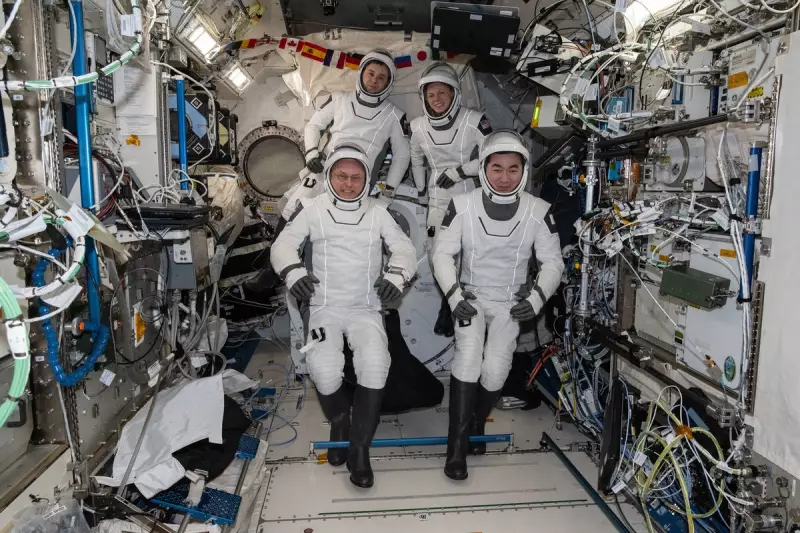
In a historic first for NASA, an ailing astronaut has returned to Earth ahead of schedule, cutting short a mission to the International Space Station (ISS) for medical reasons. The astronaut, whose identity remains confidential, landed safely with three crewmates in a SpaceX capsule early on Thursday, 15 January 2026.
An Unexpected Splashdown in the Pacific
The crew's journey home was expedited, with their Dragon capsule splashing down in the Pacific Ocean near San Diego less than 11 hours after departing the orbiting laboratory. The middle-of-the-night return, guided by SpaceX, concluded a mission that began in August 2025 far earlier than planned.
Officials have steadfastly refused to name the astronaut involved or disclose the nature of the health problem, citing medical privacy rules. However, they confirmed the individual was in a stable condition while on the station. NASA decided on an early return to ensure the astronaut could access comprehensive diagnostic testing and care on Earth as swiftly as possible.

Mission Cut Short and Station Operations Impacted
The health issue first arose on 7 January 2026, prompting NASA to cancel a planned spacewalk by astronauts Zena Cardman and Mike Fincke the following day. The decision to bring the entire crew home was made soon after. This marks the first time NASA has terminated a spaceflight early specifically for medical reasons, though Russian space agency Roscosmos has undertaken similar actions decades ago.
The early departure has left the ISS with a reduced crew of just three: one American and two Russian astronauts. NASA and SpaceX are now working to move up the launch of the next crew, which includes two Americans, one French, and one Russian astronaut. Its liftoff, initially targeted for mid-February, may now occur sooner.
Looking Ahead: A Reduced Crew and Future Launches
While the space station has operated with skeleton crews before, NASA confirmed that no spacewalks can be conducted until the next team arrives, even in an emergency scenario. The recovery operation for the returning crew proceeded normally, with the recovery ship carrying its standard complement of medical personnel.
The returning crew comprised NASA's Zena Cardman and Mike Fincke, along with Japan's Kimiya Yui and Russia's Oleg Platonov. While the timeline for the astronauts' return to Houston, Texas, was not immediately clear, NASA emphasised throughout the week that the situation, while serious, was not classified as an in-flight emergency.
This unprecedented event underscores the complex challenges of managing health and safety for humans living and working in the extreme environment of space, setting a new precedent for future mission protocols.