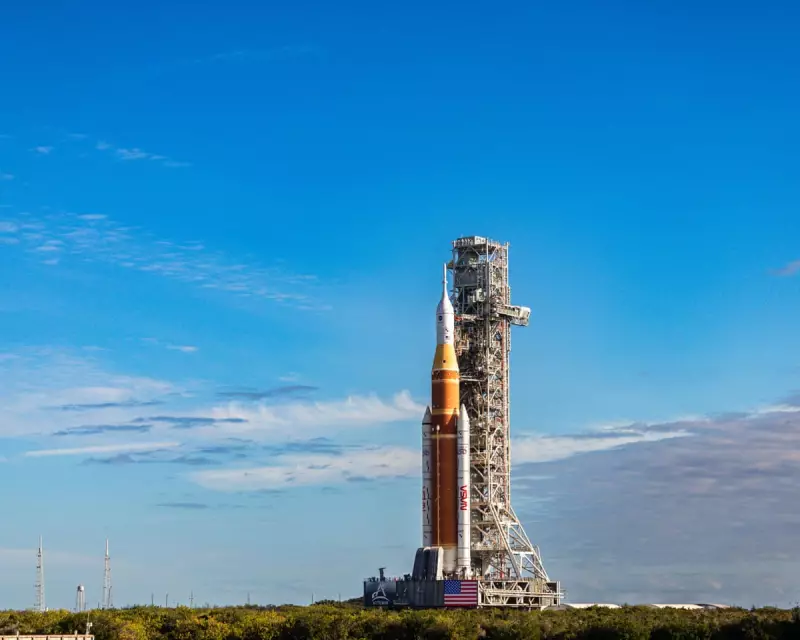
In a monumental step towards returning humans to deep space, NASA's towering new Moon rocket has completed a slow, majestic journey to its launch pad in Florida. This crucial move sets the stage for Artemis II, the first mission to send a crew of astronauts on a lunar fly-by in over half a century, with a potential launch window opening as soon as February.
The Dawn of a New Lunar Era
At daybreak, the 98-metre (322-foot) Space Launch System (SLS) rocket, topped with the Orion crew capsule, began its painstakingly slow procession from the iconic Vehicle Assembly Building at NASA's Kennedy Space Center. Moving at a mere 1.6 km/h (1 mph), the 5-million-kilogram behemoth took the entire day to complete its 4-mile trek, arriving at the pad by nightfall.
Thousands of space centre employees and their families braved the pre-dawn chill to witness the historic rollout, an event delayed for years. The crowd, led by NASA's new administrator and the four Artemis II astronauts, erupted in cheers as the rocket emerged from the same building that once housed the Saturn V rockets of the Apollo era.

"What a great day to be here," said mission commander Reid Wiseman. "It is awe-inspiring." The rocket made the journey aboard a massive, upgraded crawler-transporter, a veteran of both the Apollo and Space Shuttle programmes.
Overcoming Hurdles for a Crewed Flight
This rollout carries a significance distinct from the rocket's first uncrewed test flight in November 2022. "This one feels a lot different, putting crew on the rocket and taking the crew around the moon," noted NASA's John Honeycutt. The earlier mission revealed issues, including heat shield damage on the Orion capsule, which required extensive analysis and testing, contributing to the timeline leading to this moment.
The Artemis II crew comprises NASA veterans Reid Wiseman, Victor Glover, and Christina Koch, alongside Canadian Space Agency astronaut Jeremy Hansen, a former fighter pilot embarking on his first spaceflight. Their 10-day mission will not involve landing on the lunar surface but will pave the way for that "giant leap" on a subsequent Artemis mission.
The Path to Launch
NASA plans a critical fuelling test on the pad in early February before confirming a final launch date. The agency has a tight five-day launch window in the first half of February before the next opportunity arises in March.
This mission marks the first time humans will travel to the Moon's vicinity since Apollo 17's Gene Cernan and Harrison Schmitt concluded the programme in December 1972. As the world watches, the Artemis generation stands ready to extend humanity's reach, carrying the legacy of the twelve Apollo moonwalkers into a new chapter of discovery.