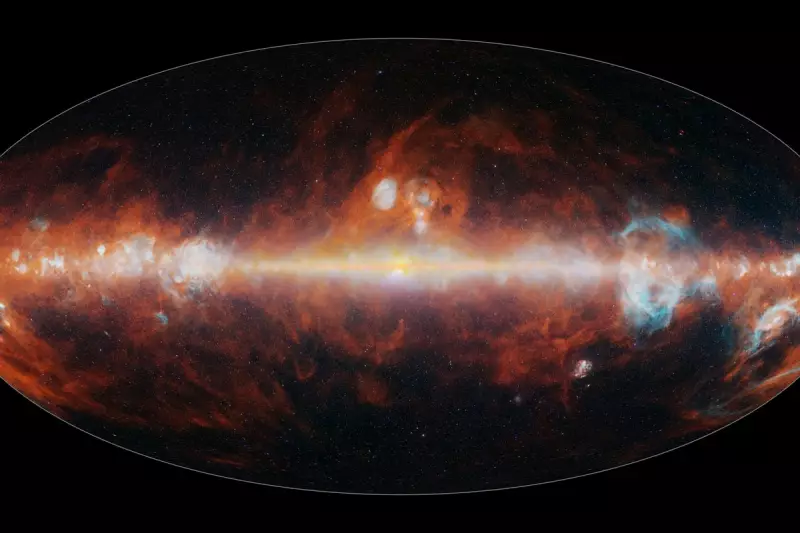
In a landmark achievement for astronomy, NASA has unveiled a spectacular new three-dimensional map of the entire cosmos, captured by its pioneering SPHEREx space telescope. This unprecedented panoramic view, presented in a stunning array of 102 infrared colours invisible to the human eye, promises to help scientists unravel some of the universe's most profound mysteries, from the distribution of galaxies to the origins of life's building blocks.
A Universe Revealed in Infrared Light
The first all-sky map from the Spectro-Photometer for the History of the Universe, Epoch of Reionization and Ices Explorer (SPHEREx) simulates a breathtaking 3D view. It showcases the cosmos in vivid detail: burnt red cosmic dust, electric blue clouds of hydrogen gas, and stars shining in hues of white, blue, and green. By detecting infrared light, the telescope reveals features and wavelengths beyond our natural vision, allowing astronomers to measure the precise distance to hundreds of millions of galaxies.
The map's three-dimensionality is key. It visually represents the phenomenon of 'redshift', where light from galaxies stretching away from us appears redder, while closer objects look bluer. This allows researchers to see not just where galaxies are, but how they are distributed across the vast expanse of the universe. Scientists will use this data, collected since the telescope's launch into low-Earth orbit in March 2025, to study how galaxies have transformed over the universe's nearly 14-billion-year history.

Big Science from a Mid-Sized Mission
While other telescopes like the James Webb Space Telescope also see in infrared, their field of view is thousands of times smaller. SPHEREx is unique in its mission to map the entire sky in an unprecedented 102 colours. "While not visible to the human eye, these 102 infrared wavelengths of light are prevalent in the cosmos," NASA stated. This comprehensive survey aims to answer colossal questions, including how events in the first infinitesimal fraction of a second after the Big Bang shaped the large-scale structure of the universe we see today.
Currently orbiting about 400 miles above Earth, SPHEREx circles our planet roughly 14.5 times per day. On each orbit, it captures around 3,600 images along a strip of sky, constantly shifting to build a complete 360-degree panorama. Over its planned two-year mission, it will complete three more full-sky scans, gathering data on more than 450 million galaxies and over 100 million stars within our own Milky Way.
Unlocking the Ingredients for Life
Beyond mapping galaxies, a core scientific goal is to probe how key ingredients for life were forged and distributed in our home galaxy. By analysing the infrared signatures of ices and molecules in stellar nurseries within the Milky Way, researchers hope to understand the cosmic pathways that lead to habitable worlds.
"SPHEREx is a mid-sized astrophysics mission delivering big science," said Dave Gallagher, Director of NASA’s Jet Propulsion Laboratory. "It’s a phenomenal example of how we turn bold ideas into reality, and in doing so, unlock enormous potential for discovery." This stunning new map is just the first step in a mission poised to redefine our understanding of the cosmos, from its largest structures to the origins of life itself.