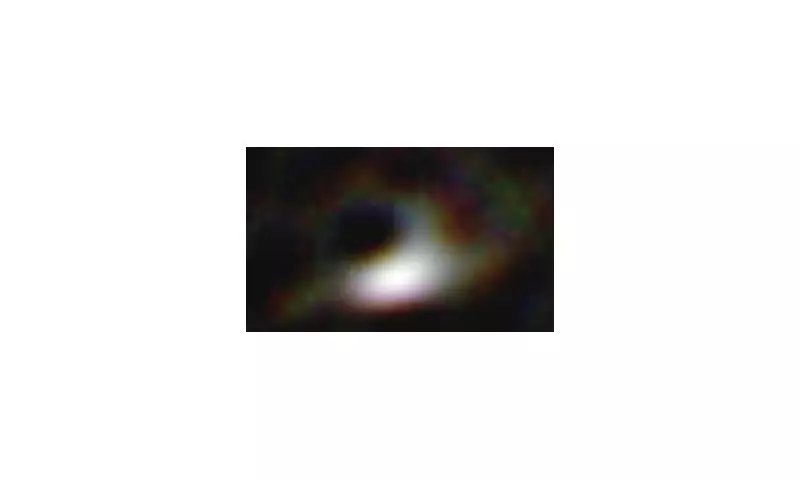
NASA has unveiled the most detailed observation ever made of a black hole's edge, a breakthrough that could resolve a galactic mystery spanning several decades. Located an astonishing 13 million light-years from Earth, the Circinus Galaxy hosts a supermassive black hole that continuously emits intense radiation into the cosmos.
Unveiling the Invisible
For years, the brilliant clouds of hot gas surrounding this celestial behemoth have obscured crucial details, making precise study nearly impossible. Now, using the revolutionary James Webb Space Telescope (JWST), NASA has exposed the strange and formidable forces operating at the very boundary of this black hole.
Supermassive black holes, like the one residing in Circinus, sustain their activity by voraciously consuming matter from their host galaxy. Scientists had long detected enormous amounts of infrared energy generated by this process, but most telescopes lacked the sensitivity to pinpoint its exact origin.

A Paradigm Shift in Understanding
Previously, the prevailing scientific assumption was that the majority of this radiation emanated from the black hole's 'outflow'—a jet of superheated matter expelled from the core. However, the new observations from JWST have completely overturned this expectation.
A black hole represents the ultra-dense core of a deceased star, where gravitational forces are so immense that not even light can escape. When supermassive black holes become 'active' by ingesting vast quantities of galactic material, the infalling matter forms a dense, doughnut-shaped ring called a torus, which orbits the black hole.
From the torus's inner walls, material is drawn into an accretion disc—a swirling vortex of matter circling the black hole akin to water draining from a sink. Friction within this disc generates immense heat, causing it to glow brightly enough for detection by our most advanced telescopes.
The Infrared Conundrum
Simultaneously, this intense energy propels a significant portion of the infalling matter outward from the black hole's poles, creating an outflow or jet. While astronomical models predict how these components interact, observing the process directly has been extraordinarily challenging.
The luminous accretion disc obscures finer details, and the incredibly dense torus conceals the inner region of infalling matter from view. Scientists attempted to match observed light wavelengths to emissions from different black hole regions, but the pieces never fit perfectly.
Notably, telescopes detected an excess of infrared light originating from somewhere near the black hole, but insufficient resolution prevented identification of its source.
Lead author Dr Enrique Lopez-Rodriguez, from the University of South Carolina, explains: 'Since the 1990s, it has been impossible to account for the excess infrared emissions from hot dust at the cores of active galaxies. Existing models considered either the torus or the outflows, but could not explain that surplus.'
Innovative Technological Solution
Models had presumed that most mass, and consequently most emissions, would reside in the outflow. To test this, astronomers needed to filter out interfering starlight and distinguish between infrared emissions from the torus and those from the outflows.
Fortunately, JWST provided an innovative solution to both challenges. Researchers employed a tool called the Aperture Masking Interferometer, which effectively transforms JWST into multiple smaller telescopes operating in unison.
On Earth, interferometers typically consist of numerous radio or optical telescopes working together as a single, colossal observatory. JWST replicates this technique using a special cover featuring seven hexagonal holes.
Dr Lopez-Rodriguez states: 'Interferometry offers the highest possible angular resolution. Using aperture masking interferometry with JWST is equivalent to observing with a 13-meter space telescope rather than a 6.5-meter one.'
Revealing the True Source
By gathering data with this method, scientists produced an image of the central region—marking the first extragalactic observation from an infrared interferometer in space and providing an unprecedented glimpse into an active galaxy's core.

Contrary to prior estimates, approximately 87 percent of the infrared emissions from hot dust in Circinus originate from areas closest to the black hole, while the outflow contributes less than one percent. This finding represents a complete reversal of predictions from astronomers' leading models for supermassive black holes.
Although the mystery of Circinus's black hole has been solved, billions more supermassive black holes populate the universe. Circinus's accretion disc was only moderately bright, making it logical for the torus to dominate its emissions. For brighter black holes, the opposite may still hold true, necessitating far more case studies.
Future Research Directions
This research has established a technique to investigate any sufficiently bright black holes using the Aperture Masking Interferometer. Dr Lopez-Rodriguez emphasises: 'We require a statistical sample of black holes, perhaps a dozen or two dozen, to comprehend how mass in their accretion discs and outflows relates to their power.'
The breakthrough underscores JWST's transformative capability in astrophysics, enabling scientists to peer deeper into cosmic phenomena than ever before and challenge long-held assumptions about the universe's most enigmatic objects.