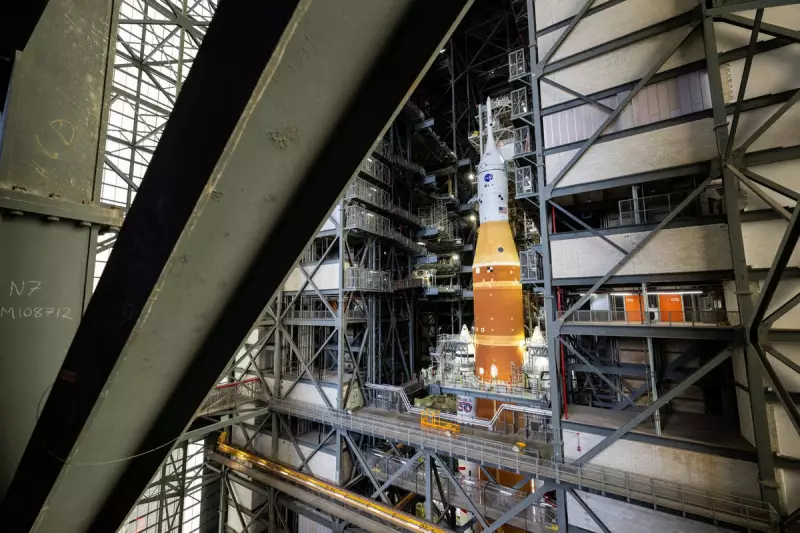
In a major milestone for human space exploration, NASA's colossal new moon rocket has begun its slow journey to the launch pad, setting the stage for the first crewed mission to the moon in more than half a century.
The Long-Awaited Rollout
At daybreak on Saturday 17 January 2026, the towering 322-foot (98-metre) Space Launch System (SLS) rocket began its four-mile (six-kilometre) trek from the iconic Vehicle Assembly Building at Florida's Kennedy Space Center. The massive transporter, upgraded from the Apollo and space shuttle eras, carried the 11 million-pound (5 million kilogram) rocket and its Orion crew capsule at a stately pace of just 1 mph (1.6 kph).
Throngs of space centre workers and their families gathered in the predawn chill to witness the historic event, which has been delayed for years. The crowd, led by NASA's new administrator Jared Isaacman and the four astronauts assigned to the mission, cheered as the rocket emerged from the same building that once housed the Saturn V rockets of the Apollo programme.

A Mission Decades in the Making
This mission, named Artemis II, represents a critical step in NASA's plan to return humans to the lunar surface. The crew—commander Reid Wiseman, pilot Victor Glover, mission specialist Christina Koch, and Canadian astronaut Jeremy Hansen—will embark on a roughly 10-day journey that will see them fly around the moon and back to Earth.
This out-and-back trip could blast off as early as February, marking the first time people have travelled to the moon's vicinity since Apollo 17's Gene Cernan and Harrison Schmitt departed the lunar surface in December 1972.
NASA's John Honeycutt noted the significance, stating on the eve of the rollout: "This one feels a lot different, putting crew on the rocket and taking the crew around the moon." The first and only other SLS launch was an uncrewed test flight in November 2022, which revealed issues with the Orion capsule's heat shield that required extensive analysis and fixes.
The Path to Launch
Before a firm launch date is set, NASA must conduct a crucial fueling test of the SLS rocket on the pad in early February. Launch director Charlie Blackwell-Thompson explained on Friday that the results of this demonstration "will ultimately lay out our path toward launch." The space agency has a narrow five-day launch window in the first half of February before the opportunity shifts to March.
It is important to note that the Artemis II crew will not land on the moon. That historic "giant leap" is scheduled for the subsequent Artemis III mission, planned for a few years from now. For now, the focus is on successfully completing this lunar flyby, proving the spacecraft's systems are ready to safely carry humans on the long journey back to our celestial neighbour.