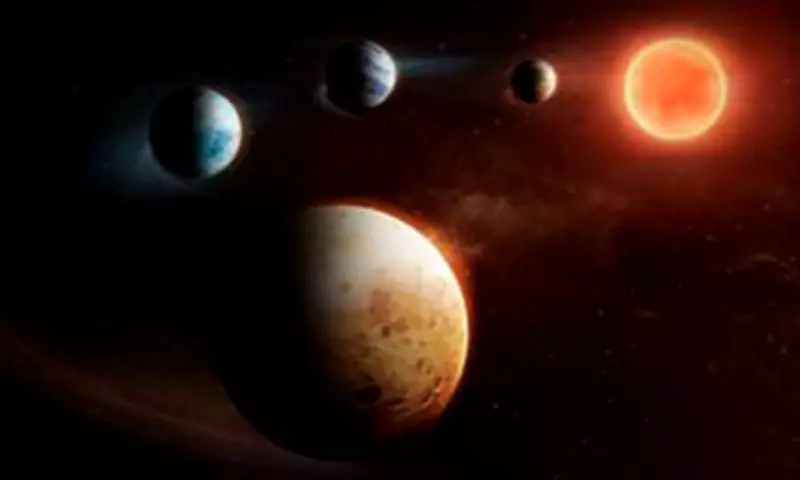
Astronomers have encountered a profoundly unusual planetary configuration that has left the scientific community thoroughly perplexed. This remarkable system, which appears to be structured 'inside out', consists of four planets orbiting a cool, faint red dwarf star designated LHS 1903.
Defying Conventional Planetary Architecture
In our own Solar System, and indeed in most observed exoplanetary systems, a clear pattern prevails: rocky, terrestrial planets like Mercury and Mars typically occupy the inner orbits closest to their host star, while gaseous giants such as Jupiter and Neptune reside in the colder, outer regions. This conventional arrangement is governed by fundamental astrophysical processes where intense stellar radiation near the star strips away lighter atmospheres, leaving behind dense, solid cores.
A Startling Discovery by Warwick Researchers
However, a dedicated team from the University of Warwick has made a groundbreaking discovery that spectacularly breaks this cosmic rule. Utilizing the European Space Agency's highly sensitive Cheops satellite, the researchers meticulously studied the LHS 1903 system. To their astonishment, they identified a configuration beginning with a rocky planet, followed by two substantial gas worlds, but culminating with another rocky planet as the outermost orbital body.

'This strange disorder makes it a unique inside–out system,' declared Dr Thomas Wilson, the lead author of the study. 'Rocky planets don't usually form far away from their home star, on the outside of the gaseous worlds. This discovery forces us to reconsider some of our most basic assumptions.'
Investigating the Origins of an Anomaly
The research team initially explored several conventional explanations for this bizarre layout. They theorised that perhaps the rocky and gaseous planets had dramatically swapped orbital positions through gravitational interactions, or that the outer rocky planet had once possessed a gaseous atmosphere which was obliterated in a cataclysmic collision. Yet, upon deeper analysis, both of these plausible scenarios were systematically ruled out.
A New Theory of Sequential Formation
Instead, the evidence pointed toward a novel and unexpected formation history. The data suggests the planets did not coalesce simultaneously from the protoplanetary disk, as standard models predict. Rather, they appear to have formed sequentially, one after another, progressing from the innermost to the outermost orbit.
Dr Wilson elaborated on this hypothesis: 'By the time this final outer planet formed, the system may have already run out of gas, which is considered absolutely vital for standard planet formation. Yet here is a small, rocky world, defying all expectations. It seems that we have found the first compelling evidence for a planet that formed in a gas-depleted environment.'
Implications and Unanswered Questions
This discovery raises profound questions about the diversity of planetary systems across our galaxy. A central mystery remains: is this peculiar 'inside-out' architecture a rare cosmic fluke, or does it represent a previously unknown class of planetary system waiting to be found?
Maximilian Günther, Cheops project scientist at ESA, emphasised the mission's purpose: 'Much about how planets form and evolve is still a profound mystery. Finding crucial clues like this one for solving this grand puzzle is precisely what the CHEOPS satellite was designed to accomplish.'
The research not only challenges textbook astronomy but also highlights the dynamic and often unpredictable nature of planetary genesis. As observational technology advances, scientists anticipate that further such anomalies will be uncovered, continually reshaping our understanding of the cosmos.