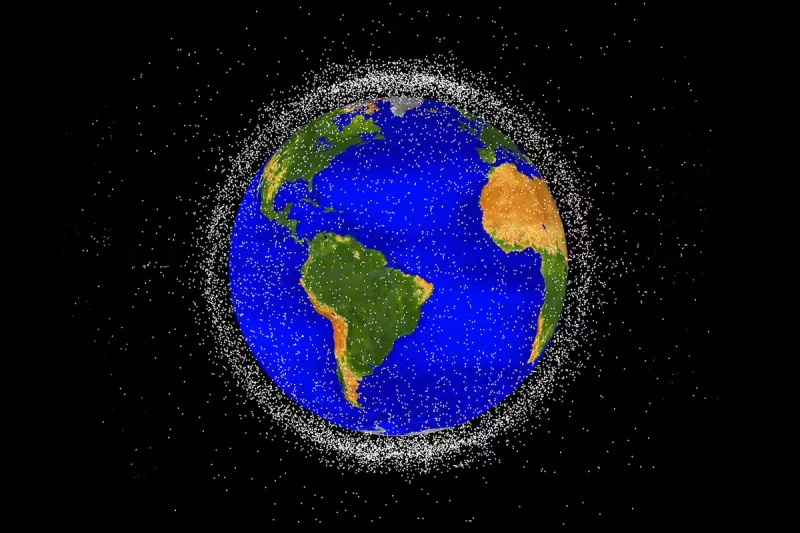
A new scientific study has issued a stark warning: the densely packed satellite traffic in low Earth orbit has become so fragile that a major space weather event could trigger a catastrophic chain reaction of collisions within just three days.
The 'House of Cards' in Orbit
Researchers, including a team from Princeton University, have developed a new metric called the "Crash Clock" to quantify the vulnerability of our orbital environment. This measure calculates how long it would take for a pile-up to occur if satellites suddenly lost their ability to manoeuvre and avoid each other—a likely scenario during a devastating solar storm.
"It is a measure, in part, of the degree to which the orbital environment is a house of cards," the authors state in their study, which is yet to be peer-reviewed. Solar storms are known to disrupt the navigational and communications systems that satellites rely on to perform these vital avoidance manoeuvres.

From Months to Mere Days: A Rapidly Escalating Risk
The analysis reveals a dramatic escalation in risk. Before the era of mega-constellations, a collision cascade might have taken around four months to develop after a major solar event. However, the enormous surge in satellite numbers since 2018 has slashed that timeframe.
The 'Crash Clock' for low Earth orbit now stands at under three days. Scientists explain this equates to a 30% probability of one or more collisions occurring within a 24-hour period if satellites are non-manoeuvrable. This level of risk is already within what researchers label the "caution region."
A further increase in orbital traffic could push the risk into the "danger region," implying a 50% chance of at least one collision within a day. The study highlights that at the most congested altitudes, such as around 550 km, satellites can come within 1 km of each other multiple times within minutes.
The Starlink Factor and an Avoidance Manoeuvre Crisis
The research specifically points to the impact of constellations like SpaceX's Starlink. Citing a SpaceX report, the scientists note that Starlink satellites perform approximately 40 collision avoidance manoeuvres per satellite annually. Across the entire mega-constellation, that translates to one avoidance manoeuvre every 1.8 minutes.
Furthermore, the number of these manoeuvres performed by Starlink has historically doubled every six months. This relentless increase is a direct result of the higher density of objects in orbit since 2018, leading to more frequent close approaches.
The study warns that "as the number of required manoeuvres continues to increase, temporary lapses in collision avoidance capabilities...will become increasingly catastrophic in their potential consequences." Events like the major solar storm of May 2024 demonstrate that such space weather can have lingering, disruptive impacts on satellite populations.
The findings present a clear and urgent challenge for satellite operators, regulators, and governments: the infrastructure upon which modern life increasingly depends is perched on a precipice, vulnerable to the sun's next violent outburst.