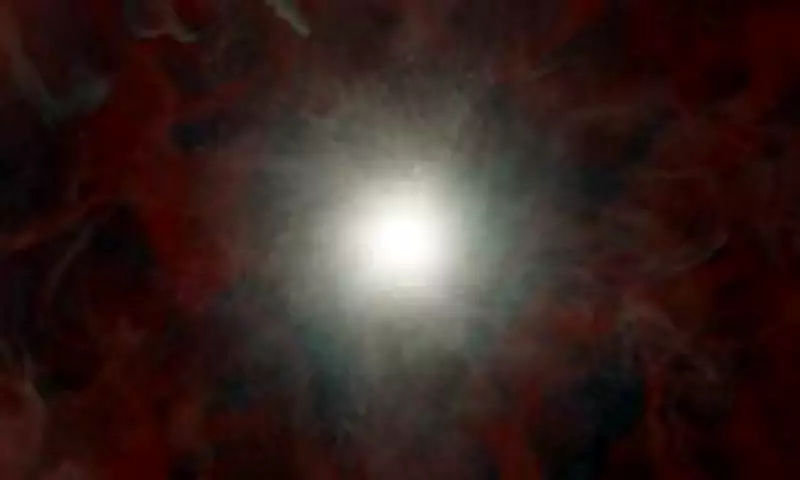
Astronomers Capture Star's Silent Transformation into Black Hole
In a groundbreaking discovery, scientists have recorded the astonishing moment a supergiant star collapsed directly into a black hole, bypassing the expected supernova explosion. This event, involving the star M31–2014–DS1 located approximately 2.5 million light-years away in the neighbouring Andromeda Galaxy, challenges fundamental theories of stellar evolution.
Defying Conventional Wisdom
Until now, astronomers widely believed that black holes form exclusively when massive stars end their lives in cataclysmic supernova explosions. However, observations of M31–2014–DS1 reveal a different narrative. In 2014, NASA telescopes detected the star briefly brightening before it gradually faded from view over the subsequent three years. Researchers now understand they inadvertently witnessed the star's death, collapse, and transformation into a black hole—a process occurring without the anticipated explosive finale.
Lead author Dr Kishalay De from the Flatiron Institute expressed his astonishment: 'It comes as a shock to know that a massive star basically disappeared—and died—without an explosion and nobody noticed it for more than five years.' This discovery suggests that stars can create black holes through a 'direct collapse' mechanism, where the star is crushed into a black hole without the outer layers being blasted away by a supernova.

The Mechanics of Stellar Collapse
To comprehend this phenomenon, it is essential to understand stellar life cycles. A star maintains equilibrium through the balance between outward pressure from hydrogen fusion and inward gravitational pull. As fuel depletes over billions of years, gravity prevails, causing the star to collapse. For stars at least ten times the sun's mass, this typically results in a neutron star formation accompanied by a supernova. Only stars about twenty times solar mass were thought capable of forming black holes via supernovae.
However, M31–2014–DS1, initially around thirteen solar masses and dwindling to five by its end, defied this model. Instead of exploding, it underwent a gradual decline. Researchers analysed light data from 2005 to 2023, noting the star glowed briefly in infrared in 2014, dimmed significantly by 2016, and became barely visible by 2022-2023, with brightness dropping to one ten-thousandth in visible and near-infrared wavelengths.
Evidence for Direct Collapse
The data aligns with predictions for a direct collapse black hole. After formation, temperature differences near the core create convection currents, pushing outer material into a dust layer that orbits the black hole. Friction within this dust generates a mid-infrared glow, observed by scientists. This process extends the collapse over decades rather than months, as co-author Morgan MacLeod of Harvard University explains: 'Instead of taking months or a year to fall in, it's taking decades. And because of all this, it becomes a brighter source than it would be otherwise, and we observe a long delay in the dimming of the original star.'
Implications for Future Research
This discovery has profound implications for astronomy, indicating that many massive stellar deaths may occur quietly and go unnoticed. Already, researchers have re-examined a puzzling object in galaxy NGC 6946, 25.2 million light-years away, suspecting it might be another instance of silent black hole formation. Dr De emphasises: 'It really impacts our understanding of the inventory of massive stellar deaths in the universe. It says that these things may be quietly happening out there and easily going unnoticed.'
Looking ahead, scientists hope this insight will aid in identifying more elusive black holes, refining our comprehension of cosmic phenomena. The observation underscores that black holes, with gravitational pulls so strong not even light can escape, may form through diverse pathways beyond traditional supernova events.