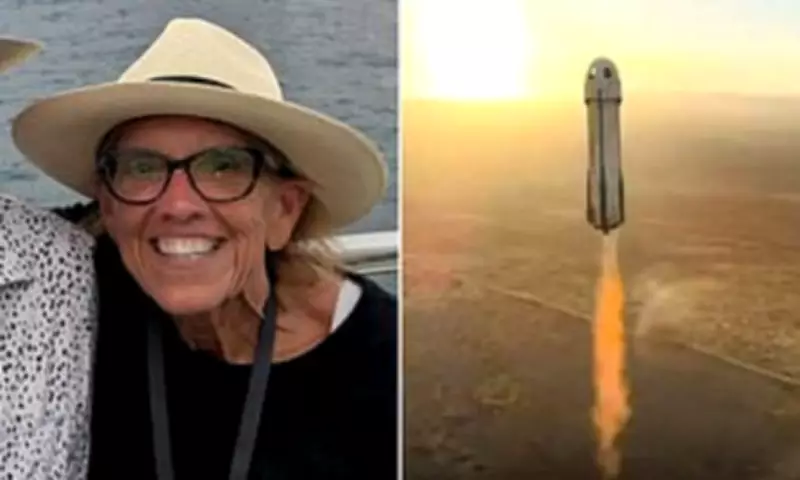
Napa Valley Woman with Terminal Illness Poised for Historic Space Journey
A 69-year-old woman from California's Napa Valley is on track to become the first terminally ill individual to travel to space, following an unexpected connection with Jeff Bezos's space tourism company, Blue Origin. Pam Harter, who was diagnosed with the exceptionally rare genetic disorder pseudoxanthoma elasticum (PXE) approximately a decade ago, has embarked on an extraordinary path that may culminate in an 11-minute voyage beyond Earth's atmosphere.
A Life-Altering Diagnosis and a Bold Decision
PXE affects only about 3,500 people in the United States, causing arteries to calcify and become brittle. There is no known cure for the condition. Harter's vascular system has progressively become blocked, leading doctors to insert two stents—one in her stomach and another in a major artery—about two years ago. By April of last year, one stent was completely blocked and the other partially obstructed.
Medical professionals presented Harter with the option of additional surgery to insert more stents, but warned that the procedure would be high-risk and significantly diminish her quality of life, requiring her to live with tubes and medical devices attached to her body. Harter made the courageous decision to decline further surgeries, stating she was finished with medical interventions. Instead, she resolved to cherish her remaining time with her husband, Todd Harter, by traveling the world.

From Global Travel to Cosmic Aspirations
The couple began their adventures with a month-long trip to Italy and Croatia. Subsequently, an old friend who operates a luxury expedition business called Future of Space contacted them. The friend mentioned that a guest had canceled a planned expedition to Ecuador and the Galápagos Islands—a destination with strict annual visitor limits—and invited the Harters to fill the vacancy.
Just ten days later, they joined an 11-day South American expedition as part of a 50-person group that included notable figures such as actor William Shatner and celebrity astrophysicist Neil deGrasse Tyson. Ticket prices for the trip started at $42,500 per person, though the Harters received a discount.
A Serendipitous Encounter That Changed Everything
During introductory sessions at the start of the expedition, Harter chose not to disclose her terminal illness to the group. Instead, she posed a provocative question: 'Wouldn't it be amazing if I could be the first hospice patient in space?' The idea captivated the group, and in a remarkable twist of fate, the woman seated beside Harter revealed she worked with Blue Origin and immediately offered to connect her with the right contacts.
Blue Origin, founded by Amazon's Jeff Bezos, offers civilian spaceflights that travel more than 62 miles above Earth—the internationally recognized boundary of space—for an undisclosed price believed to be in the millions. Passengers experience approximately 11 minutes of weightlessness while gazing down at our planet.
Rapid Developments and Overwhelming Support
Less than 24 hours after Harter's introduction to the group, while still on the South American trip, she received an email from Blue Origin containing an application and a non-disclosure agreement. She promptly signed both documents, and it soon appeared she would be launching into space aboard a Blue Origin rocket in January.
'I was kind of dumbfounded,' Todd Harter told the Napa Valley Register, describing how events unfolded rapidly. 'From there, the rest of the trip, there were all these people excited about her potentially going into space.' Harter learned that at least one individual had postponed their reservation to allow her to fly sooner.
'It’s surreal,' Harter expressed. 'I'm so excited. I can't believe the things that people have done.' She hopes her three adult children—twin sons living in Illinois and a daughter in California—will attend her launch. More importantly, Harter aims to use her story to reduce the stigma surrounding hospice care and demonstrate what terminally ill patients can achieve. She considers this mission even more significant than the prospect of officially being recognized as an astronaut after her flight.

Logistical Challenges and Unforeseen Delays
Specific details of Harter's flight are still being finalized, and a precise launch date has not been scheduled. She is also seeking sponsors to help cover the costs, which she cannot disclose due to her non-disclosure agreement. The flight itself will propel passengers past the atmosphere at three times the speed of sound, presenting medical and logistical challenges for someone with Harter's condition, according to the National Alliance for Care at Home.
However, the organization noted in a press release that Blue Origin's New Shepard spacecraft is designed for accessibility, featuring a pressurized capsule and 11 minutes of weightlessness that is gentler on the body than orbital spaceflight. The company has previously transported individuals older than Harter, including William Shatner at age 90 and Ed Dwight, also 90, who broke Shatner's age record by about two months.
Perseverance Amid Uncertainty
In January, Blue Origin announced a pause in its space tourism flights for at least two years to focus on NASA contracts, potentially disrupting Harter's plans. Nevertheless, her contact at the company advised her not to panic and to continue preparations. Harter has been engaged in 'touring and training,' as she described it, and remains in communication with NASA, Virgin Galactic, and Space for Humanity.
Despite her terminal illness and the uncertain status of her Blue Origin flight, Pam Harter's determination to reach space remains unwavering. Her journey symbolizes a profound testament to human resilience and the pursuit of dreams against all odds.