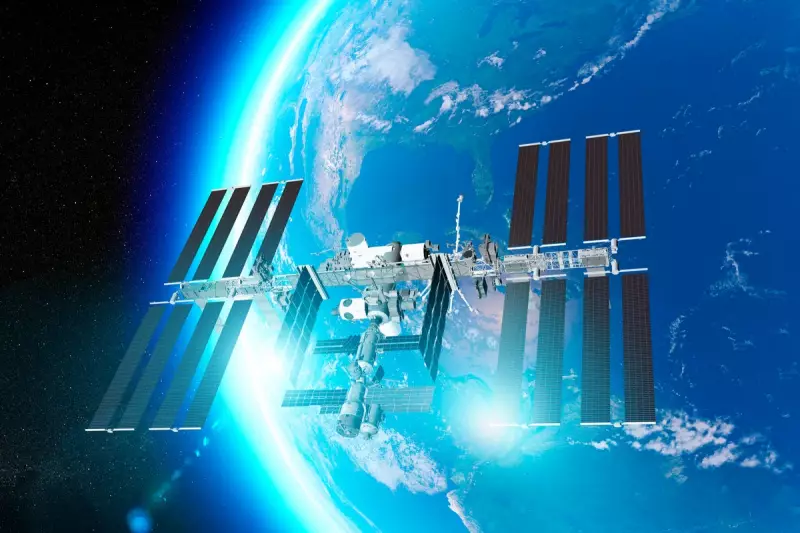
Scientists have uncovered a startling phenomenon occurring aboard the International Space Station (ISS): viruses are evolving to become more potent in the unique environment of space. A groundbreaking new study reveals that these microscopic entities behave in fundamentally different ways when freed from Earth's gravity, with significant implications for both long-term space exploration and medical science back on our planet.
Microgravity Alters Fundamental Biological Warfare
The research, conducted on the ISS, focused on observing the interaction between E. coli bacteria and T7 bacteriophages – viruses that specifically infect bacteria. Scientists ran parallel experiments on the orbiting laboratory and in terrestrial labs to directly compare the outcomes. The results were clear and significant: the process of viral infection was notably slowed under microgravity conditions.
However, the slowing of infection was just the beginning of the story. The real discovery lay in the genetic changes that followed. Through detailed genome sequencing, researchers found significant differences in the genetic mutations that occurred in the space samples compared to those on Earth. The phages (viruses) in space developed specific, unique mutations that appeared to enhance their ability to infect host bacteria, effectively making them stronger.

A Co-Evolutionary Arms Race in Orbit
It wasn't just the viruses that were adapting. The E. coli bacteria aboard the ISS also accumulated their own set of mutations. These genetic changes seemed to bolster the bacteria's defences against the attacking phages, improving their survival rates in the near-weightless environment. This created a fascinating co-evolutionary arms race, playing out on a microscopic scale 400 kilometres above the Earth.
The study, reported on Wednesday 14 January 2026, provides unprecedented insights into how life adapts to extreme environments. The lead researcher, Vishwam Sankaran, highlighted the dual nature of the findings. While the increased potency of space viruses presents a new challenge for astronaut health, the understanding of these adaptive mechanisms opens exciting doors for applied science.
Implications for Earthly Medicine and Future Spaceflight
The ramifications of this discovery are wide-ranging. On Earth, one of the most promising applications is in the field of phage therapy – using viruses to combat drug-resistant bacterial pathogens, often called superbugs. Understanding how phages can be engineered or can evolve to become more effective killers of bacteria could revolutionise our approach to antibiotic-resistant infections.
For the future of human space exploration, the findings underscore a critical health consideration. As missions aim for the Moon and Mars, protecting crews from microbial threats is paramount. This research suggests that the space environment itself could alter the behaviour and virulence of microorganisms, a factor that must be meticulously planned for.
The central mystery that remains, and which scientists openly admit they cannot yet explain, is precisely why these viruses are getting stronger in space. The unique pressures of microgravity, cosmic radiation, or other factors could be driving this accelerated evolution. Unravelling this 'why' will be the focus of urgent follow-up studies, as the scientific community grapples with the profound implications of life evolving differently off-world.