UK Faces Solar Storm Threat: Scientists Warn of Power Grid Collapse and Social Chaos
While Britons are accustomed to inclement weather, scientists now warn of a far more dangerous celestial tempest. A chilling new report has detailed the catastrophic consequences should a solar superstorm strike the United Kingdom, revealing vulnerabilities in critical national infrastructure.
The One-in-a-Century Event
The Summary of Space Weather Worst-Case Environments report outlines a scenario where an eruption of charged particles from the sun collides with Earth's atmosphere. This event, described as a one-in-100-year occurrence, does not follow a predictable timetable, meaning Britain must be prepared for this worst-case scenario at any moment.
Professor Richard Horne of the British Antarctic Survey, a co-author of the report, emphasised the uncertainty. "Space weather is really uncertain because one-in-100 events don't come around all that often," he told the Daily Mail. "We're trying to point out what some of the risks are so that people will take action."

Cascading National Blackouts
The primary concern identified is the national power grid. A geomagnetic storm, caused by solar plasma interacting with Earth's magnetic field, can induce powerful electrical currents in long metal conductors like high-voltage transmission lines.
"The thing I'd be most concerned about is the power grid," stated Professor Horne. This could trigger safety mechanisms in transformer stations, leading to cascading regional blackouts that plunge parts of the country into darkness. In a severe event, transformers could be permanently damaged, with replacements potentially taking months to install, leading to prolonged power shortages.
Transportation Catastrophes and Nuclear Risks
The danger extends far beyond the energy sector. The same geomagnetic currents could surge through railway tracks, interfering with critical signalling systems.
The report warns that a major storm could cause multiple signalling failures, potentially leading to deadly train collisions through "right side" and "wrong side" errors where systems incorrectly detect train positions.
Furthermore, the sensitive electronic control systems within nuclear power stations are identified as vulnerable. High-energy neutrons from solar particles could penetrate facilities, causing system errors or burnout, though researchers note this specific risk requires further investigation with industry experts.
Satellite Collapse and Communication Breakdown
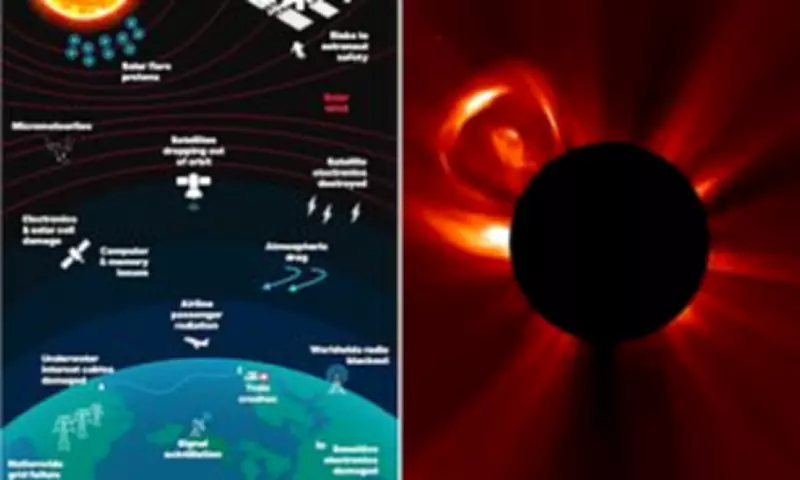
Space infrastructure faces severe threats. Solar storms can damage satellite electronics, degrade solar panels, and alter orbits through atmospheric swelling. This not only shortens satellite lifespans but increases collision risks with space debris, jeopardising global navigation systems like GPS.
Communication systems would suffer extensively. Geomagnetic storms could disrupt the ionosphere for days, causing radio blackouts in the UHF and VHF ranges used by aviation and maritime services, leading to widespread travel chaos and grounded flights.
Social Unrest and Cult Activity
Perhaps most alarmingly, the report highlights potential social consequences. Extended power cuts, internet outages, and supply chain disruptions would disproportionately affect society's most vulnerable.
Professor John Preston, a sociologist from the University of Essex and report co-author, warned of possible "extreme behaviour" driven by misinformation and doomsday beliefs. "We know that certain cults look at solar and space events as an indicator of the end of the world," he explained, referencing the 1997 Heaven's Gate cult suicides linked to the Hale-Bopp comet.
Understanding Solar Storms
Solar storms typically involve Coronal Mass Ejections (CMEs), where the sun's magnetic fields release billions of tonnes of charged particles and plasma into space. These events follow the sun's 11-year solar cycle, with increased activity during solar maximum periods.

While creating beautiful auroras, these storms pose significant risks to modern technology. The report serves as a stark warning for Britain to bolster its resilience against this unpredictable but potentially devastating space weather threat.