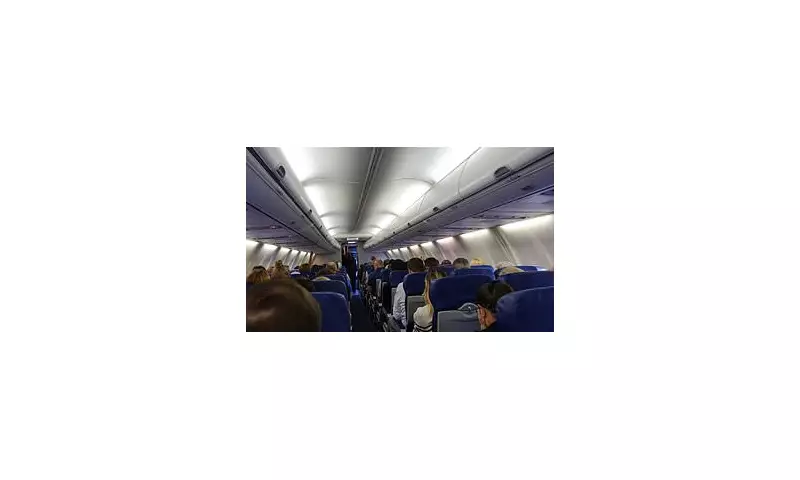
United Airlines is fighting a class-action lawsuit that accuses the carrier of charging passengers extra for window seats that do not have an actual window.
The Core of the Legal Dispute
In August, passengers in the United States filed the lawsuit against United Airlines and Delta Air Lines. They alleged false advertising and claimed their consumer rights were violated. The plaintiffs stated that both airlines advertised and took premium fees for window seats on specific aircraft, including Boeing 737 and 757 models, as well as Airbus A321 planes, where a window was missing.
The central issue is that United's online seating chart does not inform customers when a window seat lacks a window. The passengers are demanding that United compensates all affected California-based passengers who paid an additional fee for these windowless window seats over the past four years.

United's Defence and Legal Argument
In a recent filing to a federal court in San Francisco, United Airlines requested that the judge dismiss the case. The airline's defence hinges on the argument that it never made a contractual promise that a seat labelled as a 'window' seat would actually offer a view.
As reported by Reuters, United stated: 'The word "window" identifies the position of the seat - i.e., next to the wall of the main body of the aircraft.' The airline further contended that the use of the word 'window' on boarding passes and seating charts cannot reasonably be interpreted as a guarantee of an exterior view.
Additionally, the Chicago-based airline argued that federal law largely prevents customers from pursuing breach of contract claims related to airline surcharges, including fees for preferred seating.
Passenger Outrage and Wider Implications
Attorney Carter Greenbaum, who is representing the plaintiffs in the cases against both United and Delta, strongly criticised the airline's position. He said United's defence was 'contrary to the reasonable expectations of countless passengers who unknowingly paid extra money for windowless window seats.'
Speaking to Reuters, Greenbaum added, 'Consumers deserve better than empty promises and United's word games.' He is also representing Delta customers in a separate, similar class-action lawsuit filed in a federal court in Brooklyn, New York.
The plaintiffs argue that passengers typically select window seats for specific reasons, such as comfort, to alleviate motion sickness, to manage a fear of flying, to entertain children, or simply to enjoy the scenery. They claim passengers would have chosen different seats or avoided the extra fee had they known they would be seated next to a blank wall.
Both lawsuits are seeking millions of dollars in damages, potentially affecting over a million passengers per airline.
How to Avoid a Windowless Window Seat
For travellers wanting to ensure their window seat comes with a view, it pays to check specific seat maps. While this varies by airline and aircraft, some known windowless 'window' seats include:
- easyJet (A319 aircraft): Avoid seats 26A and 26F.
- British Airways: Skip seats 22A, 22K, 37A, 37K on Boeing 777-300s; 12A, 12K, 50A, 50K, 70A, 70K on Airbus A380s; and 30A, 30F on A320neo planes.
- Norwegian: Steer clear of seats 10A, 11A, and 11F.
The problem has left many passengers frustrated, especially those who paid up to £13 for what they believed was a premium spot with a view.