Corporate Giants Face Mounting Pressure Over ICE Operations in Minnesota
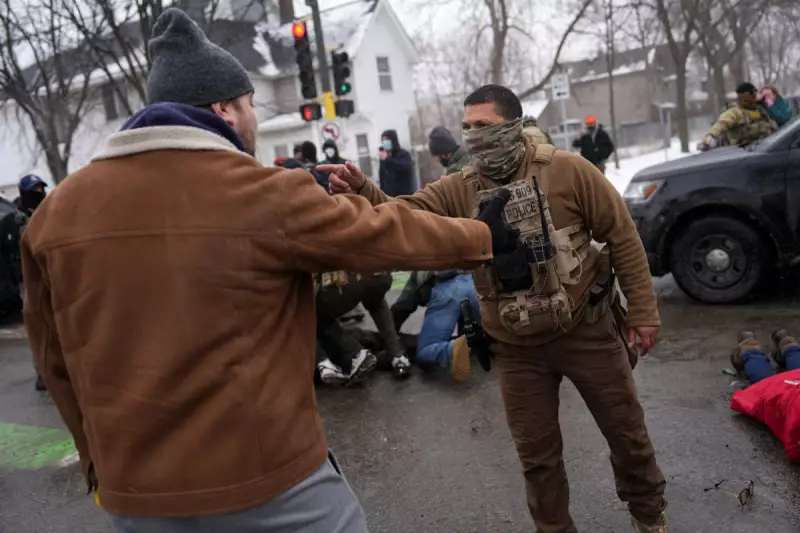
Workers across Minnesota are intensifying their campaign against some of America's largest corporations, demanding they take a firm stance against Immigration and Customs Enforcement (ICE) operations within the state. This movement has gained significant momentum following two high-profile incidents involving federal immigration officers.
Labor Movement Mobilises Following Tragic Incidents
The pressure on employers escalated dramatically after the death of Renee Good, an unarmed woman killed by a federal immigration officer in Minneapolis earlier this month. This tragedy was followed by the Saturday killing of Alex Jeffrey Pretti, a 37-year-old Veterans Affairs Hospital ICU nurse and member of the American Federation of Government Employees.
These events have galvanised Minnesota's labour movement, with Bernie Burnham, Minnesota AFL-CIO President, issuing a powerful statement: "ICE continues to make everyone less safe, and Minnesota's Labor Movement repeats and amplifies our call for them to leave our state immediately. We stand shoulder to shoulder with our fellow Minnesotans in the face of a hostile federal government."

Economic Blackout Strategy Targets Major Corporations
On Friday, a coalition of labour unions, community leaders, and faith leaders organised a Day of Truth & Freedom, calling for a comprehensive economic blackout involving no work, no shopping, and no school attendance. This strategic action represents a significant escalation in the protest movement against ICE operations.
Organisers have specifically targeted large corporations, demanding they take concrete stands against ICE. Their requirements include ceasing all economic activity with the agency and implementing policies to ban ICE agents from entering work sites without proper judicial warrants.
Corporate Silence Draws Sharp Criticism
Major companies including Target, Home Depot, Enterprise, Delta Airlines, and Hilton have been directly targeted with actions leading up to the 23 January economic blackout. Hundreds of Target workers have signed a letter addressed to the company's CEO and other senior leaders, criticising what they perceive as corporate silence on the ICE operations affecting Minnesota communities.
Sheletta Brundidge, a Minneapolis activist and former Target employee, expressed her disappointment: "That Target CEO should be out at the street talking to people. He should be part of the protesting. Has he gone out to the site where Renee Good was killed and dropped off water or hand warmers? Have they done anything for her children?"
Brundidge, who started a Target boycott with activist Nekima Levy Armstrong, added pointedly: "Silence doesn't mean I don't know what to say. Silence says I don't give a damn. I don't care about the people that shop here. I don't care about the people who work here."
Corporate Responses and Internal Measures
Despite multiple requests for comment, none of the targeted companies have responded publicly to the growing pressure. However, reports indicate that Target's executives recently met with Minneapolis clergy who protested in the company's lobby. According to The Wall Street Journal, the retail giant has begun distributing internally updated guidelines for how staff should respond to "unannounced immigration-related contacts."
Hilton has faced particular scrutiny after a Hampton Inn in its network cancelled reservations for ICE agents, leading to Hilton removing the property from its network earlier this month. More recently, Hilton backed decisions to close a DoubleTree hotel and an Intercontinental hotel in the Twin Cities region where ICE agents were staying, following reported bomb threats.
Hilton CEO Chris Nassetta clarified the company's position: "A safety and security issue is a different issue—it's closed to all."
Construction Industry Impact and Worker Testimonies
The economic impact of ICE operations extends beyond corporate boardrooms to affect everyday workers. A construction worker and member of Centro de Trabajadores Unidos en La Lucha, who requested anonymity for fear of retaliation, explained: "We want ICE out of Minnesota. In construction, they are causing harm and chaos. People can't work."

This worker and several colleagues recently delivered a petition to DR Horton, America's largest house developer by volume, at their regional office in Lakeville, Minnesota. They demanded the developer prevent ICE from entering job sites without valid warrants and call for an end to ICE violence and raids.
Jac Kovarik, communications coordinator for CTUL, noted the irony of their reception: "The police said we need to leave because it is private property, and a few community members pointed out that this is precisely what we are asking of DR Horton – to not allow ICE on their private job sites without a signed and valid judicial warrant."
Economic Consequences and Government Response
A recent report by North Star Policy Action estimates that the immigration enforcement operation is costing Minnesota taxpayers at least $18 million per week. This stands in stark contrast to the substantial economic contribution of immigrant workers and business owners, who generate approximately $41 billion annually in economic output for the state.
The US Department of Homeland Security has responded critically to the labour movement's actions, with a spokesperson calling them "beyond insane." The spokesperson questioned: "Why would these labor bosses not want these public safety threats out of their communities?" They cited 23 unnamed photos of claimed undocumented immigrants arrested in Minnesota with criminal records as evidence supporting their position.
However, critics point out that under the Trump administration, thousands of people targeted by ICE have had no criminal record, and numerous US citizens have also been detained. The administration's approach to immigration enforcement continues to generate significant controversy and division across Minnesota and beyond.