

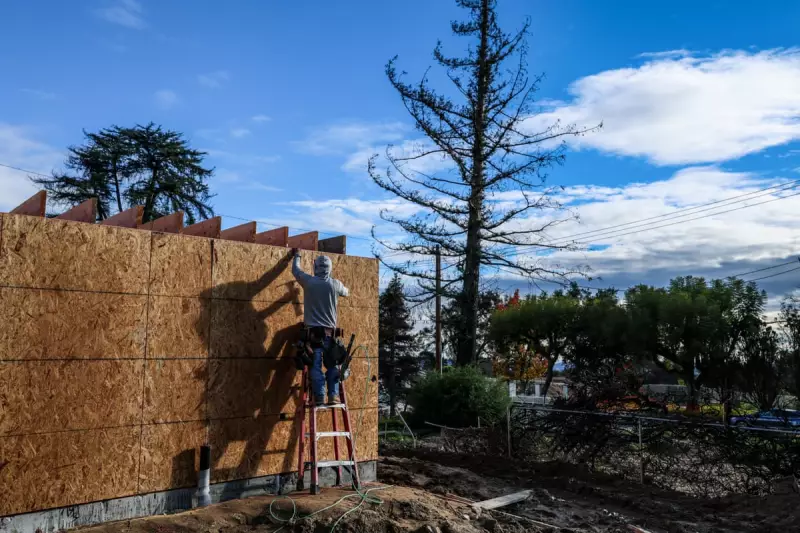
In a move that has ignited political controversy, former President Donald Trump has signed an executive order designed to accelerate the reconstruction of tens of thousands of homes devastated by the catastrophic Los Angeles-area wildfires of January 2025. The order, announced on Tuesday and formally signed on Friday, seeks to bypass what the White House describes as "unnecessary, duplicative, or obstructive" permitting requirements that have slowed recovery efforts.
Federal Intervention in Local Rebuilding Efforts
The executive order directs federal agencies, including the Federal Emergency Management Agency (FEMA) and the Small Business Administration (SBA), to develop regulations that would preempt state and local permitting rules. This would allow builders to "self-certify" compliance with essential health, safety, and building standards, potentially streamlining the rebuilding process for homeowners. Additionally, the order mandates that federal agencies expedite waivers, permits, and approvals, even if they conflict with environmental, historic preservation, or natural resource laws.
However, the practical authority of the federal government over local and state permitting remains unclear, raising questions about the order's immediate impact. The wildfires, which ignited on 7 January 2025, resulted in 31 fatalities and destroyed approximately 13,000 residential properties across communities including Palisades, Malibu, Altadena, and Pasadena. The largest blazes, the Palisades and Eaton fires, burned for over three weeks, with cleanup operations lasting around seven months.

California Officials Dismiss Order as "Political Stunt"
California Governor Gavin Newsom has sharply criticised the executive order, dismissing it as ineffective and urging Trump to focus instead on approving the state's $33.9 billion disaster aid request. Newsom, who has travelled to Washington DC to advocate for the funding, remarked on social media that "an executive order to rebuild Mars would do just as useful," adding, "Please actually help us. We are begging you."
Los Angeles Mayor Karen Bass echoed these sentiments, labelling Trump's move a "political stunt." She called for more substantive actions, such as an executive order to pressure insurance companies to pay out claims promptly, extend mortgage forbearance by three years, and establish a special fund for no-interest loans to fire survivors. Bass emphasised that rebuilding plans in Pacific Palisades are already being approved in half the time compared to pre-wildfire projects, with over 70% of home permit clearances no longer required.
Slow Progress and Financial Barriers to Rebuilding
Despite these efforts, progress has been sluggish for many survivors. According to Associated Press findings, fewer than a dozen homes had been fully rebuilt one year after the disaster. As of December, construction was underway for at least 511 homes in the Eaton fire footprint and 370 in the Palisades area. County and city records indicate that about 2,600 rebuild permits had been issued across Los Angeles County by 5 January, representing roughly 41% of applications received, though many properties still lack filed applications.
Dr Thomas Chandler, Managing Director of the National Center for Disaster Preparedness at Columbia University, noted that "it is predominantly the wealthy who are rebuilding," as those with resources and developer networks have moved faster. Joy Chen, Executive Director of the Eaton Fire Survivor's Network, highlighted that financial constraints, not permitting delays, are the primary obstacle. A December survey by the non-profit Department of Angels found that nearly one-third of survivors cited rebuild costs and insurance payouts as key barriers, while only 21% mentioned permitting issues.
Audit of Hazard Mitigation Funding
Trump's order also instructs Homeland Security Secretary Kristi Noem and FEMA Acting Administrator Karen Evans to audit California's use of Hazard Mitigation Grant Program (HMGP) funding within 60 days. This audit could lead to future conditions on funding or even "recoupment or recovery actions." Notably, Trump has not approved any HMGP funding requests from states since February, part of a broader strategy to reduce federal support for climate mitigation initiatives.

The executive order has thus sparked a heated debate between federal intentions and local realities, underscoring the complex challenges facing wildfire survivors in Southern California as they strive to rebuild their lives and communities.





