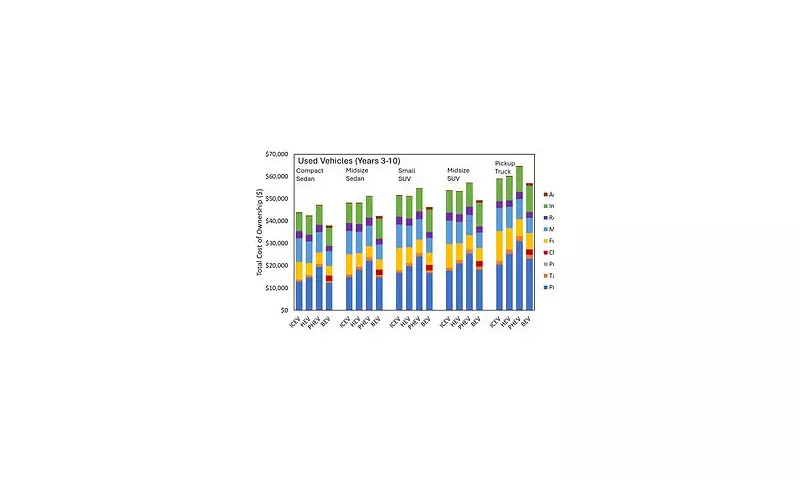
Used electric vehicles (EVs) now represent the most cost-effective choice for motorists over the entire lifespan of a car, according to a comprehensive new study. Researchers from the University of Michigan have concluded that opting for a pre-owned EV delivers substantial financial benefits when compared to both new and used petrol-powered alternatives.
Significant Savings Identified
The analysis reveals striking figures: when compared to purchasing a brand-new mid-sized SUV with an internal combustion engine, acquiring a three-year-old electric version of a similar vehicle yields lifetime savings of approximately £9,486. In contrast, choosing a used petrol vehicle over a new one only saves around £2,190 over its operational lifetime. This substantial disparity highlights the evolving economic dynamics within the automotive marketplace.
The Depreciation Factor
This financial advantage is primarily attributed to the accelerated depreciation rates experienced by electric vehicles. New EVs typically carry a price premium of about 35 percent compared to their petrol equivalents. However, the rapid pace of technological advancement in battery and electric drivetrain systems means older EV models lose their value much faster than conventional cars.

'This presents a mixed picture for consumers,' explained study co-author Professor Greg Keoleian from the University of Michigan. 'For those considering a new electric vehicle, the knowledge that resale values may be impacted by faster depreciation isn't particularly encouraging. However, for buyers in the used vehicle market, these depreciation patterns create very positive opportunities.'
Comprehensive Cost Analysis
To reach these conclusions, the research team examined an extensive dataset comprising 260,000 used car listings from the classified advertisements platform Craigslist. Their methodology incorporated multiple cost factors including initial purchase price, depreciation trends, and recurring expenses such as fuelling, maintenance, and repair outlays.
Since the study focused on the United States market, data from seventeen American cities was utilised to calculate regional variations in fuel costs, electricity charging expenses, and repair charges. The findings demonstrated remarkable consistency across different vehicle categories and geographical locations.
'The uniformity of the results was surprising,' noted lead author Dr. Maxwell Wood. 'We anticipated that electric vehicles might prove cheaper in certain scenarios, specific cities, or particular vehicle types. However, their costs remained consistently lower across all vehicle classes and in nearly every city we examined.'
Operational Cost Advantages
The research further established that used electric vehicles not only offered lower purchase prices but also maintained comparable, if not reduced, costs for fuel, repairs, and ongoing maintenance. This combination of reduced capital outlay and lower operational expenses creates a compelling financial case for second-hand EV ownership.
Important Considerations and Caveats
Despite these promising findings, researchers highlight several significant qualifications that prospective buyers should consider. Dr. Tien Viet Nguyen from the London School of Economics, who conducted separate research into EV lifetime costs, commented on the study's implications.
'Our independent research confirms that battery electric vehicles typically have structurally lower operational costs,' Dr. Nguyen stated. 'Their steep early-life depreciation means second owners avoid the largest capital expenditure. However, factors including potentially higher insurance premiums and certain repair costs could offset some of these savings.'
Charging Infrastructure Impact
The study also revealed that financial benefits were most pronounced for owners who could primarily charge their vehicles at home. For drivers without access to home charging facilities, or those requiring frequent on-the-road charging, higher electricity costs could substantially diminish the overall savings.

In fact, the research identified two cities—Boston and San Francisco—where elevated electricity prices actually resulted in higher lifetime costs for electric vehicles compared to their petrol counterparts. Additionally, the researchers noted that used EV batteries typically offer reduced capacity and range compared to new vehicles, potentially making them less suitable for drivers undertaking frequent long-distance journeys.
Market Dynamics and Future Outlook
Experts point to several factors contributing to the current affordability of second-hand electric vehicles. Rapid technological advancements quickly render older models outdated, while an influx of competitively priced, high-quality imports from Chinese manufacturers has further depressed used EV values.
Dr. Nguyen also observed that while Craigslist data effectively captures real market behaviour, it may not fully reflect the rapidly evolving electric vehicle landscape. 'Regional variations in government incentives, charging infrastructure development, and model availability significantly influence both operating costs and resale values,' he explained. 'These factors are challenging to capture comprehensively within a single dataset.'
Evolving Technology Landscape
Looking forward, the total lifetime savings associated with used electric vehicles may change as depreciation rates stabilise. Professor Robert Elliot, an economist from the University of Birmingham not involved in the study, commented on the technological trajectory.
'Depreciation rates are intrinsically linked to rapidly evolving technology,' Professor Elliot noted. 'Battery technology continues to improve dramatically. We are approaching the commercialisation of solid-state batteries offering extremely fast charging capabilities and extended range, which will inevitably influence future depreciation patterns.'
Professor Elliot further highlighted that the study's American context might actually understate potential savings for UK drivers. 'Remember this research focuses on the US rather than the UK,' he pointed out. 'American fuel prices are considerably lower than British prices, suggesting that the UK results could demonstrate even stronger financial advantages for used EV ownership.'
Recent complementary research also indicates that EV batteries often last significantly longer than commonly assumed, sometimes even outlasting the vehicles themselves. Meanwhile, intense competition from Chinese electric vehicle brands in European markets continues to flood the marketplace with affordable options, further driving down second-hand values and enhancing the economic case for used electric vehicle adoption.