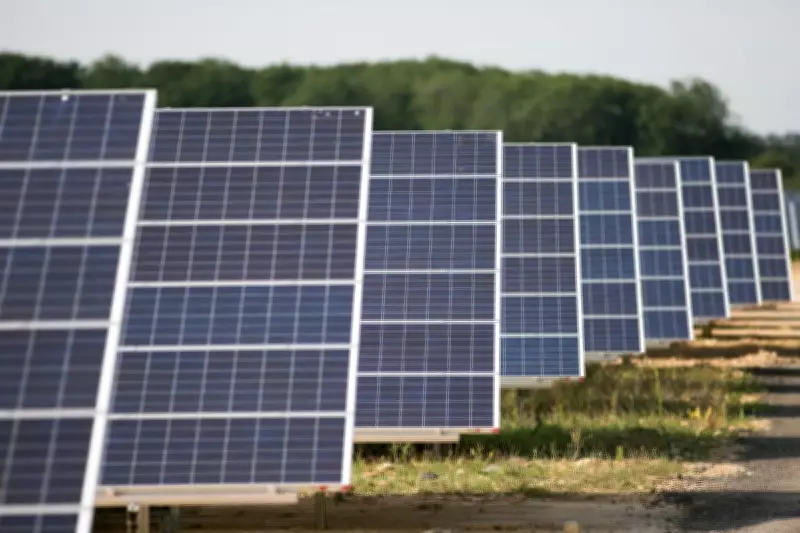
The government has granted approval for the Springwell Solar Farm, an ambitious 800-megawatt development in Lincolnshire, which is set to become the United Kingdom's largest power-generating solar installation. This significant project, located in North Kesteven, will include advanced battery storage capabilities and essential grid connection infrastructure, marking a major step forward in the nation's renewable energy strategy.
Powering Homes and Enhancing Energy Security
Developers estimate that the Springwell Solar Farm could generate enough electricity to power more than 180,000 homes each year. This impressive output is equivalent to supplying approximately half of all households across the entire county of Lincolnshire, highlighting the project's substantial scale and potential impact on local energy provision.
Government Commitment to Clean Energy
Energy Minister Michael Shanks emphasised the government's dedication to accelerating the transition to clean, domestically produced power. He stated, "We are driving further and faster for clean homegrown power that we control to protect the British people and bring down bills for good." Shanks pointed to the lessons learned from international conflicts, noting that solar energy represents one of the most cost-effective power sources available, offering a pathway to reduce dependence on volatile international fossil fuel markets and secure greater energy independence for the UK.

The Springwell project is the 25th nationally significant clean energy initiative approved by the current administration. Collectively, these approved projects are projected to generate sufficient energy to power the equivalent of more than 12.5 million homes across the country, underscoring a broad commitment to expanding renewable infrastructure.
Broader Renewable Energy Context
This approval coincides with other recent government measures aimed at boosting renewable energy adoption. These include initiatives to roll out plug-in solar systems in retail stores, standardise solar panel installations on new homes, and fast-track the next renewables auction to July of this year, all designed to accelerate the UK's clean energy transition.
Record Renewable Generation in 2025
Provisional figures released by the Department for Energy Security and Net Zero (Desnz) earlier this month revealed that renewable technologies achieved a record share of the UK's electricity generation in 2025. According to the data, renewable sources such as wind and solar accounted for 52.5 percent of total electricity generation last year, a notable milestone in the nation's energy landscape.
These renewable technologies collectively generated 152.5 terawatt-hours of electricity in 2025, representing an increase of 5.7 percent compared to the previous year. Desnz attributed this growth to the continued rollout of renewable energy projects across the UK, combined with more favourable weather conditions that enhanced generation efficiency.
Expanding Renewable Capacity
The statistics further indicate that the UK added 3.8 gigawatts of new renewable capacity to the national grid in 2025, bringing the total installed renewable capacity to 65.1 gigawatts. This marks a significant increase from 61.3 gigawatts in 2024 and a dramatic rise from just 9.3 gigawatts in 2010, illustrating the rapid expansion of renewable energy infrastructure over the past decade and a half.
Ministerial Perspective on Energy Independence
Reflecting on the 2025 achievements, Energy Minister Michael Shanks remarked, "Britain didn't just break records in 2025 – we blew them away." He described the year as "a major step towards greater control over our energy, our bills and our future," highlighting the strategic importance of reducing reliance on external energy sources.

Shanks also addressed current geopolitical tensions, noting that the conflict involving Iran is driving up global oil and gas prices. He drew parallels to the aftermath of Russia's invasion of Ukraine, stating, "Four years on from Russia's invasion of Ukraine we are again seeing what it means to be in the grip of volatile fossil fuel markets we do not control." The minister affirmed the government's dual approach of providing immediate financial relief, such as budget measures cutting bills by £117, while simultaneously accelerating the deployment of clean, homegrown energy sources like solar and wind to achieve long-term energy security and price stability for consumers.