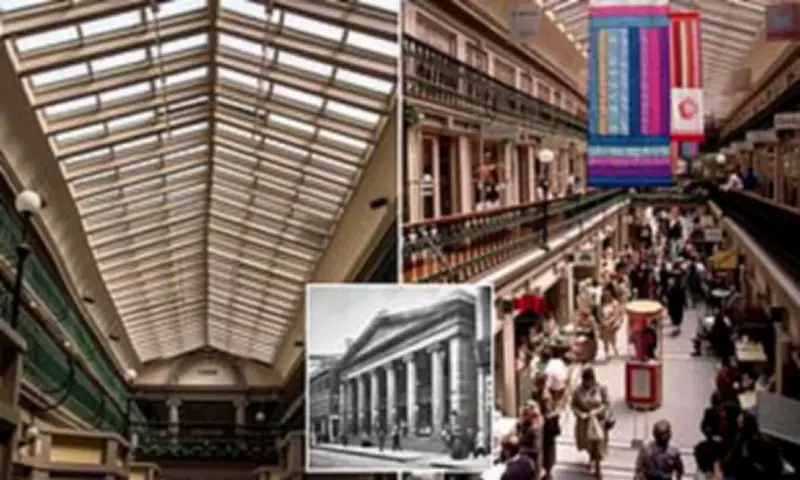
America's Oldest Indoor Mall Reborn as Micro-Loft Community
The Arcade Providence, recognized as the nation's first enclosed shopping mall located in downtown Providence, Rhode Island, has undergone a remarkable transformation from a historic retail space into a vibrant residential community. This Greek Revival structure, which originally opened in 1828, now houses 48 distinctive micro-loft apartments, with one unit recently hitting the market for $225,000.
From Endangered Landmark to Affordable Housing
After operating for more than 150 years as a bustling commercial center with dozens of shops and restaurants, The Arcade Providence faced closure in 2008 when it was designated as 'endangered.' Rather than allowing the historic building to deteriorate, developers embarked on an ambitious $10 million redevelopment project that converted the space into affordable micro-lofts, with rents starting at just $550 per month.
Each compact condo unit comes equipped with essential amenities including built-in beds and seating arrangements, full bathrooms with standing showers, tankless water heaters, half-size refrigerators, sinks, dishwashers, and microwaves. The units range from 225 to 450 square feet, featuring 46 one-bedroom layouts, one two-bedroom unit, and one three-bedroom configuration.

A Unique Living Experience with Historic Character
'There isn't a hiding spot in this whole building,' remarked Robin Dionne, director of outreach and client relations at The Arcade Providence, highlighting the community-oriented design of the development. Residents enjoy views through large front windows and can interact with neighbors from their balconies while observing shoppers on the ground floor below.
'It's cool to be part of such a historic building and knowing that every single one of these units used to be a shop of some kind,' explained mall resident Amy Henion, capturing the unique appeal of living within a converted commercial space that once housed 78 small businesses.
Rapid Success and Current Availability
The micro-loft community achieved full occupancy within just one year of its 2013 opening, generating an impressive waiting list of more than 4,000 prospective tenants. Even before the official launch, developers had received 300 applications for these pet-free residences.
Now, Apartment 314—a 265-square-foot micro-loft located at 65 Weybosset Street—has become available for purchase at $225,000. The unit features a kitchenette with white cabinetry housing a dishwasher, built-in microwave, and refrigerator, plus space for additional appliances like a hot plate or air fryer. The bedroom area includes a shelving nook that can function as a study or office space, a standing closet, and storage beneath the platform bed.
Strategic Location and Community Amenities
The development specifically targets young professionals and students, benefiting from its proximity to prestigious institutions including Brown University and the Rhode Island School of Design, along with thousands of nearby employment opportunities. 'It's a nice spot for people if they want to come to Providence from Boston or New York,' noted Lisa Jones of Residential Properties, Ltd., who holds the listing with David Hasslinger.
Residents enjoy access to numerous shared amenities including a game room, television room, porches, on-site laundry facilities, bike storage, locked basement storage units, and a parking garage across the street. The ground floor continues to host retail spaces and offices that support small businesses while providing convenient services for residents.
Preserving History While Meeting Modern Needs
Originally known as The Westminster Arcade, this National Historic Landmark was constructed in 1828 using granite blocks, stuccoed ashlar, Greek Revival columns, and features a spacious skylit atrium. The building served not only as a commercial hub but also as a vital pedestrian corridor connecting downtown Providence's most important thoroughfares.
'When it was built, it wasn't common to see so many retailers in one space,' Dionne explained. 'Nordstrom and Macy's did not exist. So for small businesses, the downtown area was the place to be. As people spread out to the suburbs, people's shopping habits changed.'

Visionary Redevelopment Amid Economic Challenges
The Great Recession significantly impacted Providence's financial district, leading to office vacancies and the eventual closure of The Arcade. 'By the time we decided to close, there were only seven or eight tenants left,' Dionne recalled. 'But people really love the building, so I think everyone in general was sad.'
Owner and developer Evan Granoff collaborated with J. Michael Abbott of Northeast Collaborative Architects to create what they described as a 'live small/play big' micro-loft community. 'He knew there was a huge market of young people trying to establish themselves,' Dionne explained. 'It was his idea for professionals on-the-go, for people who don't want roommates.'
Economic Impact and Future Potential
Former Mayor Jorge Elorza praised the project following its opening, stating: 'Providence has shown that bold vision and creative planning can be an economic boon to a city. From creating more downtown housing to providing retail space for local entrepreneurs, to rehabilitating a beautiful and historic building—the project is a great example of economic development that just works.'
The development represents a significant response to national trends toward compact urban living and affordable housing shortages in cities across America. With homeowners association fees of $198.29 per month, these micro-lofts provide accessible housing options for Providence's Gen Z and millennial residents as they begin their careers.
'Many tenants are artisans, and the project functions as an incubator for young professionals,' noted Northeast Collaborative Architects, highlighting the community's role in supporting creative and entrepreneurial endeavors within a historically significant architectural setting.