

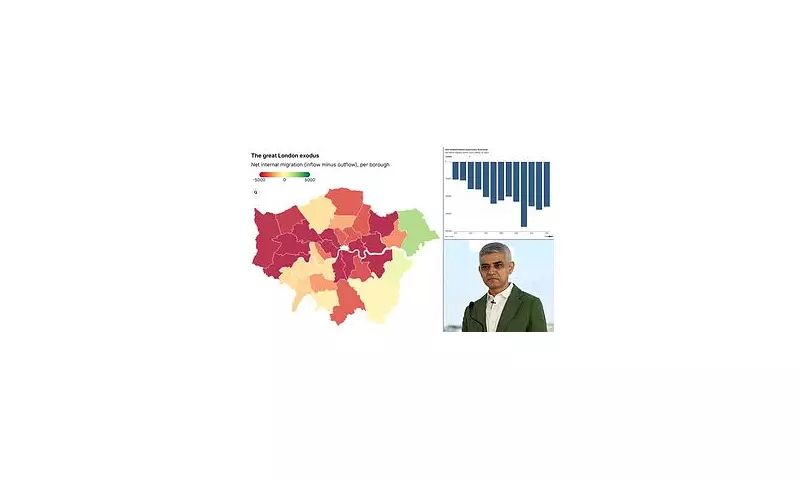
London is experiencing a dramatic population shift, with one resident packing up and leaving the capital every 75 seconds, according to a new analysis of official figures. The data reveals a stark internal migration crisis, as young families and professionals seek more affordable and safer lives elsewhere in the UK.
The Scale of the Departure
The analysis, based on Office for National Statistics (ONS) data, shows that almost 415,000 people moved out of London to the Home Counties or beyond in 2024. While 287,000 people moved into the capital, this resulted in a net internal migration loss of nearly 128,000 residents. This marks one of the highest figures since records began, surpassed only by the outflows seen in 2023 and 2021.
With the notable exception of the West Midlands, every other English region saw a net influx of people moving in from elsewhere in the UK. The South West led the way with a net gain of 28,600 people, followed by the South East (+22,300) and the North West (+20,800). Within London itself, only two boroughs—Havering and Bexley—recorded a net increase in arrivals.

Driving Forces: Cost, Crime, and Quality of Life
Experts point to a potent combination of factors forcing residents out. The relentless cost-of-living pressures and sky-high property prices are primary drivers. The average London house price sits around £550,000, compared to just £160,000 in the North East. Renters face typical monthly bills of £2,200, far above the sub-£1,000 fees common in the Midlands and the North.
Commentators also suggest that soaring crime rates in what some call 'lawless London' have played a significant role. Reform UK's candidate for Mayor of London, Laila Cunningham, blamed the current mayor, stating: "Sadiq Khan has allowed criminality to flourish in London... It’s hard not to conclude [people are leaving] because they simply don’t feel London is a safe place where you can raise a family." She pledged to refocus police priorities on "grooming gangs and real crime, not tweets."
This perception has contributed to falling property values in some of London's most exclusive postcodes, with areas like Knightsbridge and Kensington seeing prices drop to 15-year lows.
Economic Ripples and the Northern Powerhouse
The exodus is reshaping the UK's economic geography. Industry analysts note that surging costs in the capital are driving both employers and employees to seek smaller, more viable options in cities with growing infrastructure. The regeneration of Birmingham, Leeds, and Manchester, fueled by investment and improved transport links, is creating new hotspots.
Nathan Khider, founder of Nathan K Real Estate, told the Mail: "Since a lot of the major companies decided to move up north due to costs... a lot of people also had to move north." Dave Sayce of Compare My Move highlighted the stark affordability: "In practical terms, buyers could afford almost three homes in the North West for the price of one in London."
At a local authority level, Birmingham experienced the UK's largest net exodus (-16,400), while East Riding of Yorkshire, North Yorkshire, and Cornwall saw the biggest influxes.
The Mayor of London's office defended its record, citing action on the cost of living, including frozen transport fares and free school meals. A spokesperson stated: "Keeping Londoners safe is his top priority, and London’s homicide rate per capita is the lowest since records began." They also pointed to a 14% drop in neighbourhood crime and a record-breaking programme of affordable housebuilding.
Despite these measures, the sheer volume of departures signals a profound challenge for the capital, as it contends with retaining its population amidst fierce competition from other UK regions offering a lower cost of living and a perceived higher quality of life.






