Nevada's Housing Crisis: From Affordable Beacon to Symbol of American Cost Struggles
Once celebrated as a beacon of affordable housing, Nevada has transformed into a powerful symbol of America's intensifying struggle with soaring living costs. Many voters across the state are expressing deep frustration as prices for essential goods, particularly housing, continue to climb relentlessly, reshaping both personal dreams and political landscapes.
The Distant Dream of Homeownership
For 27-year-old Brian Torres Suazo, the milestone of homeownership feels increasingly unattainable. Despite holding a secure job with union wages and access to down payment assistance programs, Torres Suazo anticipates continuing to share an apartment with roommates for the foreseeable future. He finds himself sidelined by stubbornly high housing costs, even in cities like his native Las Vegas, which were once synonymous with affordability.
"I would be paying more—a lot more—in mortgage than I am for rent right now," said Torres Suazo, who works as a food runner on the famous Las Vegas Strip. He often feels that politicians are not listening to ordinary working people like him. "It'd be nice if more people that knew what it's like to work for a living could be in those rooms to make decisions," he added, voicing a sentiment shared by many in a restless electorate.

A National Issue Hits the Desert
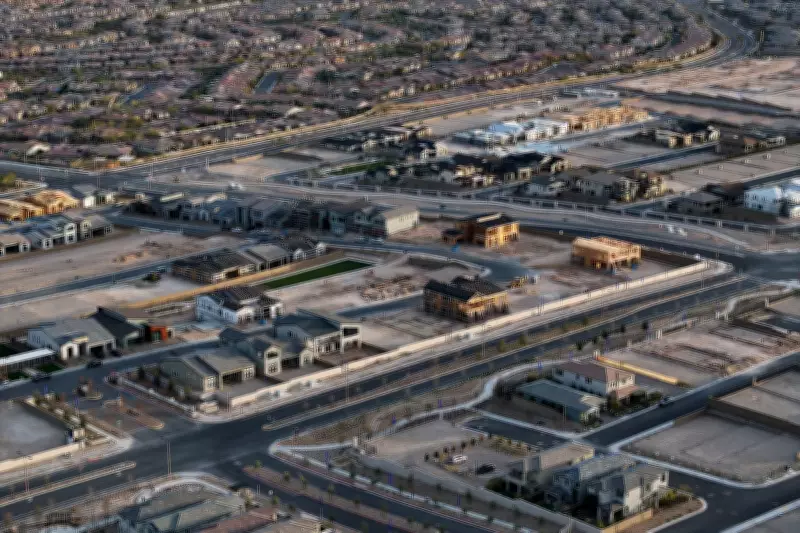
In all directions from the glittering Strip, tract homes with sharp-angled roofs and earthy paint schemes proliferate across the desert landscape. Streets extend into empty dirt lots, awaiting future development, while wooden signs advertise homes ranging from the $300,000s for townhomes to over $1 million for luxurious properties in desirable suburban neighbourhoods.
While housing affordability has long been a potent political issue in expensive coastal metropolitan areas like New York and San Francisco, this concern has now emerged virtually everywhere. During the coronavirus pandemic, white-collar workers empowered by remote work cashed out equity from high-priced cities and drove up prices across Sun Belt destinations including Las Vegas, Phoenix, Dallas, and Charlotte, North Carolina.
Simultaneously, near-zero interest rates triggered a wave of refinancing, granting existing homeowners mortgage payments that now appear impossibly low by current standards. The population of Clark County, which encompasses Las Vegas, surged by 17% to 2.4 million between 2014 and 2024, significantly outpacing the national growth rate of 6% over the same period.
"If you ask locals who grew up here, some of them feel that housing is out of reach for them," observed Las Vegas real estate agent Tony Clifford. "You talk to somebody from out of state—Northwest, West, California—we're still so cheap compared to them."
Soaring Prices and Stabilising Markets
Although home prices and mortgage rates have retreated slightly from historic peaks in much of the country, and Las Vegas is currently considered a buyer's market with houses lingering longer on the market and sellers accepting discounted offers, monthly mortgage payments remain substantially higher than pre-pandemic levels.
According to the Case-Shiller index, which tracks previously sold homes excluding new construction, resale home prices in Las Vegas skyrocketed by 53% between December 2019 and December of last year. Federal Reserve data reveals that the median home sale price in Las Vegas jumped 65% from the first quarter of 2020 to the same period last year, reaching $393,000 before dipping to $379,000 in the fourth quarter.
Nationally, 30-year mortgage rates followed a parallel trajectory, plummeting to a low of 2.65% in 2021 before peaking near 8% in 2023 and settling around 6% this quarter. Despite this stabilisation, costs remain elevated. The median resale house with a 20% down payment at prevailing interest rates would cost approximately $2,300 per month in December 2025—double the figure from December 2019.

Corporate Investors and Political Responses
Large institutional investors own about 11% of single-family home rentals in Las Vegas, according to the Hamilton Project at the Brookings Institution, compared to roughly 3% nationally. These entities are increasingly becoming bipartisan targets as they acquire and rent out single-family homes, though economists often question the benefits of restricting their activities.
Both former President Donald Trump and Nevada Attorney General Aaron Ford, the leading Democratic candidate for governor, have joined a growing chorus of officials advocating for limits on corporate homeownership. "People live in homes, not corporations," Trump declared in a social media post in January, urging Congress to ban large institutional investors from purchasing houses.
Trump has also pressured the Federal Reserve to lower interest rates and proposed extending mortgage terms to 50 years, privatising government-sponsored enterprises Fannie Mae and Freddie Mac, and allowing homebuyers to use retirement or Education Savings Accounts for down payments. Ford's housing plan, released last month, calls for banning algorithmic rent pricing, addressing regulatory barriers to new construction, and unlocking federal land for homebuilding—a significant consideration given that the federal government owns 84% of Nevada's land.
Nevada's Republican Governor Joe Lombardo, among the most vulnerable incumbent state leaders nationally, has attempted to tackle the issue by approving $64 million to support a dozen housing development projects, primarily in the Las Vegas and Reno areas, alongside assistance for homebuyers.
Political Implications and Voter Sentiment
Democrats are positioning affordability as the central pillar of their electoral strategy for the upcoming midterms, arguing that Trump has failed to deliver on his promise to reduce prices despite Republican control of Congress. They believe anxiety over living costs has been instrumental in their recent off-year election victories, including gubernatorial races in New Jersey and Virginia.
Multiple surveys, including a January AP-NORC poll, indicate that many Americans believe Trump is focusing on the wrong priorities and largely neglecting domestic cost issues. While economic concerns propelled Trump's reelection, recent polling suggests most Americans have not yet perceived benefits from his policies, with about half of registered voters in a recent New York Times poll stating his policies have made life "less affordable" for most citizens.
Democratic strategist Paul Begala, who helped architect Bill Clinton's 1992 campaign emphasising domestic economic concerns during global turmoil, asserts that affordability will remain a salient issue in November, even as the Iran war elevates foreign policy interest. "Trump's refusal to lower the cost of living, and his willingness to raise the cost of health care, electricity, hamburger, and now gas, is a two-edged sword that will cut down a large number of congressional Republicans," Begala predicted.
The Complex Reality for Homeowners
Housing presents a thorny political dilemma. Existing homeowners often appreciate high prices that inflate their net worth—at least on paper—a reality Trump has acknowledged repeatedly this year by assuring homeowners he aims to maintain their property values. However, these elevated prices can become financial handcuffs for those seeking to upgrade to larger homes or better neighbourhoods but find themselves priced out.
Michele Niemeyer exemplifies this predicament, feeling trapped in the condo she purchased for over $500,000 near the Strip. Her homeowners association fee recently increased to $686 monthly, straining her budget, while her unit's value has plummeted. Yet, the neighbourhoods that were within her budget when she bought the condo are now unattainable. "I want to move," Niemeyer confessed. "I just don't know where."
As Nevada continues to grapple with its transformed housing landscape, the state stands as a microcosm of broader American economic anxieties, where the dream of affordable homeownership collides with the realities of a shifting market and political crosscurrents.