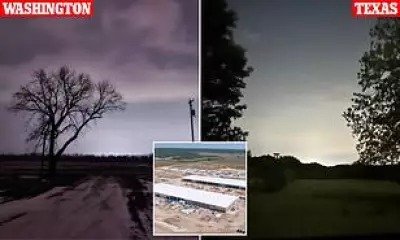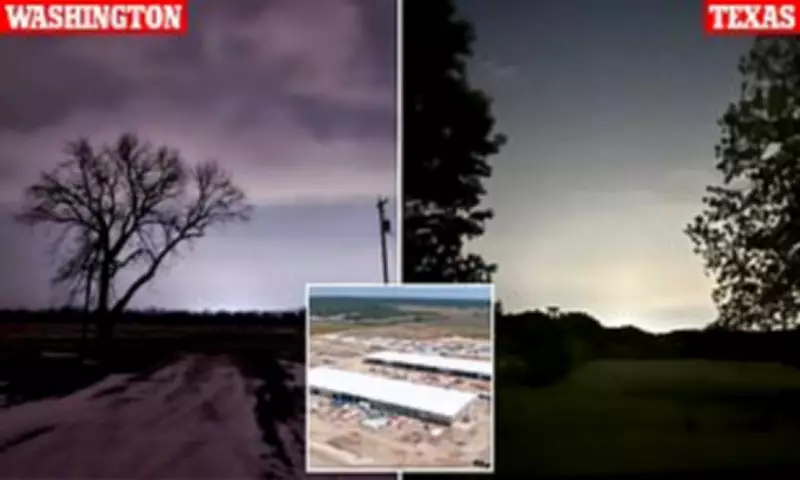
An eerie image has captured how a massive data center has brought permanent artificial daylight to a rural Texas community, with opposition to such facilities now uniting Americans across the political spectrum. In Crowell, a small town surrounded by cotton, wheat, and cattle fields, residents once enjoyed clear, pitch-black nights filled with bright stars — a rarity in more populated areas. But on Wednesday, a resident shared a backyard photo of an ordinary spring night, where a bright white glow cut through the trees.
"If you want to see the effects of a data center first hand, come on over to my place after dark tonight and look east," the resident wrote in a Facebook thread. He described the artificial light as "shining even brighter than the entire city" and polluting the sky so badly that "you cannot even see the stars we sing about shining big and bright." Another resident shared a video from the same night, noting a continuous low humming sound replacing the usual crickets.
Crowell, home to nearly 800 residents, is the latest community preparing for a hyperscale data center — part of a wave quietly emerging across the US to power the artificial intelligence boom. These multibillion-dollar projects, including Crowell's expected $40 billion facility, have driven both Democrats and Republicans to flood town halls in united opposition.

Bipartisan Unity Against Data Centers
"There is a political realignment going on," said environmental activist Christy McGillivray. "I feel like the ground is shifting under my feet. The words I have used my entire life to describe politics are not adequate anymore." Data centers are becoming powerful forces due to their immense demands for energy, water, and land, threatening to reshape local areas. Supporters, including local officials, tout these projects for bringing jobs and tax revenue to struggling economies, appealing to farmers selling land and unions seeking construction work. However, as data centers expand, Americans grow increasingly furious over electricity prices, declining home values, environmental concerns, and fears surrounding AI.
"I don't care if you're a Democrat or Republican, we're all coming together to fight this," said Republican Starlet Peedle. In Texas, residents are banding together to raise concerns about water use, as over 60% of the state faces a severe water crisis fueled by drought and rapid population growth. Julie Waters, born and raised in Crowell, shared lengthy Facebook posts urging residents to compile questions and attend town meetings in large numbers. "We can't deplete our natural resources in the name of AI. My elderly parents need clean water. Farmers and ranchers must be able to grow crops and raise cattle," she wrote.
Waters also shared a video driving through the data center site, showing farmland being torn up by machinery, with trucks, buildings, and wind turbines scattered across the once-clear landscape. Her posts have drawn hundreds of comments, with some warning that the skyline will "FOREVER change" and that the project will "USE UP ALL RESOURCES AND LEAVE THAT TOWN DRIED UP."
Light Pollution Spreads Nationwide
Dystopian photos of Crowell's night sky are not unique, exposing a growing light pollution problem across the nation. Jeff Lambert in New Jersey posted photos from his nighttime drive home, showing a bright white hue illuminating the sky over land and homes. "First the data center noise...now we have THIS?? Hold onto your seats! It's like daytime for over a mile all around it - blinding light in both directions," he wrote. Data centers have unexpectedly bridged the partisan divide, partly due to their size, sudden rollout, and perceived secrecy. Citizens of all political stripes largely agree that they feel lied to, a sentiment that has proven motivating.

Peedle, a Michigan resident, said even meetings with town officials felt like "marketing sessions," adding that the project felt "sneaky." Often, proposals are given unusual names such as "Project Cannoli," "Project Cherry Blossom," or, in Peedle's Lyon Township, "Project Flex." "I don't know why it wasn't just called 'Project Data Center,'" said resident Geoff Barker during a town meeting. "I mean it could have been 'Project Evasive' or 'Project Disingenuous.'" Republicans and Democrats across states have been collaborating via Signal chats and Facebook groups, working to obtain government documents, gather signatures, and raise legal funds.
Virginia and Wisconsin appear on a similar trajectory, with polls showing public opinion sharply against data centers. Charles Franklin, director of the Marquette University Law School Poll, noted that around 70% of Wisconsin residents believe the benefits aren't worth it, adding that the issue is unusually unifying. "There was stunningly little difference for our normally extremely polarized state," he said. Even comedy has picked up on the widespread hatred, with Milwaukee performer Charlie Berens quipping, "This is the most bipartisan issue since beer." In Maine, a data center crackdown lasted briefly before a Democratic governor vetoed it, but the push is spreading to over 13 states and dozens of towns. In some cases, politics outpace policy, with an Indianapolis councilman reporting that a gunman fired 13 shots into his home, leaving a note reading "No Data Centers."