

From Postwar Utopia to National Symbol of Decline
Under clear blue skies and festive bunting, the entire population of County Durham seemed to gather in hopeful anticipation. Thousands lined the streets, waving flags with fervent pride as a grand royal procession weaved past their newly constructed homes. The date was 27 May 1960, and the recently crowned Queen Elizabeth II was officially opening the town of Newton Aycliffe during her first provincial tour following the birth of Prince Andrew. A commemorative pamphlet, priced at two shillings and sixpence, captured the moment with Light Infantry buglers playing to an exhilarated crowd.
The message resonated with powerful clarity: Newton Aycliffe, a town built entirely from scratch upon the rubble of the second world war, heralded the dawn of a new, fairer postwar Britain. This was a nation promising its citizens a modern, prosperous quality of life, liberated from the squalor of its bomb-damaged cities. Located six miles north of Darlington, this former industrial wasteland was personally selected by William Beveridge, the architect of the welfare state, as the site for his pioneering new town in the late 1940s.
The Broken Promise of Beveridge Way
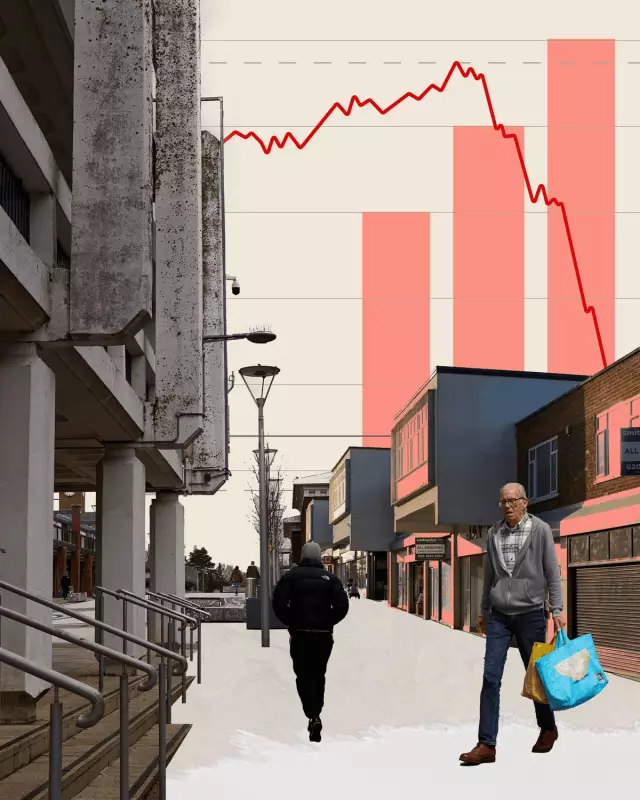
Beveridge envisioned a community of "hopes and dreams" and a "paradise for housewives," centred on a high street he proudly named Beveridge Way. Nearly eight decades later, this single shopping precinct tells a profoundly different and troubling story. Of the 45 retail units on Beveridge Way today, a staggering 23 stand empty—a vacancy rate nearly four times the national average. The remaining businesses include a Ladbrokes betting shop, a Greggs bakery, four charity shops, four discount stores, and a pawnbroker.

The banks have long since departed, with the nearest now requiring a ninety-minute round trip by bus to Darlington. Faded signage bears silent witness to an exodus of household names: Wilko, Select, and Peacocks among them. "In the 60s it was a fabulous place to live," recalled Ian Gaul, 67, over a pint in the Phoenix working men’s club adjacent to the high street. "The town centre was absolutely beautiful. You couldn’t wish for a better place." His assessment of the present is brutally stark: "You would be ashamed to bring someone here now. It’s unrecognisable."
The Distant Billionaire Landlord
While Newton Aycliffe's story mirrors the decline of many British high streets, one peculiar factor sets it apart: the entire town centre is wholly owned by a London-based multibillionaire, Benzion Freshwater, who is wealthier than Sir Richard Branson. Since 1990, his company, Daejan Holdings, has held the deeds. The Freshwater family heads one of the UK's richest dynasties, with a fortune estimated at £2.6bn, and a property empire spanning prime assets in New York, Florida, and London.
For Daejan, the Newton Aycliffe holdings represent a minuscule fraction of their global portfolio. The £3.2m worth of property on Beveridge Way accounts for just 0.12% of its total assets. Company accounts reveal losses of £4m in the town over the past two years, a sum that appears as little more than "a line on a spreadsheet" to the distant owners. The firm, once London's largest private commercial landlord, is shrouded in secrecy and declined to comment for this article.
Local frustration is palpable. Shopkeepers complain that vacant units are left to deteriorate rather than being offered at discounted rates or let short-term to community groups. Electrical faults go unfixed, and buildings decay. "It's like they're hanging on to what's left and that's it—they're not bothered if shops go," said Nadine Nesbitt, owner of Petite Boutique, who noted her rent has not increased in years but that others have left due to "arguments over rent."
A Political Barometer for Labour and Reform
The visible decay of high streets like Beveridge Way is no longer just a commercial or social issue; it has become a potent political barometer. Studies reveal a direct correlation between feelings about local high streets and support for Reform UK. The thinktank Power To Change found that in areas with the most derelict high streets, Reform soared to second place in 24% of constituencies during the general election, compared to 14% nationally.

County Durham was among ten English local authorities won by Nigel Farage's party in last year's local elections—a victory he celebrated in a Newton Aycliffe working men's club. Researchers at the University of Warwick concluded in 2024 that a town's visible economic decay "significantly influences populist sentiment." This presents a clear and present danger for Labour, particularly in its traditional heartlands across the Midlands and north of England, where high street decline is often most acute.
Labour MP Alan Strickland, whose family was drawn to Newton Aycliffe decades ago and who now represents the area, acknowledges the crisis. "The high street has lacked attention for too long," he stated. "We need strong leadership from the landlord and the county council to bring forward ambitious plans for its future." The Labour government has announced a 'Pride in Place' scheme, pledging £20m each to 250 struggling areas, but local scepticism remains high.
The Human Cost of Neglect
For residents, the decline is a daily source of disappointment and practical hardship. "Now you can't even get a decent pair of shoes here," lamented Janice Mills, 74. "To get anything decent you have to go to a retail park, and if you don't have a car you're done for. I just hate this town centre—it's absolutely useless." Sandra Seal, 78, helping in her son's grocery store, expressed frustration that even faulty lights go unfixed by the management.
The potential closure of Youngs newsagent, which houses a vital sub-post office, threatens to remove a key amenity. Co-owner Diane Young, planning to retire, said the closure of Woolworths in 2009 marked the start of the decline. "If we go there would be nothing to come into the town for," she warned. The transformation of the British high street continues, with traditional retailers replaced by barbers, vape shops, and takeaways—a change many residents dislike but feel powerless to prevent.
As one local government expert starkly summarised, the situation in Newton Aycliffe pits "one of Britain's richest families against a council with debts of more than £434m." The story of Beveridge Way is no longer just about retail vacancies; it is a microcosm of national neglect, economic disparity, and the shifting political allegiances that could redefine the path to Downing Street.





